
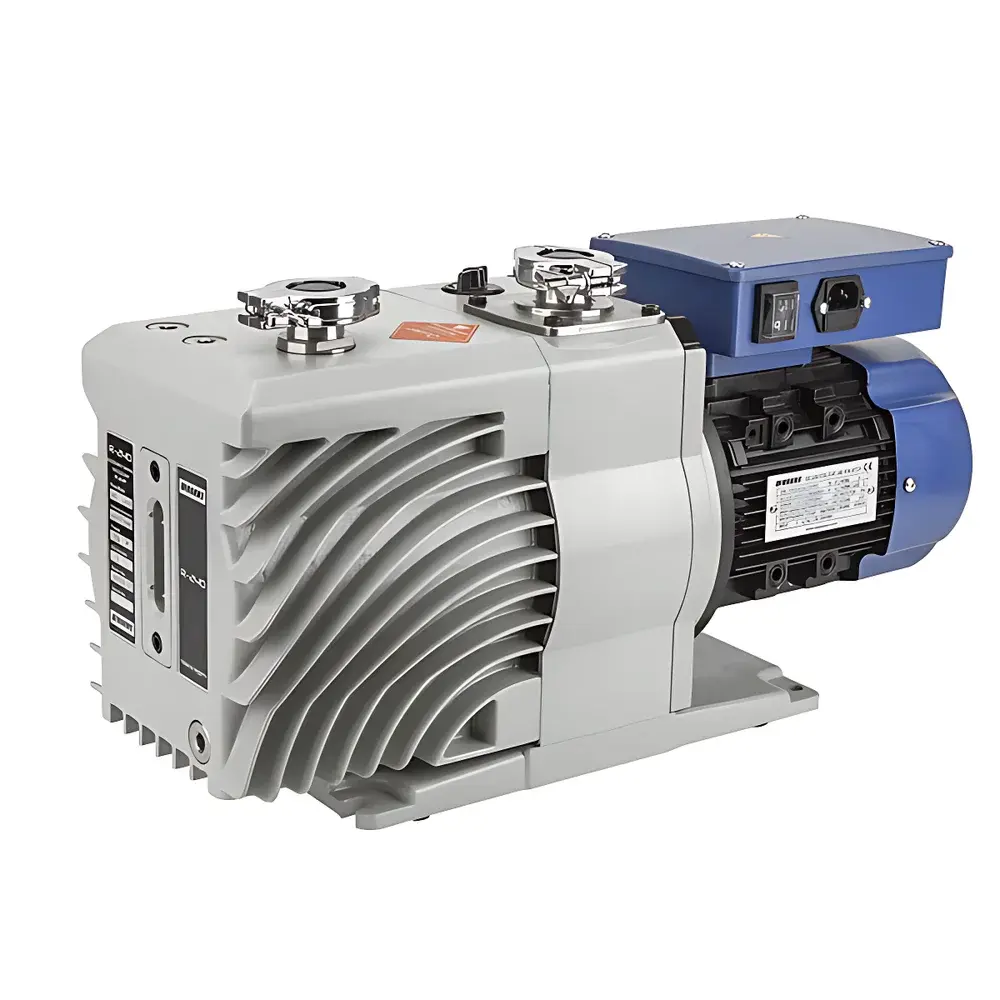
WIGGENS R-8D Two-Stage Oil-Sealed Rotary Vane Vacuum Pump
| Brand | WIGGENS |
|---|---|
| Origin | Germany |
| Model | R-8D |
| Pump Type | Two-Stage Rotary Vane |
| Ultimate Vacuum | ≤4 × 10⁻⁴ mbar |
| Pumping Speed | 180 L/min |
| Motor Power | 550 W |
| Dimensions (W×D×H) | 300 × 150 × 230 mm |
| Weight | 29 kg |
| Noise Level (with gas ballast closed) | <54 dB(A) |
| Inlet/Outlet Port | DN25 KF |
| Oil Capacity | 1.1 L |
| Motor Rating | 220–240 V, 50 Hz, IP54 Enclosure |
| Gas Ballast Valve | Integrated |
| Max. Water Vapor Tolerance | High |
| Chemical Resistance | Enhanced vs. standard mineral-oil vane pumps |
Overview
The WIGGENS R-8D is a two-stage oil-sealed rotary vane vacuum pump engineered for reliable, continuous operation in demanding laboratory and pilot-scale applications. Based on the proven Couette-flow principle of positive displacement, it achieves high volumetric efficiency through precisely machined vanes rotating within an eccentrically mounted rotor chamber, with oil serving both as a sealing medium and lubricant. Its ultimate vacuum performance of ≤4 × 10⁻⁴ mbar and pumping speed of 180 L/min make it suitable as a primary vacuum source for moderate vacuum processes—or as a robust forepump for high-vacuum systems such as turbomolecular or diffusion pumps. Designed and manufactured to German engineering standards, the R-8D complies with IEC 61000-6-3 (EMC emission) and IEC 60034-1 (rotating electrical machines), ensuring electromagnetic compatibility and motor safety in shared lab environments.
Key Features
- Two-stage configuration delivers significantly lower ultimate pressure compared to single-stage equivalents—critical for applications requiring stable sub-10⁻³ mbar conditions.
- Integrated gas ballast valve enables controlled admission of atmospheric air during operation, facilitating continuous removal of condensable vapors (e.g., water, solvents) without oil degradation.
- IP54-rated sealed motor provides protection against dust ingress and low-pressure water jets—enhancing operational safety in non-classified but humidity-variable lab settings.
- Optimized oil circulation path and anti-backflow check design prevent oil migration into the vacuum line upon shutdown, eliminating post-cycle contamination risks.
- Low-noise operation (<54 dB(A) with gas ballast closed) meets ISO 3744 acoustic requirements for quiet laboratory zones.
- Rounded, transparent oil-level sight window enables rapid visual verification of oil volume and clarity—supporting proactive maintenance scheduling per ISO 55001 asset management guidelines.
- Enhanced chemical resistance via proprietary refined mineral oil formulation extends service life when handling mildly aggressive vapors (e.g., alcohols, acetone, ethyl acetate) common in organic synthesis and lyophilization workflows.
Sample Compatibility & Compliance
The R-8D is compatible with standard KF-25 (ISO-K) vacuum flanges and integrates seamlessly with common lab vacuum accessories—including cold traps, vacuum manifolds, and pressure controllers. It supports ASTM E581 (Standard Practice for Vacuum System Integrity Testing) and ISO 21360-1 (vacuum leak detection protocols) when used with calibrated Pirani or capacitance manometers. While not intrinsically safe for Class I Div 1 hazardous locations, its motor and housing conform to EN 60079-0 general requirements for non-explosive atmospheres. For GLP/GMP-regulated environments, the pump’s consistent performance profile and documented maintenance intervals support audit readiness under FDA 21 CFR Part 11-compliant data acquisition systems when paired with validated vacuum monitoring hardware.
Software & Data Management
The R-8D operates as a standalone mechanical device with no embedded firmware or digital interface. However, it is fully compatible with third-party vacuum control platforms—including MKS Instruments’ Vue™, Pfeiffer Vacuum’s Vacuum Controller VC 100, and Edwards’ nXDS series controllers—enabling remote start/stop, real-time pressure logging, and automated gas ballast actuation via analog 0–10 V or digital RS485 Modbus RTU signals. When integrated into a validated system, event timestamps (e.g., runtime, oil change alerts) can be captured with full electronic audit trail functionality compliant with Annex 11 and ALCOA+ data integrity principles.
Applications
- Vacuum distillation and solvent recovery in synthetic chemistry labs
- Freeze-drying (lyophilization) of pharmaceuticals and biologics—leveraging high water vapor tolerance
- Vacuum filtration of fine particulates in environmental and materials science sample prep
- Leak testing of hermetic enclosures using pressure-rise or helium mass spectrometry methods
- Thin-film deposition (e.g., thermal evaporation, sputtering) where stable forepressure is required for turbomolecular pump staging
- Vacuum impregnation of porous ceramics and composites
- Electron microscopy specimen preparation (critical point drying, carbon coating)
FAQ
What is the recommended oil change interval under continuous operation?
Under typical laboratory use (≤8 hrs/day, ambient temperature ≤30°C, non-corrosive loads), oil replacement is advised every 500 operating hours or semiannually—whichever occurs first. Extended intervals require oil analysis per ASTM D6595.
Can the R-8D be used with aggressive halogenated solvents like chloroform or carbon tetrachloride?
No. While chemically enhanced, the standard mineral oil is incompatible with strong oxidizers and halogenated hydrocarbons. For such applications, consult WIGGENS for fluorinated oil retrofit options and associated material compatibility validation.
Is a cold trap necessary for routine rotary evaporation?
Yes—especially when evaporating water or low-boiling solvents. A −20°C cold trap upstream prevents vapor condensation in the pump chamber, preserving oil integrity and vacuum stability per ASTM D2879 guidelines.
How does the gas ballast function affect ultimate vacuum specification?
With gas ballast open, ultimate vacuum degrades to ~1–5 × 10⁻² mbar due to deliberate air dilution. This trade-off is essential for vapor-laden processes but must be closed for high-vacuum attainment.
Does the R-8D meet ISO 8573-1 Class 3 purity requirements for instrument air?
No—it is not designed as a compressed air source. Its exhaust contains oil mist and is intended for venting to fume hoods or dedicated exhaust ducts per local occupational health regulations (e.g., OSHA 1910.1200).



