
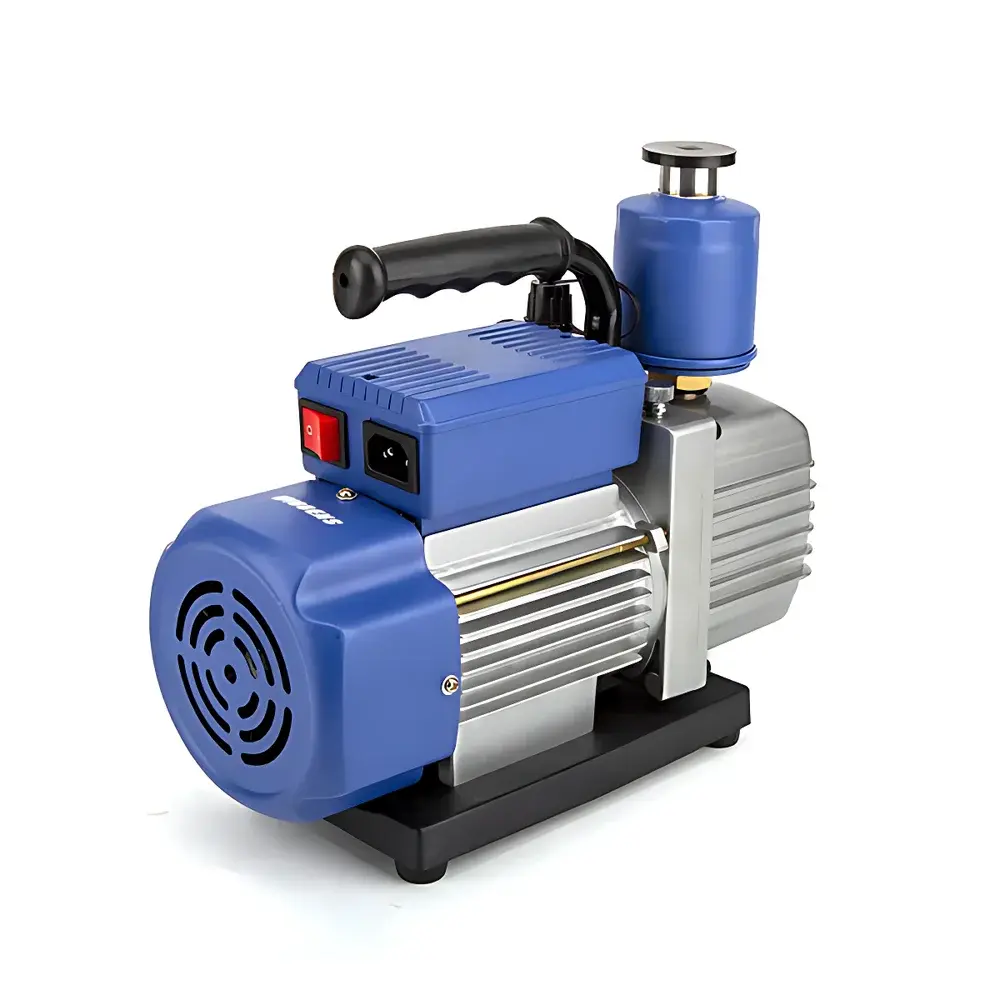
WIGGENS R-8SN Rotary Vane Oil-Sealed Vacuum Pump
| Brand | WIGGENS |
|---|---|
| Origin | Germany |
| Model | R-8SN |
| Pump Type | Single-Stage Rotary Vane |
| Ultimate Vacuum | 2.5 × 10⁻² mbar |
| Pumping Speed | 120 L/min |
| Motor Power | 250 W |
| Motor Speed | 1400 rpm |
| Noise Level | < 54 dB(A) |
| Oil Capacity | 0.33 L |
| Weight | 11 kg |
| Ingress Protection | IP40 |
| Inlet/Outlet Ports | SAE 3/8″, UNF 7/16″–20 |
| Oil Mist Emission | Low |
| Gas Ballast (Air Bleed) Valve | Integrated |
| Motor Protection | Thermal Overload Cut-off |
| Enclosure Rating | IP54 (Motor) |
Overview
The WIGGENS R-8SN is a single-stage rotary vane oil-sealed vacuum pump engineered for reliable, continuous operation in demanding laboratory and pilot-scale applications. Based on the classic Couette-flow principle of positive displacement, it achieves stable ultimate vacuum levels down to 2.5 × 10⁻² mbar by mechanically compressing gas between rotating vanes and the stator wall, with oil serving dual functions: sealing inter-vane clearances and lubricating critical moving parts. Designed and manufactured under German engineering standards, the R-8SN complies with IEC 60034 (rotating electrical machines) and meets CE marking requirements for electromagnetic compatibility (EMC) and low-voltage directives. Its robust cast-aluminum housing, precision-ground vanes, and thermally stabilized motor ensure consistent performance across extended duty cycles — making it suitable not only as a standalone roughing pump but also as a front-stage support for high-vacuum systems such as diffusion pumps or turbomolecular pumps.
Key Features
- Integrated gas ballast (air bleed) valve enables efficient removal of condensable vapors—including water, solvents, and low-molecular-weight organics—without compromising ultimate vacuum integrity.
- Low-noise operation (< 54 dB(A)) achieved via balanced rotor dynamics, vibration-damping mounting, and optimized airflow path design—critical for shared lab environments where acoustic footprint affects workflow continuity.
- Compact footprint (W × D × H ≈ 280 × 190 × 270 mm) and lightweight construction (11 kg) facilitate benchtop integration and repositioning without structural reinforcement.
- Oil-level observation window with circular graduated scale allows real-time visual monitoring of oil volume and clarity—reducing risk of dry-run damage or overfilling.
- Thermally protected, sealed motor (IP54-rated) delivers stable 250 W output at 1400 rpm with built-in thermal cut-off to prevent winding overheating during prolonged operation or inlet blockage events.
- Anti-backstreaming oil seal design prevents oil migration into vacuum lines upon shutdown—eliminating contamination risks in sensitive downstream processes like freeze-drying or thin-film deposition.
- Corrosion-resistant internal coatings and chemically stable mineral oil formulation enhance tolerance to mild acidic or polar vapors encountered in solvent recovery or vacuum distillation workflows.
Sample Compatibility & Compliance
The R-8SN is compatible with non-reactive, non-explosive gas loads typical of academic, pharmaceutical, and materials science laboratories. It is routinely deployed in applications governed by ASTM D2873 (vacuum distillation), ISO 2160 (corrosivity testing), and USP <1229> (sterile processing validation). While not intrinsically safe for Class I, Division 1 hazardous locations, its IP40-rated enclosure provides protection against solid ingress (e.g., dust, particulates) per IEC 60529. For use with corrosive or polymerizable vapors, integration with a cold trap (–40 °C or lower) and/or chemical scrubber is strongly recommended. The pump does not meet FDA 21 CFR Part 11 requirements for electronic records; however, its mechanical simplicity supports full traceability under GLP/GMP audit protocols when paired with manual logbooks and scheduled maintenance records.
Software & Data Management
The R-8SN operates as a standalone electromechanical device without embedded firmware, digital interface, or connectivity options. All operational parameters—including runtime, oil change intervals, and gas ballast usage—are documented manually per institutional SOPs. This architecture eliminates cybersecurity vulnerabilities, ensures long-term serviceability without software obsolescence, and simplifies qualification (IQ/OQ/PQ) for regulated environments. Users may integrate external pressure transducers (e.g., Pirani or capacitance manometers) and data loggers to record vacuum profiles over time—enabling correlation with process endpoints in freeze-drying cycles or solvent evaporation kinetics.
Applications
- Vacuum filtration of biological suspensions and fine particulates in chemistry and life sciences labs.
- Roughing stage for high-vacuum systems used in electron microscopy sample preparation and surface analysis (XPS, AES).
- Process support for lyophilization (freeze-drying) of biopharmaceuticals, where controlled vapor removal and low ultimate pressure are essential for sublimation efficiency.
- Vacuum-assisted degassing of resins, adhesives, and composites prior to curing.
- Leak detection via helium mass spectrometry (when used as backing pump).
- Encapsulation and vacuum impregnation of porous materials including ceramics and carbon-based substrates.
- Distillation and concentration of heat-sensitive compounds under reduced pressure to minimize thermal degradation.
FAQ
What type of oil is recommended for the R-8SN?
WIGGENS specifies a high-refined mineral vacuum pump oil meeting DIN 51506 VDL standards (viscosity grade ISO VG 100). Synthetic oils are not recommended unless validated for compatibility with internal elastomers and seals.
Can the R-8SN be operated continuously for 24/7 applications?
Yes—provided ambient temperature remains below 35 °C, oil level is maintained within the sight-glass range, and gas ballast is engaged when handling condensables. Scheduled oil changes every 500 operating hours are advised for uninterrupted service.
Is the pump suitable for pumping hydrogen or acetylene?
No. The R-8SN is not rated for flammable, explosive, or oxidizing gases. Use only with air, inert gases (N₂, Ar), and non-reactive organic vapors at concentrations below their lower explosive limit (LEL).
How often should the oil be changed?
Under standard lab conditions (≤ 8 h/day, ambient ≤ 25 °C, minimal condensables), oil replacement is required every 500 hours or quarterly—whichever occurs first. More frequent changes are necessary when processing water-rich or chlorinated solvents.
Does the R-8SN include an exhaust filter?
It does not ship with a standard oil mist filter; however, an optional inline oil mist separator (WIGGENS part #900102-23) can be installed at the exhaust port to reduce airborne hydrocarbon emissions and comply with local occupational exposure limits (e.g., OSHA PEL for mineral oil mist: 5 mg/m³).



