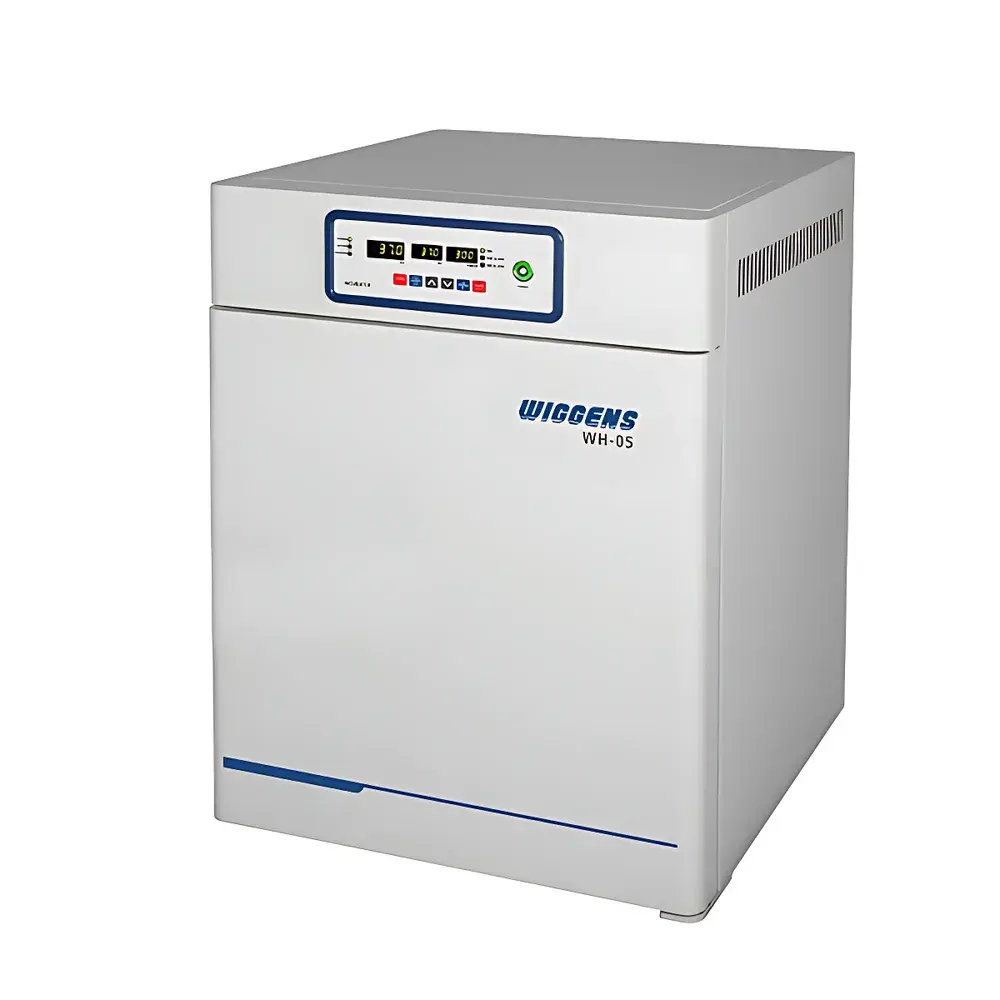
WIGGENS WH-05 Temperature-Controlled Incubator
| Brand | WIGGENS |
|---|---|
| Origin | Germany |
| Model | WH-05 |
| Temperature Range (with Humidity) | RT + 5°C to 65°C |
| Temperature Uniformity | < ±0.2°C at 37°C and 25°C RT |
| Chamber Volume | 50 L |
| Temperature Accuracy | < ±0.3°C at 37°C and 25°C RT |
| Temperature Stability | ±0.1°C at 37°C |
| Heating Power | 340 W |
| Power Supply | AC 220–240 V, 50/60 Hz |
| Internal Dimensions (W×D×H) | 345 × 368 × 375 mm |
| External Dimensions (W×D×H) | 440 × 480 × 610 mm |
| Net Weight | 35 kg |
| Standard Shelving | 2 stainless steel adjustable shelves (max. 3) |
| Timer Range | 1 min – 99 h 59 min |
| Optional | RS232 interface with data logging software, Ø30 mm test port |
Overview
The WIGGENS WH-05 Temperature-Controlled Incubator is a compact, precision-engineered laboratory incubator designed for reliable, stable thermal environments in microbiological culture, cell maintenance, enzyme assays, and BOD testing. Engineered for consistent performance across life science workflows, it employs a high-accuracy PID feedback control system coupled with a dual-sensor monitoring architecture—one for chamber air temperature and another for heater surface temperature—to minimize overshoot and ensure rapid thermal recovery after door opening. The unit maintains setpoint stability within ±0.1°C at 37°C and delivers uniformity of < ±0.2°C across the full 50 L working volume at both ambient (25°C) and physiological (37°C) operating points—meeting routine requirements for ISO 13485-aligned quality systems and GLP-compliant environmental conditioning.
Key Features
- Precision PID temperature control with real-time digital display and Bias correction function for manual offset compensation during calibration verification
- Dual safety architecture: independent overtemperature cut-off circuit (separate from main controller) plus audible/visual alarm activation when deviation exceeds user-defined thresholds
- Double-sealed tempered glass inner door (5 mm thick) with low-emissivity coating—provides clear visual access while minimizing radiant heat loss and surface condensation
- Robust chamber construction: electropolished stainless steel interior (304 grade), corrosion-resistant cold-rolled steel exterior with epoxy-polyester powder coating, and fully adjustable stainless steel shelving (2 standard, up to 3 optional)
- Intelligent power recovery mode: configurable auto-restart or auto-hold behavior following unexpected power interruption—critical for unattended overnight cultures
- Energy-efficient insulation using CFC-free polyurethane foam (≥40 mm thickness) with thermal conductivity ≤0.022 W/m·K, ensuring external cabinet surface temperature remains ≤35°C even at 65°C internal setpoint
- Programmable timer (1 minute to 99 hours 59 minutes) enabling scheduled heating cycles and automatic shutdown—supports time-bound protocols such as staggered inoculation or synchronized assay initiation
Sample Compatibility & Compliance
The WH-05 accommodates standard Petri dishes (up to 150 mm diameter), multi-well plates (6–96-well), Erlenmeyer flasks (up to 1 L), and tissue culture vessels without spatial interference. Its sealed chamber design—featuring dual silicone gaskets and positive-pressure relief valve—prevents cross-contamination between adjacent experiments and supports humidity retention (when used with optional external humidifier). The incubator conforms to IEC 61010-1:2010 safety standards for laboratory equipment and meets electromagnetic compatibility requirements per EN 61326-1. While not certified for sterile applications, its smooth, non-porous interior surfaces support validated cleaning procedures compliant with ISO 14644-1 Class 8 cleanroom practices. Documentation includes factory calibration certificate traceable to PTB (Physikalisch-Technische Bundesanstalt, Germany).
Software & Data Management
An optional RS232 serial interface enables bidirectional communication with PC-based monitoring software (supplied separately), supporting real-time temperature logging, remote setpoint adjustment, and event-triggered data export (CSV/Excel format). The software implements audit-trail functionality—including operator ID, timestamp, parameter change history, and alarm log—with optional password-protected access levels aligned with FDA 21 CFR Part 11 electronic record requirements. A 30 mm diameter test port (optional) permits integration with external sensors (e.g., CO₂ probes, RH transducers) or tubing for gas supplementation systems. All firmware updates are delivered via signed HEX files with version-controlled release notes.
Applications
- Maintenance of bacterial, fungal, and mammalian cell lines under standardized thermal conditions (e.g., E. coli at 37°C, Saccharomyces cerevisiae at 30°C)
- Biochemical incubation for ELISA plate development, antigen-antibody binding kinetics, and enzyme activity profiling
- Environmental simulation for accelerated stability studies (ICH Q1A guidelines) and shelf-life assessment of diagnostic reagents
- Seed germination trials, plant tissue culture pre-incubation, and entomological developmental staging
- Quality control testing of pharmaceutical excipients and medical device packaging materials per ASTM D3574 and ISO 11607
FAQ
What is the maximum operating temperature with humidity enabled?
The WH-05 achieves a temperature range of RT + 5°C to 65°C; however, active humidification requires external accessories and is not integrated into the base model.
Is the incubator suitable for CO₂-sensitive applications?
No—this is a temperature-only incubator. For CO₂-dependent cultures, refer to WIGGENS’ dedicated CO₂ incubator series (e.g., WH-CO2 series) with infrared sensor-based gas control.
Can the unit be validated for GMP environments?
Yes—the WH-05 supports IQ/OQ documentation packages, including temperature mapping protocols (per ISO 14644-3), sensor calibration logs, and alarm response verification reports.
How does the door-open detection logic operate?
Upon door opening, the fan and heater deactivate immediately; the status LED illuminates, and a delayed audible alert activates after 60 seconds if the door remains open—reducing thermal drift and energy waste.
What maintenance intervals are recommended?
Quarterly inspection of door seals and gasket integrity; annual verification of temperature sensor accuracy against NIST-traceable reference standards; biannual cleaning of condensate drain path (if humidifier equipped).