
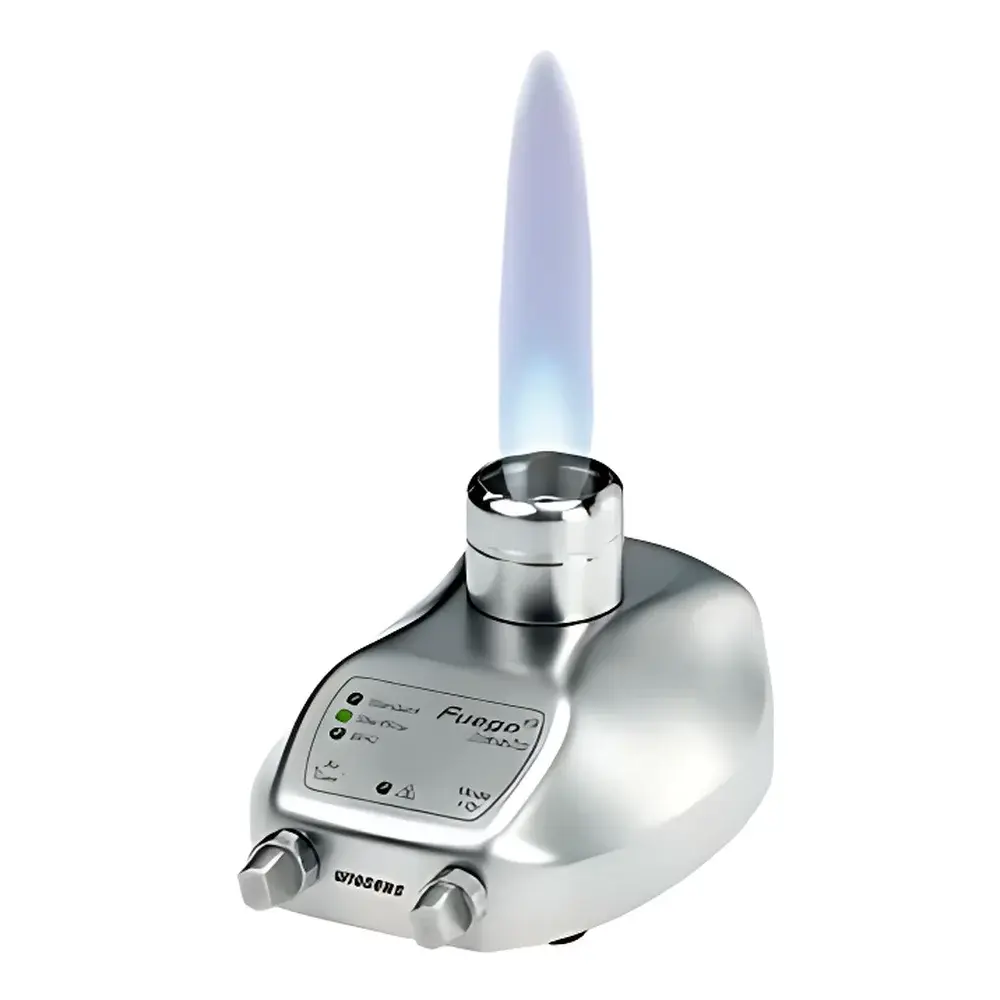
WIGGENS Fuego Basic RF Bunsen Burner
| Brand | WIGGENS |
|---|---|
| Origin | Germany |
| Model | Fuego Basic RF |
| Max. Flame Temperature | 1350 °C (LPG), 1300 °C (Natural Gas) |
| Gas Consumption | 70 g/h |
| Adjustable Gas Pressure Range | LPG 20–50 mbar, Natural Gas E/LL 18–25 mbar |
| Power Supply | 100–240 V AC, 50/60 Hz, ≤0.3 A |
| Dimensions | 103 × 49 × 130 mm |
| Weight | 700 g |
| Compliance | DIN EN ISO/IEC 17025, CE, EEC |
| Safety System | SCS (Safety Control System) with flame monitoring, overheat protection, and gas cutoff |
| Ignition | Piezoelectric, 23 mm burner orifice |
| Operating Modes | Rotary knob control + wireless footswitch (2–5 m range, AA battery–powered) |
| Accessories | Sterilization needle holder, left/right tilt mechanism, dual-gas inlet (natural gas & propane/butane), rotating-lock gas hose connector, tool set, universal power adapter |
Overview
The WIGGENS Fuego Basic RF Bunsen Burner is a precision-engineered laboratory combustion device designed for reproducible, high-temperature open-flame applications in microbiological sterilization, glassware annealing, loop flaming, and rapid thermal treatment. Unlike conventional burners relying on manual air–gas mixing, the Fuego Basic RF employs an aerodynamically optimized nozzle geometry—derived from fluid dynamics principles—to minimize ambient airflow disruption and sustain a stable, laminar, stoichiometrically balanced blue flame. Its maximum operating temperature of 1350 °C (with LPG) and 1300 °C (with natural gas) meets stringent requirements for dry-heat sterilization validation per ISO 17664 and USP , while its microprocessor-controlled ignition and real-time thermal feedback ensure consistent thermal output across repeated cycles.
Key Features
- Aerodynamic burner head design minimizes turbulence-induced flame flicker, delivering exceptional flame stability and spatial uniformity under variable lab ventilation conditions.
- Integrated SCS (Safety Control System): continuously monitors gas supply pressure, flame presence via thermocouple feedback, surface temperature of the burner head, and triggers automatic gas cutoff upon overheat (>180 °C) or flame extinction.
- BHC (Burner Head Check) protocol verifies mechanical integrity prior to ignition—detecting physical obstruction, misalignment, or thermal saturation of the burner orifice to prevent unsafe re-ignition.
- Dual-mode operation: intuitive rotary knob for fine flame adjustment and immediate on/off control; optional wireless footswitch (2–5 m operational radius, AA-powered) enables hands-free activation during sterile procedures or glove-compatible workflows.
- Robust one-piece stainless-steel housing with external thermal shielding ensures structural longevity and operator safety; smooth, corner-free surfaces facilitate ISO 14644-compliant cleaning and residue-free decontamination.
- Universal gas compatibility: factory-configured for both natural gas (E/LL grade, 18–25 mbar) and liquefied petroleum gas (LPG, 20–50 mbar), with quick-swap inlet fittings and rotating-lock hose connectors compliant with DIN 477-1.
Sample Compatibility & Compliance
The Fuego Basic RF is validated for use with standard microbiological inoculation loops, platinum wires, glass spreaders, and ceramic spatulas. Its flame geometry and thermal profile are compatible with ASTM E2872 (Standard Practice for Validation of Dry Heat Sterilization Processes) and support GLP/GMP-aligned documentation when integrated into validated lab workflows. The device bears CE marking per Directive 2014/35/EU (Low Voltage Directive) and 2014/30/EU (EMC Directive), conforms to DIN EN 61000-6-3 for electromagnetic immunity, and satisfies essential requirements of the German Equipment and Product Safety Act (GPSG). All electronic subsystems—including the microcontroller, piezoelectric igniter, and wireless receiver—are independently certified to IEC 61000-4-2 (ESD immunity) and IEC 61000-4-4 (electrical fast transient robustness).
Software & Data Management
While the Fuego Basic RF operates as a standalone analog-digital hybrid instrument without cloud connectivity or firmware-upgradable software, its embedded microcontroller maintains full audit-trail capability for critical safety events. Each activation cycle logs timestamped records of ignition attempts, flame detection status, thermal excursion alerts, and gas cutoff triggers—accessible via internal non-volatile memory for post-event forensic review. These logs comply with FDA 21 CFR Part 11 requirements for electronic records when exported manually using manufacturer-provided diagnostic utilities (available upon request under NDA). No external software installation is required; all configuration and diagnostics are accessible through front-panel LED indicators and tactile feedback protocols.
Applications
- Routine sterilization of inoculation loops and needles in clinical microbiology and pharmaceutical QC labs.
- Controlled flame polishing of glass capillaries and Pasteur pipettes in cell culture facilities.
- Thermal fixation of bacterial smears prior to Gram staining protocols (ISO 13408-1).
- Localized heating of reaction vessels during synthetic chemistry workflows requiring rapid, localized thermal input.
- Validation of dry-heat depyrogenation cycles in cleanroom environments supporting ISO 14644-1 Class 5–7 operations.
- Teaching laboratories requiring fail-safe, repeatable flame sources aligned with national curriculum safety standards (e.g., UK CLEAPSS, US NSTA).
FAQ
What gas types are supported, and what pressure ranges must be maintained?
The Fuego Basic RF supports natural gas (grade E or LL, 18–25 mbar) and LPG (propane/butane mixtures, 20–50 mbar). Gas supply must be regulated externally; the unit does not include an integrated pressure regulator.
Is the wireless footswitch rechargeable or battery-operated?
It operates on two standard AA alkaline batteries (included), with an estimated service life of ≥12 months under typical lab usage (≤20 activations/day). No charging circuitry is integrated.
Does the unit meet requirements for GMP-regulated environments?
Yes—the SCS architecture, traceable calibration history (via serial-numbered manufacturing log), and CE/EN compliance support inclusion in GMP validation protocols per Annex 15 of the EU Guidelines and FDA Guidance for Industry: Process Validation.
Can the burner head be removed for cleaning or replacement?
The burner assembly is field-serviceable using the included hex key and wrench; however, disassembly beyond the standardized nozzle requires authorized service to maintain SCS certification integrity.
What is the purpose of the rear-mounted sterilization needle holder?
It provides ISO 11137-aligned passive cooling and secure vertical storage for heated inoculation needles immediately post-sterilization, minimizing contamination risk and enabling sequential workflow continuity.



