
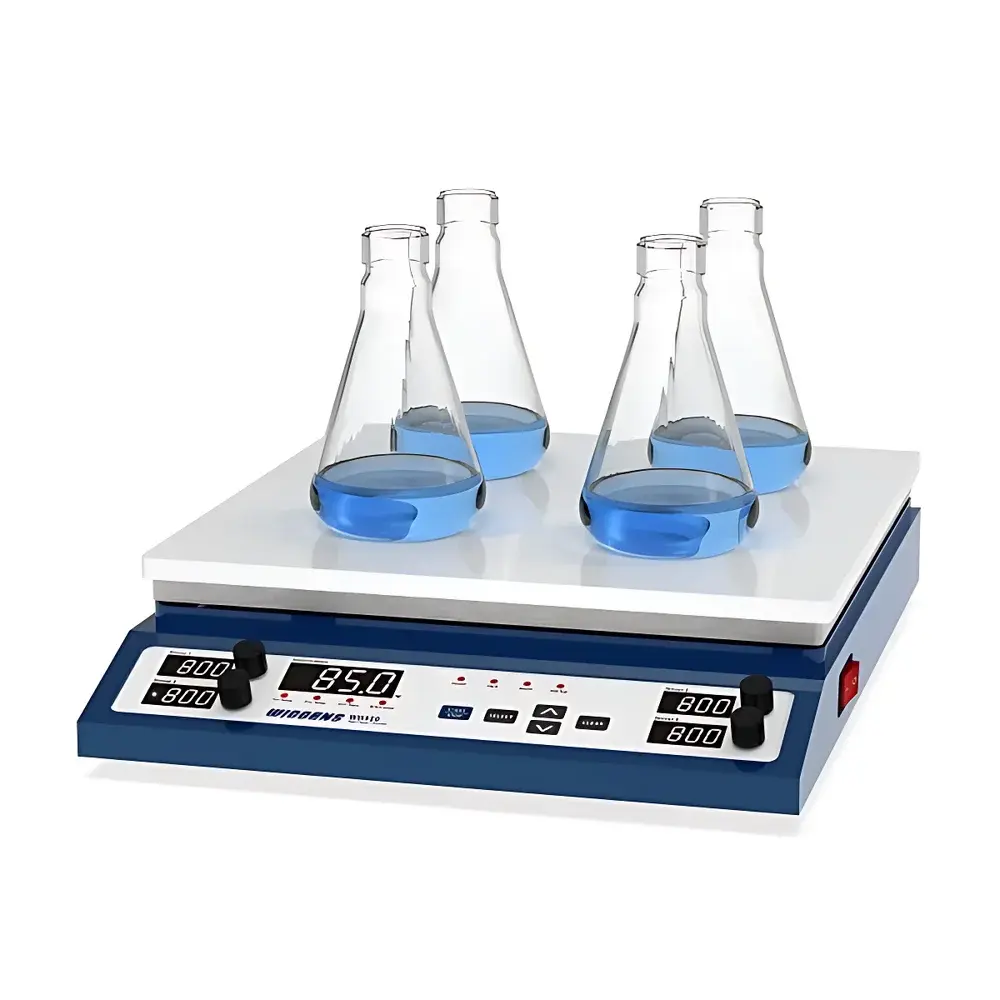
WIGGENS WH420 Multi-Position Heating Magnetic Stirrer
| Brand | WIGGENS |
|---|---|
| Origin | Germany |
| Model | WH420 |
| Stirrer Type | Heating Magnetic Stirrer |
| Max. Stirring Volume | 2 L (H₂O) |
| Speed Range | 150–1500 rpm |
| Heating Plate Temp. Range | ≤300 °C |
| Sample Temp. Control (with Pt100) | ≤300 °C |
| Temp. Accuracy (Pt100) | ±1 °C |
| Safety Cut-off Temp. | 370 °C |
| Heating Power | 1000 W |
| Positions | 4 |
| Plate Dimensions | 160 × 155 mm per position |
| Timer Range | 1–9959 min or continuous |
| PID Control | Yes |
| Interface | RS232 |
| Housing | Sealed corrosion-resistant enclosure |
Overview
The WIGGENS WH420 Multi-Position Heating Magnetic Stirrer is an engineered solution for laboratories requiring simultaneous, independent thermal and mechanical agitation of up to four samples under reproducible and traceable conditions. Based on the principle of magnetic coupling—where a rotating permanent magnet beneath the heating plate induces rotation in a PTFE- or glass-coated stir bar immersed in the sample—the WH420 delivers precise rotational motion without mechanical shaft penetration. Integrated resistive ceramic-coated aluminum heating plates provide uniform thermal distribution across each position, while real-time feedback from a calibrated Pt100 sensor enables closed-loop temperature regulation of the sample medium—not just the plate surface. Designed for compliance-critical environments, the system operates within defined thermal safety thresholds (370 °C automatic cut-off), features dual-layer thermal monitoring (plate and sample), and maintains stable performance even under prolonged operation in chemically aggressive settings.
Key Features
- Four independently controllable stirring positions, each with dedicated digital setpoints for temperature, speed, and timer
- Microprocessor-based PID temperature control with ±1 °C accuracy (measured via Pt100 probe immersed in sample)
- High-brightness LED display showing real-time setpoint/actual values for temperature (°C), speed (rpm), and elapsed/remaining time
- Auto-recall function retains last-used parameters across power cycles—essential for standardized SOP execution
- Corrosion-resistant design: ceramic-coated aluminum heating plates withstand exposure to acids, bases, and organic solvents; sealed housing isolates electronics from ambient vapors and spills
- Integrated anti-spill drip channel above the control panel prevents liquid ingress into internal circuitry
- Overtemperature protection: visual alert (flashing LED) at >60 °C plate surface; automatic heating termination if plate or sample exceeds 370 °C
- RS232 interface supports bidirectional communication for remote parameter setting, data logging, and integration into LIMS or ELN platforms
Sample Compatibility & Compliance
The WH420 accommodates standard laboratory vessels—including glass beakers (50–500 mL), round-bottom flasks, and reaction vials—up to 2 L total volume per position (tested with aqueous media). Its ceramic-coated heating surface resists degradation from common reagents (e.g., 6 M HCl, 5 M NaOH, acetone, ethanol), supporting applications in synthetic chemistry, buffer preparation, dissolution testing, and enzymatic assays. From a regulatory standpoint, the device supports GLP and GMP workflows through its audit-ready parameter retention, deterministic thermal response, and hardware-enforced safety limits. While not intrinsically certified for hazardous locations, its sealed architecture meets IP20 environmental protection requirements for typical analytical lab spaces. The Pt100 sensor path complies with IEC 60751 Class B tolerances, and temperature stability profiles align with ASTM E2479–22 guidelines for thermal validation of benchtop heating systems.
Software & Data Management
The WH420 communicates via industry-standard RS232 serial protocol, enabling direct connection to Windows/Linux-based host systems. Compatible terminal software (provided by WIGGENS or third-party tools such as Tera Term or LabVIEW drivers) allows users to log timestamped records of setpoint temperature, actual temperature, speed, and timer status at user-defined intervals (e.g., every 10 s). All logged data are exportable in CSV format for statistical process analysis (SPC), deviation reporting, or inclusion in electronic batch records. The device supports FDA 21 CFR Part 11–compliant configurations when paired with validated software layers that enforce electronic signatures, audit trails, and role-based access control—making it suitable for regulated pharmaceutical QC labs performing method transfer or stability studies.
Applications
- Controlled-rate heating and mixing during crystallization screening and polymorph studies
- Buffer equilibration and pH adjustment under constant agitation and temperature
- Preparation of homogeneous catalyst suspensions for heterogeneous reaction kinetics
- Dissolution testing of solid dosage forms per USP with synchronized temperature ramping and stirring
- Cell culture media warming and component dispersion prior to sterile filtration
- Environmental sample digestion protocols requiring precise thermal ramping (e.g., EPA Method 3050B)
FAQ
Does the WH420 support external temperature probes other than Pt100?
No—only the supplied or WIGGENS-certified Pt100 probe is supported for sample temperature feedback; alternative sensors may compromise control loop integrity and void calibration validity.
Can the timer be used for delayed start or multi-stage programs?
The built-in timer functions as a countdown or continuous run counter only; advanced multi-step sequences require external scheduling via RS232-connected software.
Is the heating plate surface resistant to hydrofluoric acid (HF)?
No—while the ceramic coating resists most common acids and bases, HF etches silicon-based ceramics and aluminum substrates; use alternative containment (e.g., PTFE inserts) when handling HF-containing solutions.
What maintenance is required to ensure long-term accuracy?
Annual verification of Pt100 probe calibration against a NIST-traceable reference bath and visual inspection of ceramic coating integrity are recommended; no routine lubrication or internal servicing is needed due to brushless motor design and solid-state heating elements.



