
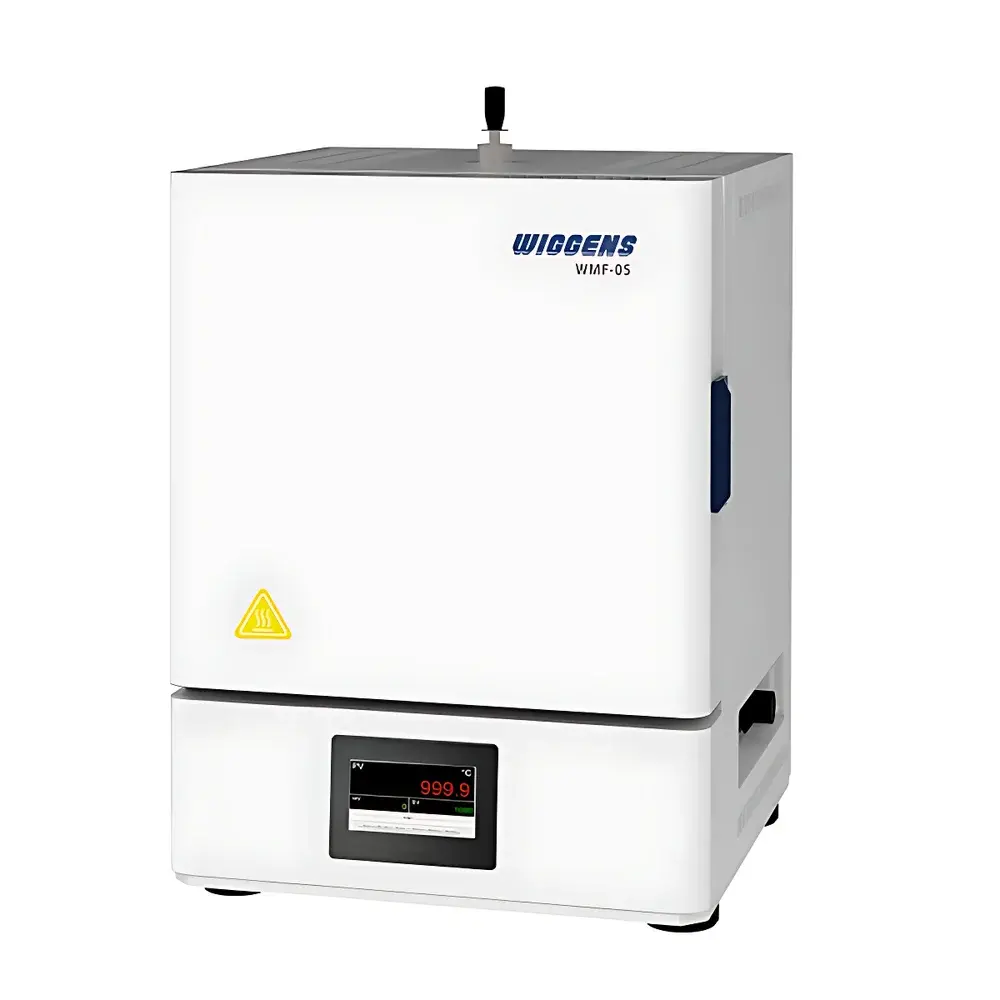
WIGGENS WMF-05H High-Temperature Muffle Furnace
| Brand | WIGGENS |
|---|---|
| Origin | Germany |
| Model | WMF-05H |
| Instrument Type | Box-Type Muffle Furnace |
| Max Temperature | 1600 °C |
| Temperature Control Accuracy | ±1.5 °C |
| Max Power | 4500 W |
| Heating Configuration | Triple-Side Heating |
| Internal Chamber Dimensions | 150 × 200 × 150 mm (W × D × H) |
| Control Interface | 5-inch LCD with PID Algorithm |
| Programmable Profiles | 10 programs × 30 segments each |
| Data Connectivity | RS232, RS485, RJ45 Ethernet, USB storage export |
| Safety Features | Dual Overtemperature Protection (digital + independent mechanical), Leakage Current Protection, Overload Protection, Password-Protected Parameter Lock, Passive Vent Port |
| Compliance | Designed for GLP-compliant thermal processing environments |
Overview
The WIGGENS WMF-05H is a high-temperature box-type muffle furnace engineered for precision thermal treatment in research laboratories, materials science facilities, and quality control environments. Operating on the principle of resistive heating via embedded high-alloy heating elements, it delivers uniform temperature distribution across its ceramic-fiber insulated chamber—enabled by triple-side heating architecture. With a maximum operating temperature of 1600 °C, the WMF-05H supports critical applications including ashing, calcination, sintering, heat treatment of ceramics and metals, and pre-conditioning of reference standards. Its robust construction adheres to IEC 61000-6-3 (EMC emissions) and IEC 61000-6-2 (immunity) standards, and its thermal control system is calibrated per ISO/IEC 17025 traceable protocols to ensure reproducibility in regulated workflows.
Key Features
- Triple-side heating configuration ensures radial and axial thermal homogeneity within the 150 × 200 × 150 mm internal chamber, minimizing thermal gradients during extended dwell cycles.
- PID-based digital temperature controller with real-time feedback from a Type S thermocouple (platinum–rhodium alloy), rated for continuous operation up to 1600 °C and offering ±1.5 °C accuracy at maximum setpoint.
- Integrated 5-inch color LCD interface enables intuitive navigation through setup menus—including temperature ramp rate, soak time, segment count, and program loop parameters—without external software dependency.
- Dual-layer safety architecture: primary electronic overtemperature cutoff (software-configurable) plus an independent mechanical overtemperature limiter with physical reset button, compliant with EN 60519-1 requirements for industrial heating equipment.
- Programmable logic supports up to 10 distinct thermal profiles, each containing up to 30 programmable segments with individually defined ramp rates (0.1–30 °C/min), hold durations (0–9999 min), and cycle repetitions.
- Real-time graphical display of temperature vs. time curves during active operation; all historical run logs—including actual temperature traces, power output (%), alarm timestamps, and fault codes—are timestamped and exportable via USB flash drive.
Sample Compatibility & Compliance
The WMF-05H accommodates standard crucibles (alumina, platinum, graphite), ceramic boats, and refractory trays up to 130 mm in height and 180 mm in width. Its passive vent port maintains atmospheric equilibrium without forced exhaust, making it suitable for non-volatile residue analysis per ASTM E1868 and ISO 1171. The furnace meets electrical safety requirements under UL 61010-1 and CE marking directives (2014/35/EU Low Voltage Directive, 2014/30/EU EMC Directive). For pharmaceutical or clinical lab use, its data logging and parameter lock functions support alignment with FDA 21 CFR Part 11 when paired with validated third-party SCADA systems via RS485 Modbus RTU or Ethernet TCP/IP protocols.
Software & Data Management
While the WMF-05H operates autonomously via its embedded controller, its communication interfaces enable integration into centralized laboratory infrastructure. RS232 and RS485 ports support legacy serial command sets for remote start/stop and setpoint adjustment; the RJ45 Ethernet interface implements standard TCP/IP socket communication for bidirectional data exchange with LIMS or MES platforms. All operational data—including temperature history, program execution status, and diagnostic events—is stored in non-volatile memory with automatic timestamping (YYYY-MM-DD HH:MM:SS). USB export generates CSV-formatted files compatible with Excel, MATLAB, or statistical process control (SPC) tools. Audit trail functionality records user login attempts, parameter modifications, and emergency stop activations—essential for GLP/GMP documentation.
Applications
- Ash content determination in food, feed, and environmental samples (AOAC 942.05, ISO 2171).
- Thermal decomposition studies of polymers and composites under inert or air atmospheres.
- Sintering of oxide ceramics (e.g., ZrO₂, Al₂O₃) and metal powders prior to density or microstructural analysis.
- Calibration of thermocouples and reference materials using fixed-point annealing procedures.
- Pre-treatment of catalyst supports and electrochemical electrodes requiring precise oxidative conditioning.
- Residue-on-ignition testing in geological and metallurgical assay workflows (ASTM D5291, ISO 625).
FAQ
What type of thermocouple is used for temperature sensing?
A Type S (Platinum–10% Rhodium / Platinum) thermocouple is factory-installed and calibrated for continuous operation up to 1600 °C.
Is the furnace suitable for use under inert gas atmosphere?
Yes—the passive vent port allows natural gas exchange; for controlled atmospheres, optional quartz tube inserts or custom flanged adapters can be integrated with external gas manifolds.
Can multiple furnaces be monitored centrally?
Yes—via RS485 daisy-chaining (Modbus RTU) or individual Ethernet connections supporting up to 255 devices on a single subnet.
How is temperature uniformity verified across the chamber?
Uniformity is characterized per ASTM E2203 using a 9-point thermocouple mapping protocol at 1000 °C and 1600 °C; typical deviation is ≤±3 °C within the central 70% volume.
Does the unit include validation documentation?
Factory calibration certificates (as-found/as-left) and IQ/OQ templates are provided; PQ protocols must be executed on-site per user-defined acceptance criteria.



