
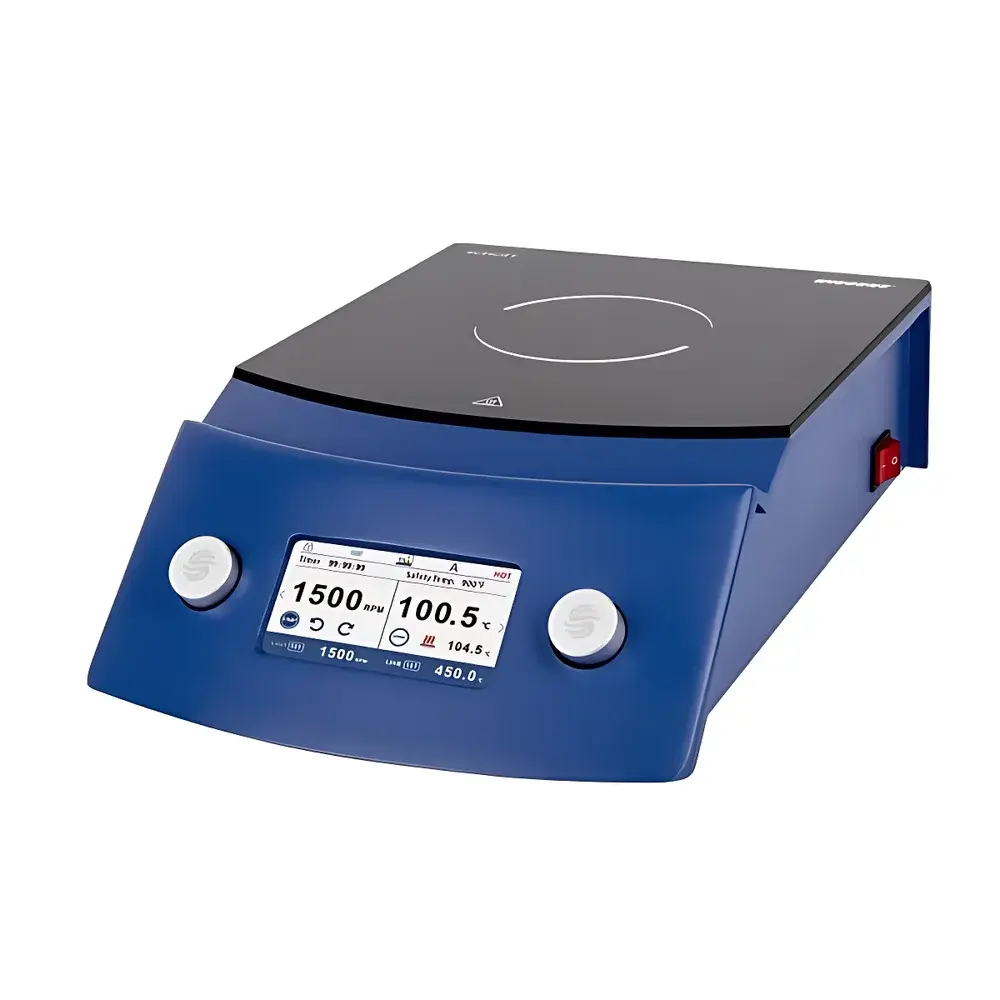
WIGGENS WH395 High-Power Infrared Heating Magnetic Stirrer
| Brand | WIGGENS |
|---|---|
| Origin | Germany |
| Model | WH395 |
| Stirring Volume (H₂O) | 30 L |
| Speed Range | 100–1500 rpm |
| Max. Heating Plate Temp. | 550 °C |
| Sample Temp. Control (with Pt100) | up to 300 °C |
| Safety Over-Temp Range | 50–600 °C adjustable |
| ΔT Over-Temp Offset | 10–50 °C adjustable |
| Temp. Stability (with Pt100) | ±1 °C |
| Heating Power | 1800 W |
| Plate Material | Enamel-Glass Coated Ceramic |
| Plate Dimensions | 280 × 280 mm |
| Heating Zone Diameter | 190 mm |
| Interface | RS232/RS485 |
| Display | TFT Screen |
| Timer Range | 00:01:00 to 99:59:00 or continuous |
| Weight | 4.1 kg |
| Power Supply | 220 V / 50 Hz |
Overview
The WIGGENS WH395 High-Power Infrared Heating Magnetic Stirrer is an engineered solution for laboratories requiring simultaneous high-efficiency heating and robust magnetic stirring under demanding thermal and mechanical conditions. Unlike conventional resistive-heating stirrers, the WH395 employs infrared radiation transfer through a thermally stable enamel-glass coated ceramic plate — enabling rapid thermal response, minimal thermal inertia, and uniform surface temperature distribution across the 190 mm active heating zone. Its core design integrates Couette-type magnetic stirring with precise open-loop or closed-loop (Pt100 feedback) temperature regulation, supporting applications ranging from gentle suspension of sensitive biological reagents to vigorous homogenization of viscous polymer solutions or high-boiling-point solvents. The unit complies with IEC 61010-1:2010 safety standards for laboratory electrical equipment and is constructed to meet long-term operational stability in ISO 17025-accredited QC/QA environments.
Key Features
- Infrared heating technology delivering >30% faster ramp-up versus standard coil-based plates, with reduced ambient heat dissipation and improved energy efficiency.
- Enamel-glass coated ceramic top plate rated for thermal shock resistance exceeding 700 °C — eliminating micro-cracking and discoloration during repeated rapid heating/cooling cycles.
- Sealed, corrosion-resistant housing combining flame-retardant rigid plastic and coated cast-iron motor assembly — suitable for use in fume hoods and corrosive chemical environments.
- Dual-mode temperature control: standalone plate setpoint (max 550 °C) or sample-targeted regulation via external Pt100 sensor (max 300 °C), with programmable overtemperature cutoff (50–600 °C) and differential offset protection (ΔT = 10–50 °C).
- Intelligent ICC (Intelligent Current Control) stirring algorithm maintaining consistent torque across the full 100–1500 rpm range, even under variable load or viscosity conditions.
- TFT graphical display with intuitive rotary/touch interface, real-time dual-parameter readout (temperature + speed), and user-configurable timer (00:01:00 to 99:59:00 or continuous mode).
- Rear-mounted accessory port for secure mounting of temperature probes, reflux condensers, or custom sensor brackets — facilitating GLP-compliant experimental setups.
Sample Compatibility & Compliance
The WH395 accommodates vessels from 10 mL glass vials to 30 L stainless steel or borosilicate reactors (water-equivalent volume). Its flat, non-porous enamel-glass surface ensures compatibility with acidic, alkaline, and organic media without degradation or leaching. The unit conforms to EN 61326-1:2013 (EMC for laboratory equipment) and carries CE marking under the EU Machinery Directive 2006/42/EC. Built-in thermal safeguards — including residual heat indicator LED, automatic shutdown at safety limit, and redundant thermal fuse — support compliance with OSHA 1910.1200 (Hazard Communication) and institutional lab safety protocols. Optional RS232/RS485 connectivity enables integration into centralized monitoring systems compliant with FDA 21 CFR Part 11 requirements when paired with validated data acquisition software.
Software & Data Management
While the WH395 operates as a standalone instrument, its RS232/RS485 serial interface supports bidirectional communication with third-party SCADA or LIMS platforms. Users may log timestamped temperature and speed values, trigger alarms on deviation thresholds, and export CSV-formatted records for audit trails. When deployed in regulated environments (e.g., pharmaceutical QC labs), the device’s deterministic control loop and hardware-enforced safety limits contribute to documented system suitability — particularly when combined with calibrated Pt100 sensors traceable to NIST standards. Firmware updates are delivered via secure USB-to-serial adapter; no cloud dependency or proprietary cloud service is required.
Applications
- Accelerated solvent evaporation and concentration in synthetic chemistry workflows.
- Controlled heating/stirring of high-viscosity resins, adhesives, or ceramic slurries prior to casting or extrusion.
- Preparation of homogeneous calibration standards for ICP-MS or HPLC analysis under reproducible thermal history.
- Thermal activation studies of catalysts or nanomaterial precursors requiring precise ramp-hold-cool profiles.
- Stability testing of formulations per ICH Q1 guidelines, where consistent thermal input and mixing intensity are critical.
- Teaching laboratories conducting calorimetry, kinetics, or phase-transition experiments with real-time parameter visibility.
FAQ
Does the WH395 support external temperature feedback for closed-loop control?
Yes — it accepts Pt100 RTD inputs for sample-targeted temperature regulation with ±1 °C stability under steady-state conditions.
Can the unit be used with metal containers or magnetic-sensitive samples?
No — magnetic stirring requires ferromagnetic stir bars; stainless steel vessels must be non-magnetic (e.g., 316L) to avoid eddy current heating or torque loss.
Is the enamel-glass surface resistant to HF or molten alkali hydroxides?
The plate withstands brief exposure to diluted HF (<5%) and NaOH/KOH ≤50 wt%, but prolonged contact with concentrated or anhydrous forms is not recommended.
What is the maximum ambient operating temperature for continuous use?
The device is rated for continuous operation at ambient temperatures up to 40 °C and relative humidity ≤80% non-condensing.
How is calibration verification performed?
Users may validate plate temperature accuracy using a NIST-traceable infrared thermometer focused on the center of the heating zone; Pt100 sensor calibration follows ISO/IEC 17025 procedures.



