
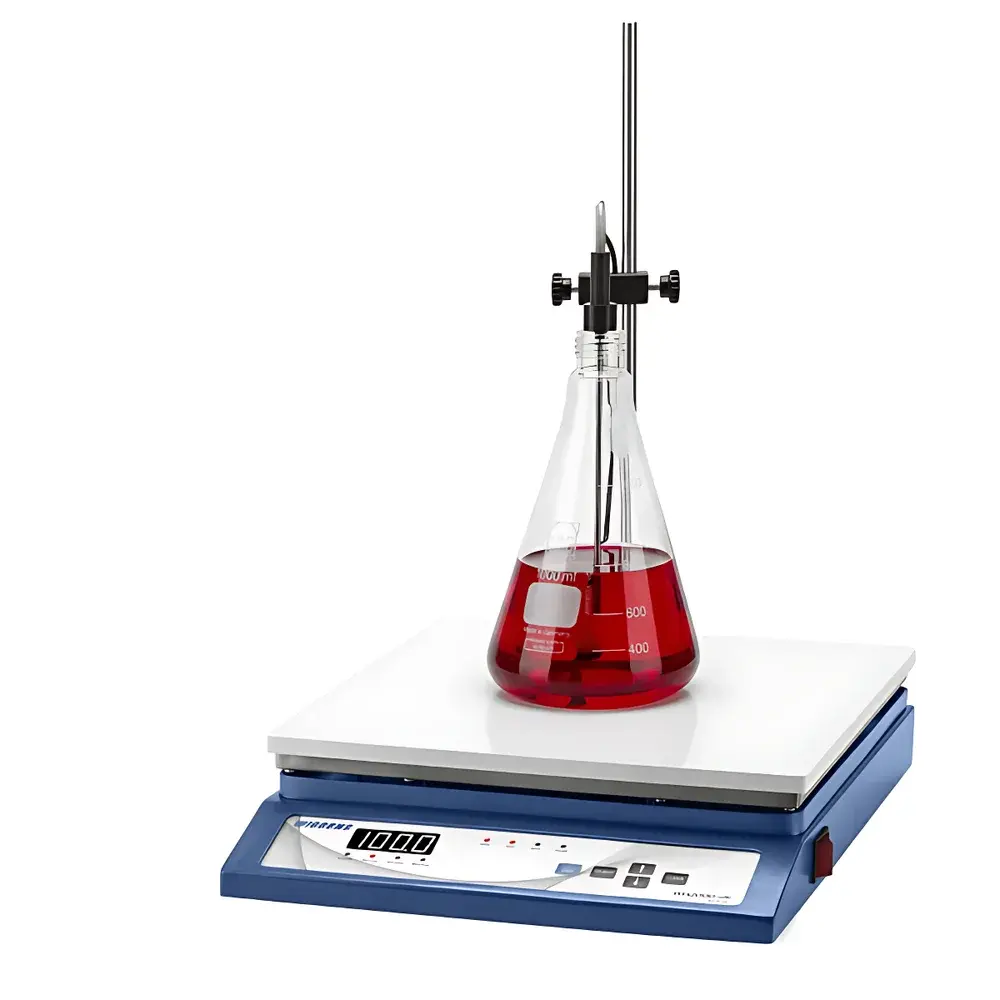
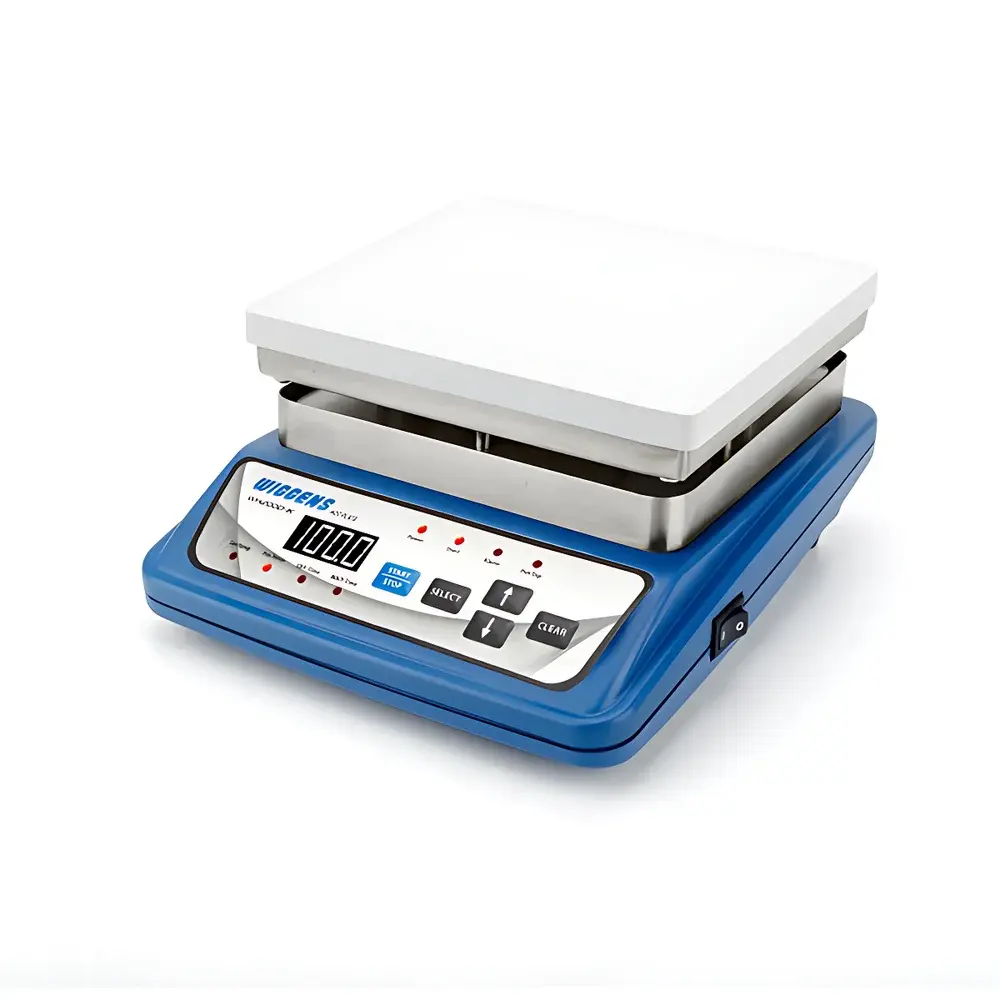
WIGGENS WH200D-3K Digital Heating Plate
| Brand | WIGGENS |
|---|---|
| Origin | Germany |
| Model | WH200D-3K |
| Heating Power | 1500 W |
| Heating Plate Dimensions | 400 × 300 mm |
| Temperature Range | 50–300 °C |
| Control Accuracy (PID + Pt100) | ±1 °C |
| Temperature Uniformity | ±1 °C |
| Housing Material | Aluminum with Ceramic-Coated Heating Surface |
| Safety Features | Over-Temp Alarm, >60 °C Status Indicator, Factory Reset, External Pt100 Input Support |
| Timer Modes | OFF / OFF-Time / WAIT-Time (1–9959 min) |
| Display | Dual LED (Setpoint & Actual Temp) |
Overview
The WIGGENS WH200D-3K Digital Heating Plate is an engineered thermal platform designed for precise, repeatable, and safe conductive heating in analytical, quality control, and synthetic laboratory environments. It operates on resistive heating principles, delivering uniform thermal energy across its large ceramic-coated aluminum surface via optimized power distribution. Unlike open-loop hotplates, the WH200D-3K integrates a digital PID temperature controller with optional external Pt100 sensor feedback—enabling closed-loop regulation of sample temperature rather than just plate surface temperature. This architecture significantly improves thermal reproducibility when heating vessels containing solvents, reagents, or reaction mixtures under controlled conditions. The unit complies with IEC 61010-1 safety standards for laboratory electrical equipment and is CE-marked for use in EU-regulated research and production facilities.
Key Features
- Dual-display LED interface showing both setpoint and real-time surface temperature—enabling immediate verification of thermal status without external instrumentation.
- PID-controlled temperature regulation with configurable parameters (P, I, D gains) to accommodate varying thermal loads and vessel geometries, ensuring stable operation across 50–300 °C.
- Three programmable timer modes: OFF (manual termination), OFF-Time (auto-shutdown after elapsed time), and WAIT-Time (delayed activation)—all adjustable from 1 minute to 9959 minutes (≈6.9 days).
- Integrated safety system including automatic visual alert (LED indicator) when surface temperature exceeds 60 °C, dual-stage over-temperature protection, and audible/visual alarm for high/low limit violations.
- Front-panel reset function to restore factory default settings—critical for audit-trail integrity in GLP/GMP-compliant workflows.
- Standard Pt100 input port enabling direct integration with external temperature probes placed inside reaction vessels—supporting accurate control of bulk liquid or slurry temperature per ASTM E220 or ISO 17025 calibration guidelines.
Sample Compatibility & Compliance
The WH200D-3K accommodates standard laboratory glassware (e.g., round-bottom flasks, beakers, crystallization dishes) up to 4 L volume when used with appropriate support stands. Its 400 × 300 mm heating area ensures compatibility with multi-vessel configurations and larger reactors. The ceramic-coated aluminum surface resists corrosion from common solvents (e.g., acetone, ethanol, dilute acids/bases) and withstands repeated thermal cycling between ambient and 300 °C. Units are supplied with documentation traceable to DIN EN ISO/IEC 17025-accredited calibration procedures. All models meet RoHS Directive 2011/65/EU and are compatible with laboratory safety management systems requiring documented risk assessment per ISO 45001.
Software & Data Management
While the WH200D-3K operates as a standalone instrument without embedded software, its analog Pt100 input and digital control logic support seamless integration into centralized lab data acquisition systems via third-party DAQ hardware (e.g., National Instruments USB-TC01 or Omega OM-DAQ-USB-2401). When paired with compliant logging software, the device supports 21 CFR Part 11–compliant electronic records—including timestamped temperature logs, operator ID tagging, and audit-trail-enabled parameter changes. Optional RS232/RS485 communication modules (sold separately) enable remote monitoring and automated shutdown protocols in process-critical applications.
Applications
- Controlled solvent evaporation in HPLC sample preparation workflows.
- Pre-heating and maintenance of reaction mixtures during Grignard, esterification, or hydrolysis procedures.
- Calibration of thermometers and temperature sensors using reference fluids (e.g., water, silicone oil) per USP and ISO 17025 requirements.
- Viscosity measurement support for rotational rheometers requiring constant bath temperature.
- Sample digestion preparation in environmental and food testing labs adhering to EPA Method 3050B or AOAC 984.27.
- Stability testing of pharmaceutical intermediates under ICH Q1A(R2) long-term storage condition simulations.
FAQ
Can the WH200D-3K control the internal temperature of a liquid sample directly?
Yes—when connected to an external Pt100 probe immersed in the sample, the unit regulates power output to maintain the measured probe temperature within ±1 °C, independent of ambient or vessel wall effects.
Is the heating surface resistant to strong acids or caustic solutions?
The ceramic coating provides excellent resistance to diluted mineral acids (≤10% HCl, HNO₃), organic solvents, and alkalis up to 1 mol/L NaOH; however, prolonged exposure to HF or hot concentrated H₂SO₄ is not recommended.
Does the unit support validation documentation for regulated laboratories?
Yes—WIGGENS provides IQ/OQ documentation templates, calibration certificates traceable to national standards (DKD/DAkkS), and compliance summaries aligned with ISO/IEC 17025, FDA 21 CFR Part 11, and EU GMP Annex 15 requirements.
What is the maximum recommended vessel height for optimal heat transfer?
For uniform thermal coupling, vessel height should not exceed 1.5× the base diameter; taller vessels may require auxiliary air circulation or magnetic stirring to minimize vertical thermal gradients.
How does the WAIT-Time mode differ from OFF-Time mode?
WAIT-Time initiates heating only after a user-defined delay (e.g., start heating 30 minutes after power-on), whereas OFF-Time terminates heating after a preset duration from activation—both critical for unattended overnight operations.



