
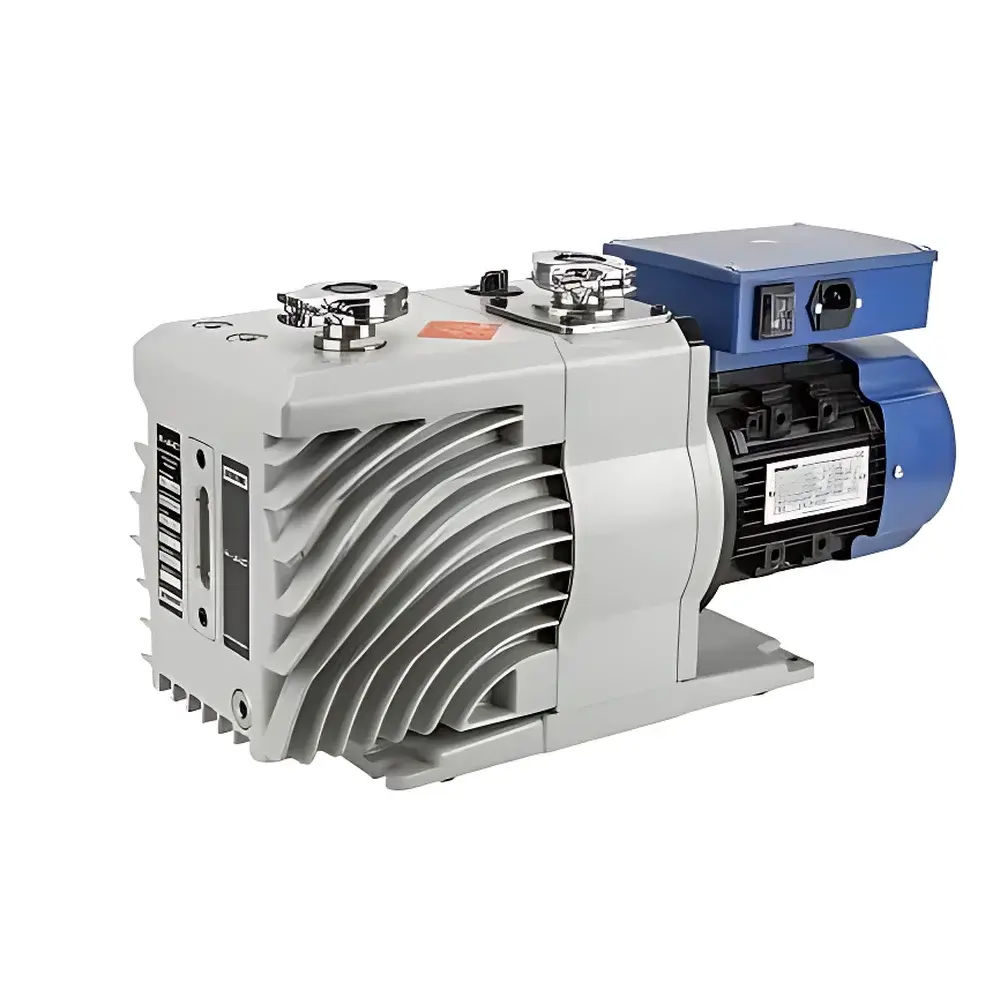
WIGGENS R-17D Two-Stage Rotary Vane Oil-Sealed Vacuum Pump
| Brand | WIGGENS |
|---|---|
| Origin | Germany |
| Model | R-17D |
| Pump Type | Two-Stage Rotary Vane |
| Lubrication | Oil-Sealed |
| Ultimate Vacuum | 4 × 10⁻⁴ mbar |
| Pumping Speed | 283 L/min |
| Motor Power | 750 W |
| Motor Speed | 1400 rpm |
| Noise Level (Gas Ballast Off) | < 54 dB(A) |
| Oil Capacity | 1.4 L |
| Protection Rating | IP44 |
| Weight | 31 kg |
| Inlet Port | DN25 KF |
| Order No. | 900112-22 |
Overview
The WIGGENS R-17D is a two-stage rotary vane oil-sealed vacuum pump engineered for reliable, continuous operation in demanding laboratory and pilot-scale applications. Based on the proven Couette-flow principle of rotary vane displacement, it achieves high volumetric efficiency through precisely machined vanes rotating eccentrically within a cylindrical stator chamber, creating sequential compression chambers that evacuate gas from the inlet to the exhaust. Its ultimate vacuum of 4 × 10⁻⁴ mbar and pumping speed of 283 L/min make it suitable as a primary vacuum source for moderate vacuum processes—and critically—as a forepump for high-vacuum systems such as turbomolecular pumps or diffusion pumps. Designed and assembled in Germany under strict quality control, the R-17D meets the mechanical robustness and long-term stability requirements of ISO/IEC 17025-accredited laboratories and GMP-compliant manufacturing environments.
Key Features
- Two-stage compression architecture for enhanced ultimate vacuum performance and improved tolerance to backstreaming
- Integrated gas ballast valve enabling controlled admission of atmospheric air to facilitate removal of condensable vapors (e.g., water, solvents), minimizing oil contamination
- IP44-rated sealed motor with thermal overload protection—designed for uninterrupted duty cycles in ambient temperatures up to 40 °C
- Low-noise operation (< 54 dB(A) with gas ballast closed) achieved via balanced rotor dynamics, vibration-damping feet, and optimized exhaust silencing
- Front-mounted circular oil level sight glass with calibrated scale—enabling rapid, tool-free verification of oil volume and condition without disassembly
- Oil mist suppression system significantly reduces airborne hydrocarbon aerosol emissions, supporting indoor air quality compliance per OSHA PEL and EU Directive 2004/101/EC
- Chemically resistant internal coatings and NBR elastomer seals enhance compatibility with mildly aggressive vapors encountered in organic synthesis and solvent recovery workflows
- DN25 KF quick-release inlet flange ensures leak-tight, repeatable connection to standard vacuum tubing, cold traps, and process vessels
Sample Compatibility & Compliance
The R-17D is compatible with non-corrosive, non-explosive gases and vapors typical in academic research, pharmaceutical development, and materials processing. It is not intended for direct pumping of halogenated solvents, strong oxidizers (e.g., nitric oxide, chlorine), or highly polymerizing monomers without upstream cold trapping or scrubbing. When used with appropriate ancillary equipment—including liquid nitrogen cold traps (for cryogenic condensation) and chemical scrubbers—the pump complies with ASTM E1677-20 (Standard Practice for Vacuum System Integrity Testing) and supports GLP audit trails when integrated into validated vacuum manifold systems. Its construction adheres to EN 60034-1 (rotating electrical machines) and EN 61000-6-3 (EMC emission limits).
Software & Data Management
While the R-17D operates as a standalone analog device without embedded digital controls, its mechanical design supports integration into automated vacuum systems via optional external pressure transducers (e.g., Pirani or capacitance manometers) and programmable logic controllers (PLCs). Analog 0–10 V or 4–20 mA output interfaces are available on compatible pressure sensors for real-time vacuum level logging in LabVIEW, MATLAB, or SCADA platforms. All operational parameters—including runtime hours, oil change intervals, and gas ballast activation logs—can be recorded manually or via external data acquisition systems to satisfy FDA 21 CFR Part 11 requirements for electronic records and signatures when deployed in regulated QC/QA environments.
Applications
- Vacuum distillation and fractional evaporation of heat-sensitive compounds
- Rotary evaporation and solvent recovery in synthetic chemistry labs
- Freeze-drying (lyophilization) of biologics and pharmaceutical intermediates
- Vacuum filtration of fine particulates in environmental and geochemical sample preparation
- Leak testing of sealed components using helium mass spectrometry (as forepump)
- Thin-film deposition (e.g., sputtering, thermal evaporation) requiring stable medium-vacuum base conditions
- Vacuum impregnation of porous ceramics and composites
- Desiccation and degassing of resins, adhesives, and casting materials
FAQ
What is the recommended oil change interval for the R-17D under continuous operation?
Under standard laboratory use (≤ 8 h/day, non-condensing loads), oil should be replaced every 500 operating hours or semiannually—whichever occurs first. Extended intervals require oil analysis (acid number, viscosity, particulate count) per ISO 4406:2017.
Can the R-17D be operated vertically or at an angle?
No. The pump must be installed horizontally on a rigid, level surface to ensure proper oil distribution across the vane tips and stator walls. Tilting beyond ±2° may cause uneven wear and premature failure.
Is the R-17D compliant with CE and RoHS directives?
Yes. The unit carries full CE marking and conforms to the Low Voltage Directive (2014/35/EU), EMC Directive (2014/30/EU), and RoHS 2011/65/EU, including restrictions on lead, mercury, cadmium, and hexavalent chromium.
How does the gas ballast function affect ultimate vacuum performance?
Activating the gas ballast introduces a controlled bleed of dry air into the second-stage compression chamber, lowering vapor partial pressure and preventing condensation—but at the expense of ultimate vacuum, typically degrading it by one to two orders of magnitude (e.g., from 4 × 10⁻⁴ mbar to ~10⁻² mbar).
What maintenance tasks require certified technician intervention?
Vane replacement, stator re-boring, and motor winding inspection must be performed by WIGGENS-authorized service centers to preserve calibration integrity and warranty validity. Field users may perform oil changes, filter replacements, and belt tensioning (if applicable) following the Operation & Maintenance Manual (OMM-900112-22 Rev. D).
Related Products



