
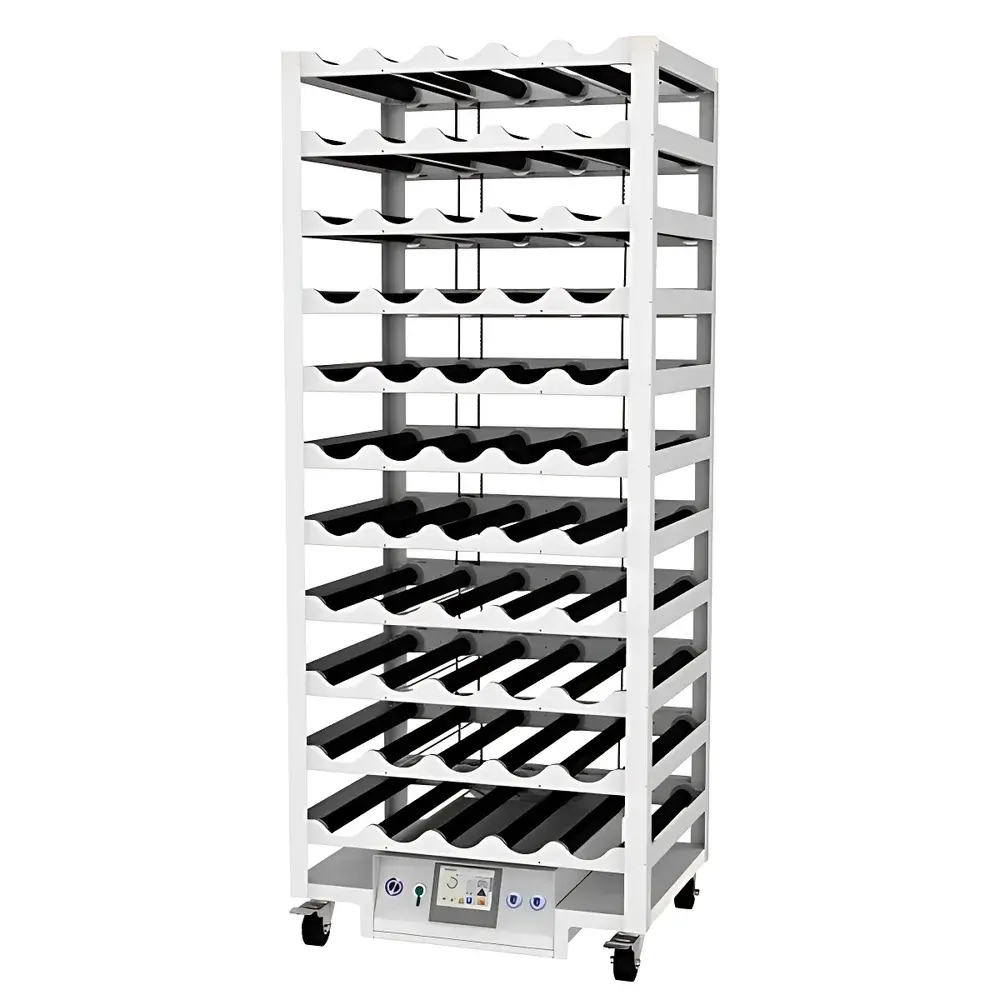
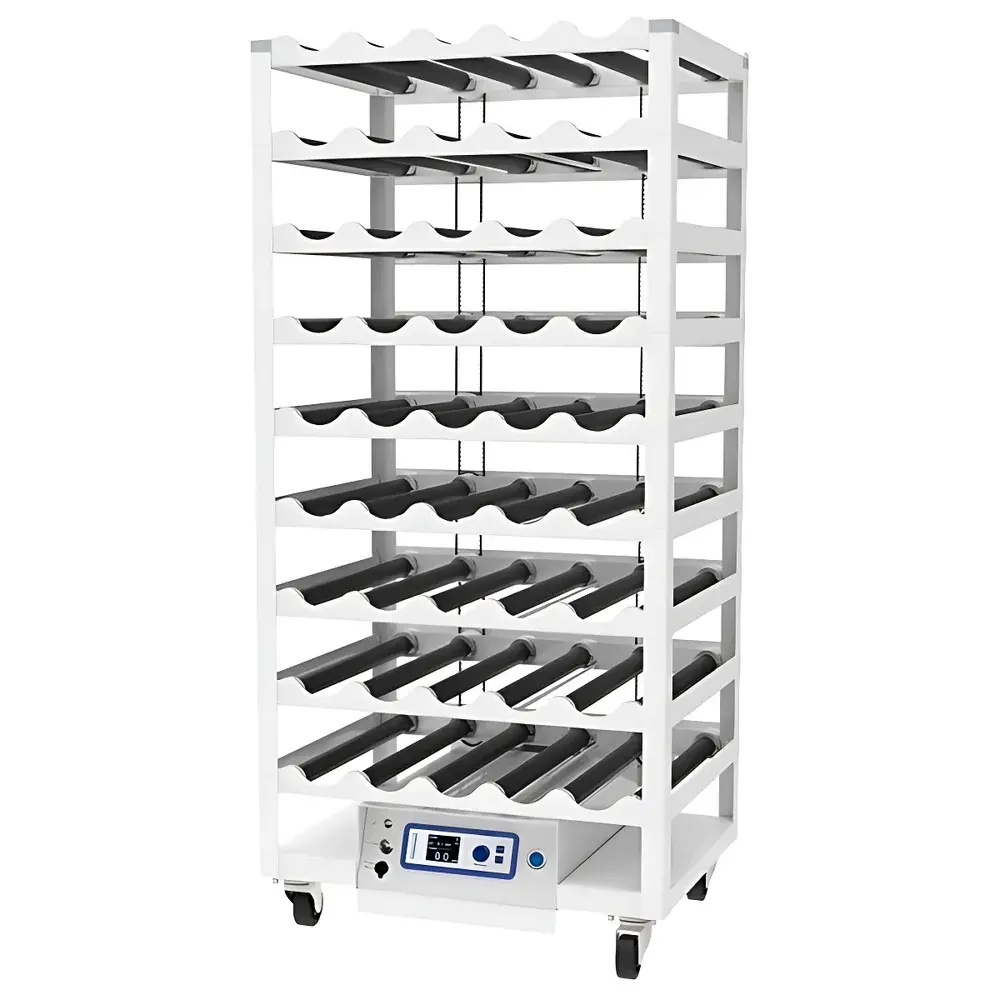
WIGGENS Celrol Pro and Celrol Elite Roller Bottles Culture Systems
| Brand | WIGGENS |
|---|---|
| Origin | Germany |
| Model | Celrol Pro / Celrol Elite |
| Drive Type | Brushless DC Motor |
| Control System | Siemens PLC with Touchscreen HMI |
| Capacity | 5–55 or 8–88 roller bottles (550 mm length) |
| Bottle Dimensions | Ø108–121 mm × 550 mm |
| Speed Range | 0.08–2.5 rpm |
| Speed Resolution | 0.01 rpm |
| Rotation Direction | Reversible (CW/CCW) |
| Drive Mechanism | Reinforced Polyurethane Belt |
| Construction | Full Stainless Steel (AISI 304) |
| Power Supply | 100–240 VAC, 50/60 Hz |
| Operating Temperature | 10–40 °C |
| Humidity Limit | ≤80% RH at 31 °C |
| Communication Interfaces | RS-232 (Pro), RS-422/RS-485 Modbus RTU, Modbus TCP, TCP/IP (Elite) |
| Optional Accessories | Backup Battery, Temperature Monitoring Module, Thermal Printer, Alarm Signal Output |
| Compliance | Designed to support GMP-aligned cell culture workflows, compatible with ISO 13485–certified environments and GLP documentation requirements |
Overview
The WIGGENS Celrol Pro and Celrol Elite Roller Bottle Culture Systems are precision-engineered platforms for scalable, adherent mammalian cell cultivation under controlled rotational conditions. Based on the well-established roller bottle methodology—where cells attach and proliferate on the inner surface of cylindrical glass or plastic vessels while gentle, continuous rotation ensures uniform nutrient distribution and gas exchange—the Celrol systems deliver reproducible hydrodynamic shear profiles essential for high-yield monoclonal antibody production, viral vector expansion, and vaccine manufacturing. Unlike orbital shakers or spinner flasks, roller bottles provide a larger surface-to-volume ratio and lower mechanical stress, making them particularly suitable for sensitive primary cells and stem cell lines. Both models integrate advanced motion control architecture, full stainless-steel construction, and programmable bidirectional rotation to meet stringent bioprocessing requirements in academic core facilities, contract development and manufacturing organizations (CDMOs), and regulated pharmaceutical labs.
Key Features
- Brushless DC motor drive system ensuring maintenance-free operation, extended service life (>20,000 hours MTBF), and consistent torque delivery across the full speed range (0.08–2.5 rpm).
- High-capacity modular design: Celrol Pro supports up to 55 bottles per unit (5-layer configuration); Celrol Elite accommodates up to 88 bottles (8-layer stack), with each layer holding five or eight 550-mm bottles depending on frame variant.
- Reinforced polyurethane timing belt transmission eliminates slippage, minimizes vibration (<0.1 mm/s RMS), and reduces acoustic noise to ≤45 dB(A) at 1 m distance—critical for integration into laminar flow hoods or incubator-embedded installations.
- Full AISI 304 stainless-steel chassis and bottle cradles comply with cleaning-in-place (CIP) protocols and facilitate autoclave-compatible surface decontamination, supporting GMP Annex 1 hygiene standards.
- Siemens SIMATIC S7-based PLC with intuitive 7-inch color touchscreen HMI enables parameter programming (speed, direction, runtime), real-time status monitoring, and event logging—including automatic restart after power interruption with audible alarm and configurable digital output for external SCADA linkage.
- Optional integrated backup battery (72 h hold-up time) preserves program state and clock during mains failure; optional temperature monitoring module provides independent validation of ambient thermal stability within the roller chamber.
Sample Compatibility & Compliance
The Celrol systems accept standard ISO-compliant roller bottles with outer diameters from 108 mm to 121 mm and fixed length of 550 mm—compatible with Corning®, Falcon®, and Greiner Bio-One® 850 cm² and 1750 cm² formats. All mechanical interfaces are engineered to prevent bottle wobble or axial misalignment during rotation, thereby minimizing shear-induced detachment and ensuring monolayer integrity. The devices are designed to operate inside Class II biological safety cabinets or integrated into WIGGENS large-volume CO₂ incubators (e.g., IN100 series) without airflow disruption. From a regulatory standpoint, the Celrol Elite’s communication stack (Modbus TCP, TCP/IP) supports audit-trail-capable data export for 21 CFR Part 11 compliance when paired with validated LIMS or MES platforms. Documentation packages include Factory Acceptance Test (FAT) reports, IQ/OQ templates, and material certifications aligned with ISO 13485 and EU MDR Annex I essential requirements.
Software & Data Management
While the Celrol Pro relies on local touchscreen interaction only, the Celrol Elite offers comprehensive remote operability via industrial Ethernet protocols. Its embedded web server allows secure HTTP(S)-based access to real-time operational data (current speed, elapsed time, error codes), historical run logs (stored for ≥30 days), and firmware versioning. Through Modbus TCP integration, process parameters can be synchronized with distributed control systems (DCS) or supervisory control and data acquisition (SCADA) networks. Optional thermal printer support enables hard-copy generation of batch records—including start/stop timestamps, average RPM deviation, and alarm events—for GLP/GMP traceability. All data exports conform to CSV and XML schema standards, facilitating import into electronic lab notebooks (ELN) such as LabArchives or IDBS E-WorkBook.
Applications
- Large-scale production of therapeutic proteins and monoclonal antibodies in suspension-adapted CHO or HEK293 cells.
- Viral vector amplification (AAV, lentivirus) requiring low-shear, high-surface-area culture formats prior to downstream purification.
- Primary human fibroblast and mesenchymal stem cell (MSC) expansion for regenerative medicine applications where phenotypic stability is critical.
- Vaccine antigen propagation (e.g., influenza, rabies) using adherent MDCK or Vero cell lines under cGMP-aligned conditions.
- Bioprocess development studies comparing roller bottle performance against bioreactors or microcarriers in terms of doubling time, viability, and metabolite profile.
FAQ
Can the Celrol system be installed inside a CO₂ incubator?
Yes—both Celrol Pro and Elite models are rated for operation at up to 40 °C and 80% RH, and their compact footprint and low heat dissipation allow seamless integration into WIGGENS IN-series and other large-volume incubators with internal mounting brackets.
Is speed calibration traceable to national standards?
Each unit undergoes factory calibration using NIST-traceable tachometric reference equipment; calibration certificates are provided upon request and include uncertainty budgets per ISO/IEC 17025 guidelines.
What happens during unexpected power loss?
The system retains its last programmed settings and resumes operation automatically upon power restoration; an audible alarm alerts operators, and optional dry-contact outputs can trigger building management system (BMS) notifications.
Does the Celrol support validation protocols for regulated environments?
Yes—IQ/OQ documentation templates, FAT checklists, and risk assessments (per ISO 14971) are available. The Elite model additionally supports electronic signature capture and audit trail generation when connected to compliant software infrastructure.
Are replacement belts and motors field-serviceable?
All wear components—including polyurethane drive belts and brushless motor assemblies—are modular and replaceable using standard tools; spare parts kits and technical bulletins are supplied with extended warranty options.




