
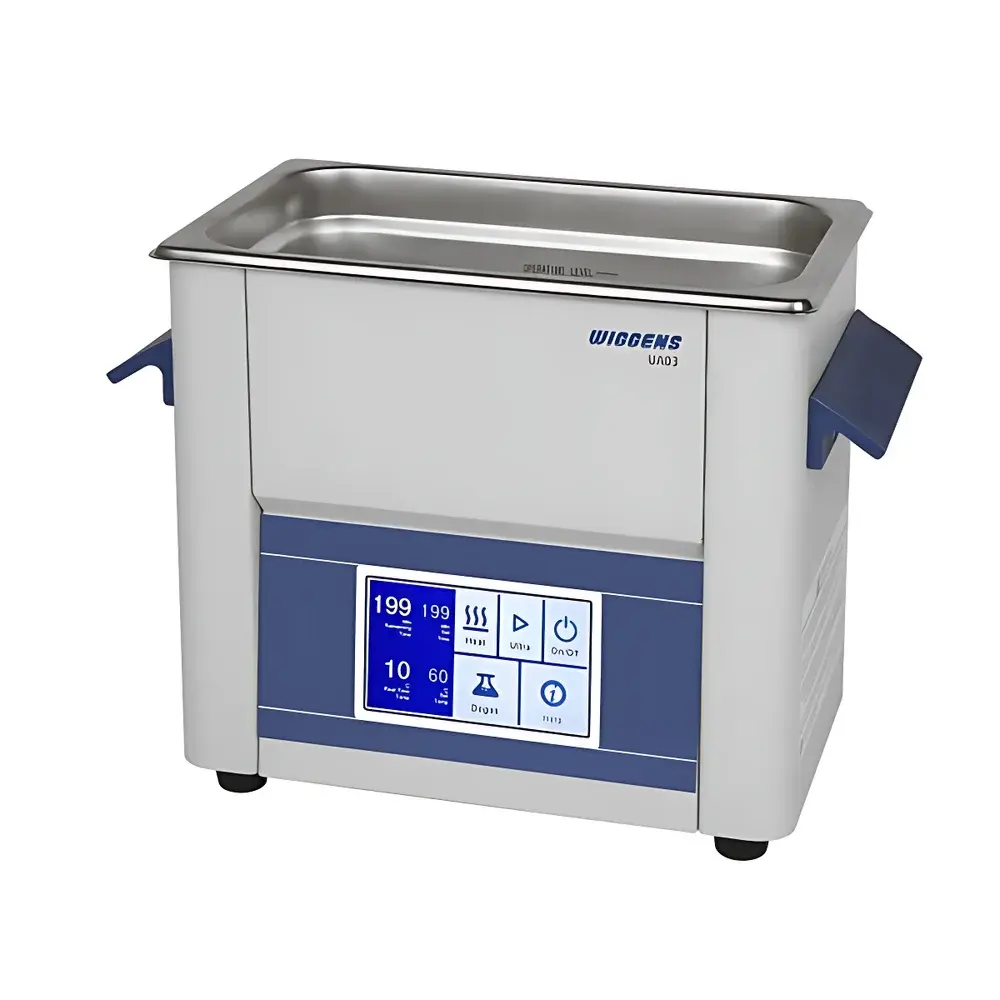
WIGGENS UA03 Advanced Ultrasonic Cleaner
| Brand | WIGGENS |
|---|---|
| Origin | Germany |
| Model | UA03 |
| Instrument Type | General-Purpose Ultrasonic Cleaner |
| Tank Capacity | 3 L |
| Ultrasonic Frequency | 37 kHz |
| Ultrasonic Power Output | 100 W (adjustable) |
| Heating Power | 88 W |
| Temperature Range | 20–80 °C (adjustable) |
| Timer Range | 1–199 min (digital, programmable) |
| Sound-Dampening Lid | Included |
| Drain Valve | Manual, side-mounted |
| Construction | 304 Stainless Steel Tank, Powder-Coated Steel Housing |
| Compliance | For non-medical laboratory use only |
| Safety Features | Overheat and overcurrent protection, auto-shutoff, power memory on power loss |
Overview
The WIGGENS UA03 Advanced Ultrasonic Cleaner is an engineered solution for precision cleaning of delicate laboratory components, glassware, instrumentation parts, and analytical sample preparation tools. It operates on the principle of controlled cavitation—generated by high-frequency mechanical oscillations (37 kHz) transmitted through a liquid medium via piezoelectric transducers bonded to the stainless steel tank base. These oscillations produce alternating compression and rarefaction cycles in the cleaning solution, leading to the formation and implosive collapse of microscopic vapor cavities. Each collapse releases localized energy exceeding 1000 atm, enabling effective removal of particulate contaminants, organic residues, and biofilm from surfaces—even within micro-channels, threaded fittings, and porous substrates—without mechanical abrasion or solvent-intensive protocols.
Designed for routine QC/QA laboratories, R&D facilities, and academic core labs, the UA03 balances robust performance with ergonomic usability and regulatory-aware design. Its non-medical classification ensures compliance with ISO/IEC 17025 documentation requirements for equipment qualification, while its closed-loop thermal control and programmable timing support method reproducibility per ASTM D2603 and ISO 13852 standards for ultrasonic cleaning validation.
Key Features
- 304 stainless steel tank (240 × 140 × 100 mm internal dimensions) resistant to corrosion, thermal cycling, and repeated chemical exposure
- Digitally controlled temperature regulation (20–80 °C ±1 °C accuracy) with independent heating element (88 W) and PID feedback loop
- Adjustable ultrasonic power output (100 W nominal, continuously variable) to match substrate sensitivity and soil load
- TFT touch-screen interface with real-time display of setpoint and actual values for time, temperature, and frequency status
- Programmable timer (1–199 minutes) with auto-shutdown and parameter retention after power interruption
- Integrated sound-dampening lid to reduce ambient noise (≤55 dB(A) at 1 m) and minimize solvent evaporation
- Manual side-mounted drain valve with quick-release fitting for safe, spill-free fluid disposal
- Stabilized anti-slip rubber feet and ergonomic carry handle for secure placement and mobility on benchtops
- Comprehensive safety architecture including overtemperature cutoff, current-limiting circuitry, and grounded chassis design
Sample Compatibility & Compliance
The UA03 accommodates standard laboratory items up to 3 L volume, including volumetric flasks, syringes, pipette tips, HPLC filters, crucibles, and small-scale reactor components. Its 37 kHz frequency provides optimal balance between penetration depth and surface shear force—suited for both soft deposits (e.g., protein residues) and hard particulates (e.g., metal oxides, ceramic dust). The unit is not intended for sterilization or medical device reprocessing; it complies with IEC 61000-6-3 (EMC emission limits) and meets CE marking requirements under the EU Machinery Directive 2006/42/EC. All firmware and operational logs adhere to ALCOA+ principles for data integrity, supporting GLP/GMP-aligned workflows where audit trails are required.
Software & Data Management
While the UA03 does not feature network connectivity or PC-based software, its embedded controller implements critical data governance functions: all user-defined parameters—including time, temperature, and power level—are retained in non-volatile memory across power cycles. The TFT interface records the last five executed cycles (timestamp, duration, setpoints), accessible via service menu for internal traceability. This architecture satisfies basic FDA 21 CFR Part 11 readiness when paired with lab-wide electronic logbook systems, as no user-modifiable audit trail exists outside operator input. Calibration certificates (temperature sensor, timer accuracy) are available upon request and conform to ISO/IEC 17025-accredited third-party verification.
Applications
- Cleaning of chromatography columns, injector ports, and autosampler vials prior to HPLC/UHPLC analysis
- Removal of solder flux and oxide layers from PCBs and microelectronic components during failure analysis
- Preparation of TEM/SEM specimens requiring particle-free surfaces
- Decontamination of reusable filtration housings and membrane supports in bioprocess development
- Routine maintenance of viscometers, density meters, and optical cuvettes in physical testing labs
- Supporting ASTM E1417 and ISO 3452-2 penetrant testing procedures through standardized pre-cleaning steps
FAQ
Is the UA03 suitable for cleaning surgical instruments or medical devices?
No. The UA03 is explicitly designated for non-medical laboratory use and lacks validation documentation required for ISO 13485 or AAMI ST33-compliant reprocessing.
Can the unit operate without heating enabled?
Yes. Temperature control is fully independent of ultrasonic activation; users may run cold ultrasonic cycles for heat-sensitive samples.
What cleaning solutions are compatible with the stainless steel tank?
Aqueous alkaline, neutral, or mild acidic detergents (pH 4–10) are recommended. Avoid halogenated solvents, strong oxidizers (e.g., >5% sodium hypochlorite), and undiluted mineral acids.
Does the UA03 include a degassing function?
Yes. A dedicated “degas” mode runs at reduced power for 5 minutes to remove dissolved air from fresh cleaning solutions—improving cavitation efficiency before sample immersion.
How often should the tank be descaled?
In hard water environments, descaling with 5% citric acid solution is advised every 2–4 weeks depending on usage frequency and water hardness (≥150 ppm CaCO₃).



