
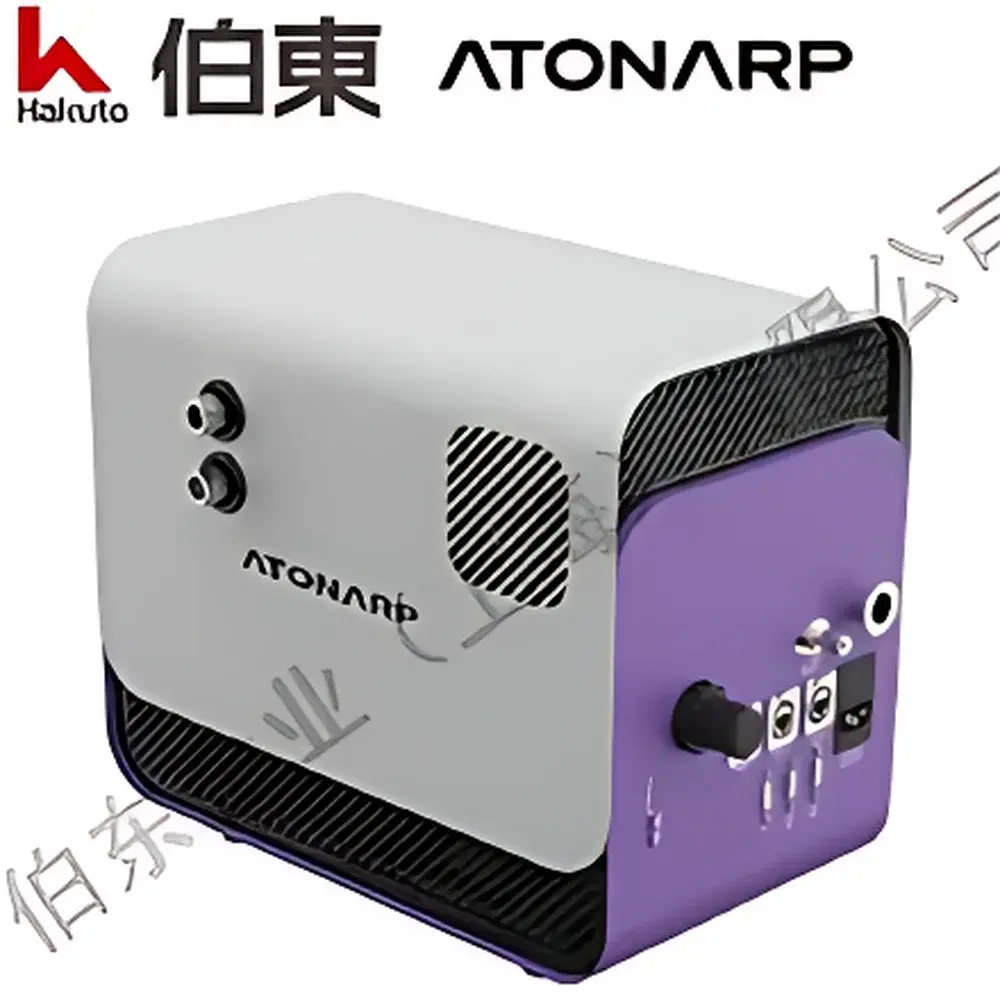
Atonarp Aston™ AST3007 Process Mass Spectrometer for 3D NAND Deposition and Etch Monitoring
| Brand | Atonarp |
|---|---|
| Origin | Japan |
| Model | AST3007 |
| Mass Range | 2–285 amu |
| Resolution | 0.8 ± 0.2 (FWHM) |
| Detection Limit | 0.1 ppm |
| Sampling Speed | High-speed dynamic acquisition |
| Sensitivity | Sub-ppb for key process gases |
| Vacuum System | Turbomolecular pump |
| Detector | Faraday Cup / Secondary Electron Multiplier (FC/SEM) |
| Operating Temperature | 15–35 °C |
| Power Consumption | 350 W |
| Dimensions (L×W×H) | 299 × 218 × 331 mm |
| Weight | 15 kg |
Overview
The Atonarp Aston™ AST3007 is a high-performance, compact quadrupole process mass spectrometer engineered for real-time, in-situ gas-phase analysis in advanced semiconductor manufacturing—specifically optimized for atomic-layer deposition (ALD), chemical vapor deposition (CVD), and high-aspect-ratio etch processes used in 3D NAND flash memory fabrication. Operating on the principle of quadrupole mass filtering, the AST3007 separates ions by their mass-to-charge ratio (m/z) under precisely controlled RF and DC voltages, enabling selective, quantitative detection of process gases, precursors, reaction byproducts, and trace contaminants with sub-ppm detection limits and millisecond-level temporal resolution. Its robust design integrates directly into vacuum tool environments—including cluster tools and single-wafer platforms—without compromising chamber integrity or process stability. Unlike laboratory-grade benchtop instruments, the AST3007 is purpose-built for industrial uptime, featuring a hardened ion source resistant to corrosive chemistries (e.g., Cl₂, NF₃, WF₆, SiH₄), minimal maintenance intervals, and seamless compatibility with factory automation protocols (SECS/GEM, OPC UA).
Key Features
- Real-time, multi-species gas monitoring at ≤100 ms cycle time—critical for closed-loop control of layer-by-layer deposition and endpoint-determined etch steps.
- Quadrupole mass analyzer with 0.8 ± 0.2 amu resolution (FWHM) across a 2–285 amu range, covering all major process species including H₂, He, N₂, O₂, Ar, Cl₂, F₂, HF, SiF₄, WF₆, NH₃, and hydrocarbon fragments.
- Dual-mode detector configuration (Faraday Cup + Secondary Electron Multiplier) ensures linear dynamic range from ppm to ppb concentrations without signal saturation or gain drift.
- Integrated turbomolecular pumping system maintains stable <1×10⁻⁶ mbar base pressure during continuous sampling, eliminating need for external roughing pumps in most configurations.
- Compact footprint (299 × 218 × 331 mm) and modular flange interface (CF35 or ISO-KF40) enable retrofit integration into existing PECVD, ALD, and ICP etch tools with minimal engineering effort.
- Chemically resistant ion source and transfer line materials (Inconel, ceramic insulators, gold-plated electrodes) ensure long-term stability in aggressive plasma and fluorine-based chemistries.
Sample Compatibility & Compliance
The AST3007 is validated for continuous sampling of reactive, corrosive, and condensable process streams encountered in 3D NAND fabrication—including nitrogen trifluoride (NF₃), sulfur hexafluoride (SF₆), chlorine (Cl₂), tungsten hexafluoride (WF₆), silane (SiH₄), ammonia (NH₃), and oxygen plasma effluents. It meets SEMI S2/S8 safety standards for semiconductor equipment and supports audit-ready data integrity per FDA 21 CFR Part 11 requirements when deployed with compliant software modules. Instrument calibration traceability follows NIST-traceable gas standards, and operational validation aligns with ASTM E2912 (Standard Practice for Calibration of Quadrupole Mass Spectrometers) and ISO/IEC 17025–compliant QA procedures.
Software & Data Management
The AST3007 operates with Atonarp’s Process Insight™ software suite, providing intuitive spectral visualization, customizable alarm thresholds, automated peak identification via embedded spectral library (covering >200 semiconductor-relevant compounds), and time-resolved concentration trending. Raw mass spectra and processed concentration data are exportable in CSV, HDF5, and SECS-II formats. The software supports secure user authentication, electronic signatures, audit trails for all parameter changes and calibration events, and integration with MES systems via RESTful API or OPC UA server. All data handling conforms to GLP/GMP documentation standards required for qualification in high-reliability fabs.
Applications
- Stacked Dielectric Deposition: Real-time monitoring of SiO₂/Si₃N₄ alternating layer growth; detection of residual precursors (e.g., TEOS, DCS) and purge efficiency to ensure stoichiometric control and interfacial purity.
- Channel Etch Endpoint Detection: Tracking Cl₂/NF₃ consumption and SiCl₄/SiF₄ evolution during high-aspect-ratio (>50:1) trench formation—enabling sub-nanometer depth control and sidewall profile uniformity.
- Staircase Etch Process Control: Quantifying endpoint signatures (e.g., abrupt rise in CO, CO₂, or NO upon oxide/nitride interface breakthrough) to define precise word-line landing positions.
- Slit Etch & Chamber Clean Monitoring: Detecting ppb-level HF, F₂, and CFₓ fragments during post-etch clean cycles to verify complete removal of polymer residues and prevent cross-contamination.
- Tungsten Wordline ALD: In-situ verification of WF₆ pulse saturation, NH₃ reduction completeness, and H₂O scavenging efficacy—directly correlating with film resistivity and step coverage uniformity.
FAQ
What mass range and resolution does the AST3007 support?
The AST3007 covers 2–285 amu with a nominal resolution of 0.8 ± 0.2 amu (FWHM), sufficient to resolve adjacent isotopes (e.g., ²⁸Si⁺ vs. ¹⁴N₂⁺) and critical process fragments.
Can the AST3007 operate continuously inside a production etch chamber?
Yes—it is rated for continuous duty in UHV-compatible environments (≤1×10⁻⁶ mbar) and features a chemically inert ion source qualified for >6 months of uninterrupted operation in Cl₂/NF₃ plasmas.
How is calibration maintained in a high-throughput fab environment?
Calibration is performed using certified multi-component gas standards; drift correction is enabled via internal reference peaks (e.g., air background N₂/O₂ ratio) and automated daily zero/gain checks.
Does the system support integration with factory automation networks?
Yes—native support for SECS/GEM messaging, OPC UA server, and Modbus TCP enables direct linkage to APC systems and MES without middleware.
Is the AST3007 compliant with semiconductor industry safety and data integrity standards?
It complies with SEMI S2/S8, CE, and RoHS directives; optional software modules provide full 21 CFR Part 11 compliance, including electronic signatures, audit trails, and role-based access control.
Related Products





