
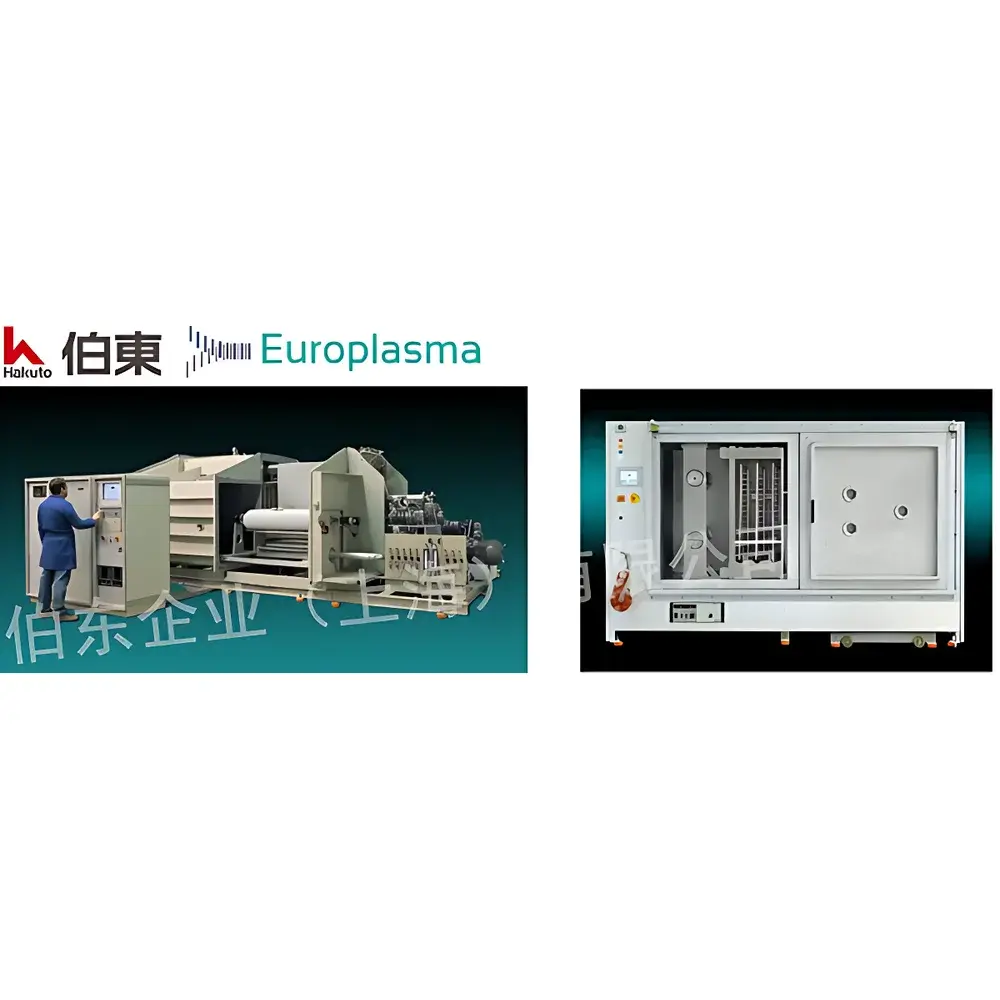
Europlasma CD 1800 Roll-to-Roll Low-Pressure Plasma Surface Treatment System
| Brand | Europlasma |
|---|---|
| Origin | Belgium |
| Model | CD 1800 |
| Sample Chamber Type | Roll-to-Roll |
| Chamber Material | Aluminum |
| Process Gases | O₂, N₂, N₂O, or custom gas mixtures (e.g., N₂/H₂) |
| Control Mode | Fully Automated |
| Technology Platform | Nanofics® plasma polymerization & PlasmaGuard® halogen-free coating |
Overview
The Europlasma CD 1800 is a fully automated, roll-to-roll low-pressure plasma surface treatment system engineered for industrial-scale functionalization of porous filtration media—both gaseous (e.g., melt-blown polypropylene respirator filters) and liquid-phase (e.g., blood filtration membranes). Operating under controlled vacuum conditions (typically 0.1–10 Pa), the system utilizes radiofrequency (RF)-free capacitive coupling to generate stable, uniform non-thermal plasma discharges. Unlike atmospheric plasma systems, this low-pressure architecture ensures deep penetration into micro- and nano-porous structures without thermal degradation, enabling precise surface-selective modification at the top 1–10 nm layer. The core mechanism involves either plasma-induced surface activation—where reactive species (atomic oxygen, nitrogen radicals, excited metastables) graft polar functional groups (–OH, –COOH, –NH₂) onto polymer chains—or plasma-enhanced chemical vapor deposition (PECVD), wherein monomer vapors (e.g., fluorinated or hydrophilic precursors) are fragmented and recombined into conformal, covalently bonded nanocoatings. This dual-mode capability supports both transient surface energy enhancement and permanent functional performance—critical for regulatory-compliant medical filtration applications.
Key Features
- Roll-to-roll architecture with 1800 mm web width and 1000 mm maximum roll diameter—optimized for continuous high-throughput processing of flexible filtration substrates.
- Aluminum vacuum chamber with integrated RF-shielded electrodes, ensuring long-term stability and minimal particulate generation in Class 7 cleanroom-compatible environments.
- Gas delivery system supporting precise blending and dosing of O₂, N₂, N₂O, or binary/mixed precursors—including halogen-free formulations compliant with IEC 60601-1 and ISO 10993 biocompatibility requirements.
- Automated process control via PLC-integrated HMI with recipe management, real-time pressure/temperature monitoring, and closed-loop gas flow regulation.
- Patented Nanofics® technology for sub-10 nm conformal plasma polymer coatings; PlasmaGuard® process option for halogen-free, extractable-free functional layers suitable for USP / cytotoxicity testing.
- No RF generator required—eliminates electromagnetic interference risks in sensitive lab or production environments and reduces maintenance complexity.
Sample Compatibility & Compliance
The CD 1800 accommodates a broad range of polymeric filtration media, including polypropylene (PP), polyethylene terephthalate (PET), polybutylene terephthalate (PBT), polytetrafluoroethylene (PTFE), and cellulose acetate. It maintains structural integrity of 3D fibrous architectures—preserving pore geometry, air permeability, and mechanical tensile strength while modifying only surface chemistry. All processes adhere to ASTM F2101 (bacterial filtration efficiency), AATCC Test Method 118-1997 (oil repellency rating), and ISO 18562-3 (biocompatibility of gas pathways). Coating durability is validated per ISO 10993-5 (cytotoxicity) and ISO 10993-10 (irritation/sensitization), with trace metal analysis performed in accordance with ICH Q3D guidelines. Data audit trails comply with FDA 21 CFR Part 11 requirements when integrated with validated LIMS or MES platforms.
Software & Data Management
Process parameters—including chamber pressure, gas composition, exposure time, power density (W/m²), and substrate speed—are logged at 100 ms intervals and stored with timestamped digital signatures. The embedded control software supports SOP-driven operation, electronic batch records (EBR), and export of CSV/Excel-formatted reports for GLP/GMP documentation. Optional OPC UA interface enables seamless integration with factory automation systems (SCADA, MES) for full traceability across production lots. All calibration events, maintenance logs, and alarm histories are retained for ≥25 years—meeting ISO/IEC 17025 accreditation requirements for accredited testing laboratories.
Applications
- Persistent hydrophilic coating: For blood filtration membranes (PP/PBT), achieving water contact angle (WCA) 12 months—enabling uniform fluid distribution and reducing hemolysis risk.
- Oleophobic barrier formation: On respirator-grade melt-blown PP, delivering AATCC 118 oil repellency grade 3–4 and increasing DOP aerosol filtration efficiency from R95 to R99-level performance without electrostatic charge dependency.
- Adhesion promotion: Pre-treatment prior to lamination or printing on fluoropolymer-based filter housings, improving bond strength by >300% versus untreated surfaces (per ASTM D3359).
- Surface decontamination: In-situ removal of organic residues and volatile siloxanes from pre-filter media—reducing outgassing in ultra-high-purity gas delivery systems.
- Functional gradient coating: Sequential deposition of multi-layer nanofilms (e.g., hydrophilic base + oleophobic topcoat) for dual-mode separation membranes used in dialysis or viral filtration.
FAQ
Does the CD 1800 require RF power generation?
No—the system operates via capacitive coupling without an external RF generator, eliminating EMI concerns and simplifying CE/UL certification.
Can it process non-planar or 3D filter geometries?
While optimized for roll-to-roll webs, the low-pressure plasma environment ensures uniform treatment of complex topographies—including pleated, folded, or corrugated filter elements—when mounted on custom carriers.
How is coating thickness verified and controlled?
Thickness is inferred via in situ optical emission spectroscopy (OES) and calibrated against ex situ XPS and ellipsometry measurements; typical Nanofics® coatings range from 2–8 nm, with repeatability ±0.3 nm (3σ).
Is PlasmaGuard® compatible with ISO 10993 biological evaluation?
Yes—PlasmaGuard® formulations are halogen-free, non-leaching, and have passed ISO 10993-5 (cytotoxicity), -10 (sensitization), and -11 (hemocompatibility) testing per manufacturer’s biocompatibility dossier.
What vacuum level and pump configuration is required?
The system interfaces with standard two-stage rotary vane or dry scroll pumps capable of reaching ≤1 × 10⁻¹ Pa base pressure; no turbomolecular pump is necessary for standard operation.



