
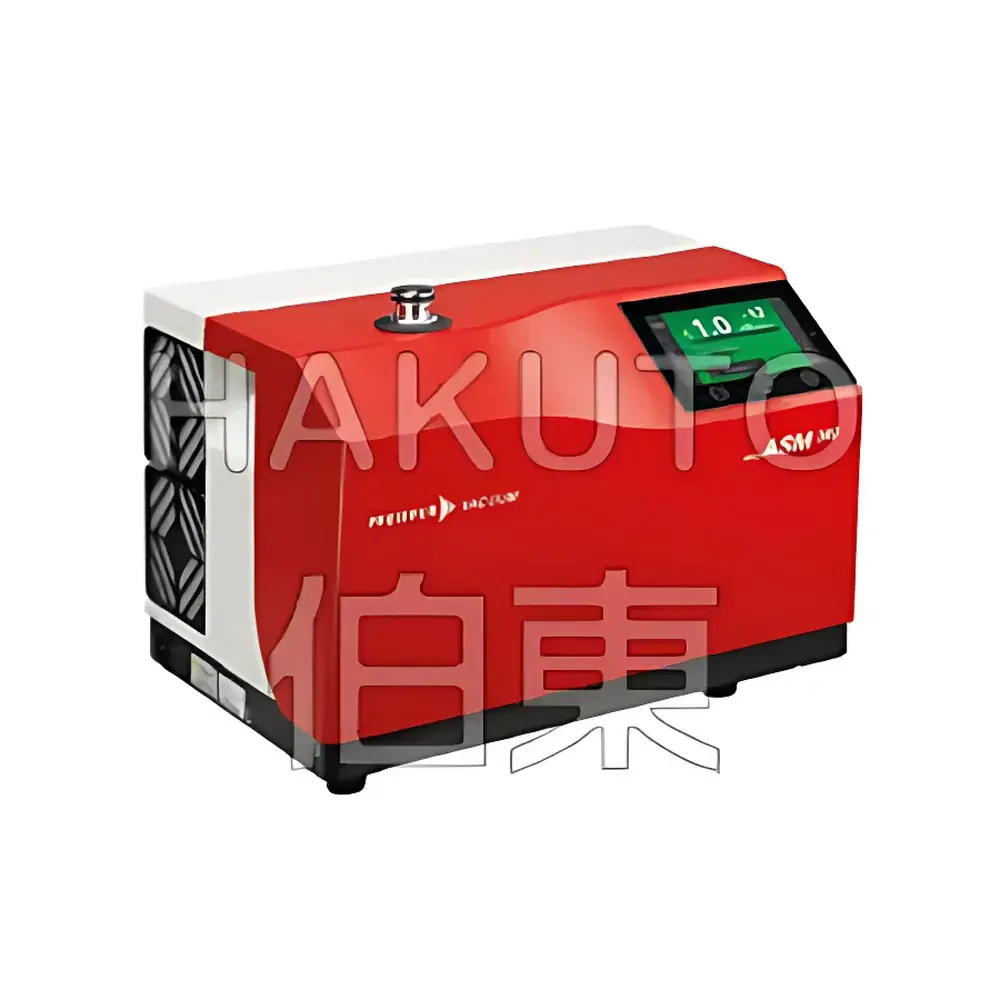
Pfeiffer Vacuum ASM 340 Helium Mass Spectrometer Leak Detector
| Brand | Pfeiffer Vacuum |
|---|---|
| Origin | France |
| Model | ASM 340 |
| Detection Limit (Vacuum Mode) | 1×10⁻¹² mbar·L/s for ⁴He |
| Detection Limit (Sniffer Mode) | 5×10⁻⁹ mbar·L/s for ⁴He |
| Max Inlet Pressure | 25 mbar |
| Helium Pumping Speed | 2.5 L/s |
| Warm-up Time | ~3 min |
| Response Time | <1 s |
| Interface | RS-232, USB, Basic I/O, Fieldbus Options |
| Operating Temperature | 0–45 °C (Vacuum Mode), 0–40 °C (Sniffer Mode) |
| Power Supply | 100–240 V AC, 50/60 Hz |
| Weight | 32–56 kg (depending on configuration) |
| Dimensions | 547 × 350 × 389 mm |
| IP Rating | IP20 |
Overview
The Pfeiffer Vacuum ASM 340 Helium Mass Spectrometer Leak Detector is a high-performance, modular leak detection system engineered for precision, reliability, and operational flexibility in industrial vacuum integrity verification. Based on quadrupole mass spectrometry, the ASM 340 selectively detects helium (⁴He, ³He) and hydrogen (H₂) as tracer gases—leveraging helium’s inertness, low natural background concentration (<5 ppm in air), and optimal mass-to-charge ratio (m/z = 4) for unambiguous identification. Unlike pressure decay or bubble testing, this instrument delivers quantitative, location-specific leak rate measurements down to 1×10⁻¹² mbar·L/s in vacuum mode and 5×10⁻⁹ mbar·L/s in sniffer (positive-pressure) mode—meeting stringent requirements for semiconductor tool qualification, aerospace component validation, medical device packaging, and high-vacuum system commissioning. Its design integrates legacy strengths from both Pfeiffer’s HLT series and former Adixen ASM platforms, incorporating dual Y₂O₃-coated filament assemblies for extended source lifetime and field-replaceable redundancy.
Key Features
- Modular vacuum architecture supporting multiple front-end configurations: optional oil-sealed rotary vane pump, dry diaphragm pump, or no forepump (for integration into existing vacuum systems)
- Pfeiffer Splitflow 50 molecular pump with helium-specific pumping speed of 2.5 L/s—enabling rapid system evacuation and sub-second response during dynamic leak scanning
- Dual Y₂O₃ (yttrium oxide) filament assembly—each filament independently operable and replaceable without disassembling the analyzer, minimizing downtime and maintenance cost
- Robust mechanical design rated IP20, validated for shock and atmospheric rupture resilience—critical for production floor deployment where accidental venting or vibration occurs
- 7-inch high-resolution capacitive touchscreen HMI with intuitive workflow navigation, multilingual UI support, and context-sensitive soft keys
- Integrated USB port for firmware updates, report export (CSV/PDF), and calibration log transfer—compatible with standard lab data management protocols
- Wide inlet pressure tolerance: functional detection begins at ≤25 mbar; gross-leak screening possible up to 100 hPa—reducing pre-evacuation time significantly versus legacy instruments
Sample Compatibility & Compliance
The ASM 340 accommodates diverse sample geometries and vacuum environments via standardized DN 25 ISO-KF inlet flange and optional accessories—including articulated sniffer probes (SNC1E1T1, BG 449 208-T), remote control units (RC 10), bypass modules (PT 445411-T), and mobile trolleys (805142/805143). It supports both vacuum-mode (negative-pressure) and sniffer-mode (positive-pressure) operation, enabling leak localization on sealed enclosures, welded joints, heat pipes, battery cells, freeze-dryer refrigeration circuits, and PLD chambers. The system complies with essential electromagnetic compatibility (EMC) directives per EN 61326-1 and safety standards under EN 61010-1. While not inherently 21 CFR Part 11–compliant out-of-the-box, its audit-trail-capable software interface and configurable user access levels facilitate validation under GLP/GMP frameworks when deployed with documented SOPs and electronic signature workflows.
Software & Data Management
Firmware-controlled operation ensures deterministic behavior across measurement cycles. Real-time signal processing includes automatic baseline drift compensation, peak integration with adjustable dwell time, and configurable alarm thresholds (absolute leak rate or relative delta). All measurement sessions are timestamped and stored internally with metadata (operator ID, test mode, ambient conditions if external sensors are connected). USB-exported datasets include raw ion current traces, integrated leak rates, and pass/fail flags—structured for ingestion into LIMS or MES platforms. Optional fieldbus interfaces (e.g., Profibus DP, EtherCAT) allow direct PLC integration for inline leak testing in automated production lines—supporting recipe-driven test sequences and real-time OEE monitoring.
Applications
- Semiconductor equipment: Verification of vacuum chamber integrity, gate valve seals, and feedthrough hermeticity prior to process qualification
- Aerospace & defense: Leak testing of propulsion system manifolds, cryogenic fuel lines, and avionics housings per ASTM E499 and ISO 10648-2
- Medical devices: Package integrity validation of sterile barrier systems (e.g., Tyvek pouches) and implantable device enclosures per ISO 11607
- Energy storage: Detection of micro-leaks in lithium-ion battery casings and electrolyte containment systems
- Research infrastructure: Commissioning of UHV beamlines, synchrotron end-stations, and fusion diagnostic vessels
- Thin-film manufacturing: Monitoring vacuum integrity of sputtering and evaporation chambers used in optical coating and photovoltaic production
FAQ
What is the minimum detectable leak rate in vacuum mode?
The ASM 340 achieves a specified sensitivity of 1×10⁻¹² mbar·L/s for helium in vacuum mode, measured per ISO 20484 under calibrated reference conditions.
Can the ASM 340 operate without an integrated forepump?
Yes—the instrument supports “pumpless” configuration when connected to an external roughing system, provided the inlet pressure remains within the specified 25 mbar limit.
Is helium the only acceptable tracer gas?
No—while optimized for helium (⁴He), the quadrupole mass filter also resolves hydrogen (H₂, m/z = 2) and helium-3 (³He, m/z = 3), enabling alternative tracer strategies where helium background interference is problematic.
How does the dual-filament design improve operational uptime?
Each filament operates independently; if one fails, the system automatically switches to the secondary filament without interrupting measurement continuity—eliminating unscheduled shutdowns for filament replacement.
Does the ASM 340 support automated reporting for quality audits?
Yes—USB-exported reports include full traceability metadata (date/time, operator, configuration, raw signal data), and optional software extensions enable PDF generation with digital signatures compliant with internal QA documentation requirements.



