
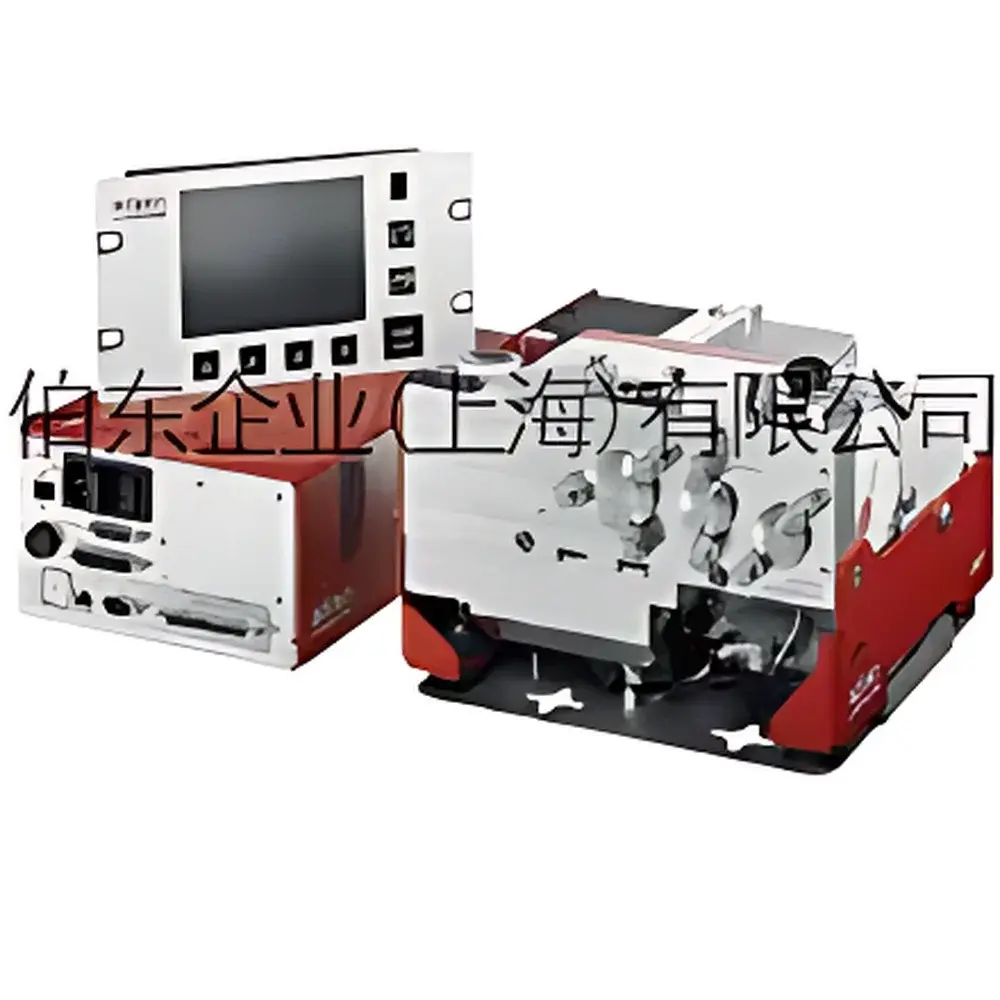
Pfeiffer Vacuum ASI 35 Modular Helium Mass Spectrometer Leak Detector
| Brand | Pfeiffer Vacuum |
|---|---|
| Origin | France |
| Model | ASI 35 |
| Detection Limit (Vacuum Mode, High Sensitivity) | 5×10⁻¹² mbar·L/s |
| Detection Limit (Sniffer Mode) | 1.5×10⁻⁸ mbar·L/s |
| Helium Pumping Speed (High Sensitivity Mode) | 6 L/s |
| Minimum Starting Pressure (High Sensitivity Mode) | 0.2 mbar |
| Analyzer Interface | DN 25 ISO-KF & DN 16 ISO-KF |
| Communication Interfaces | RS-232, Ethernet, PROFIBUS, USB |
| I/O Configuration | 6 digital inputs, 3 analog outputs, 5 relay outputs, 4 transistor/open-collector outputs |
| Dimensions (Vacuum Module) | 279 × 264 × 197 mm |
| Weight (Vacuum Module) | 15 kg |
| Operating Temperature | 10–45 °C |
| Power Supply | 90–240 V AC, 50/60 Hz |
| Max. Power Consumption | 300 W |
Overview
The Pfeiffer Vacuum ASI 35 is a modular helium mass spectrometer leak detector engineered for integration into automated industrial leak testing systems. It operates on the principle of quadrupole mass spectrometry, selectively detecting helium (⁴He and ³He) and hydrogen (H₂) as tracer gases with high specificity and minimal background interference. The instrument employs a split-flow molecular pump configuration—integrated SplitFlow 50 turbomolecular pump—to achieve rapid evacuation and stable high-vacuum conditions essential for quantitative leak rate measurement. Designed for vacuum-mode (negative-pressure) and sniffer-mode (positive-pressure) operation, the ASI 35 delivers trace-level sensitivity across multiple dynamic ranges, supporting compliance-driven validation protocols in regulated manufacturing environments including automotive, battery, HVAC, and electronics assembly.
Key Features
- Multi-gas detection capability for helium (⁴He, ³He) and hydrogen (H₂), enabling flexibility in tracer gas selection based on application safety or regulatory constraints.
- Three operational modes—high-speed gross-leak, standard, and high-sensitivity—each optimized for distinct pressure regimes and detection thresholds, with automatic mode switching supported via programmable logic control.
- Compact, ruggedized mechanical architecture rated for continuous duty in industrial settings; vibration-resistant mounting design and IP-rated internal components ensure long-term reliability under thermal cycling and mechanical stress.
- Modular subsystem layout: independent vacuum module, electronics module, and detachable control panel facilitate field serviceability, system-level customization, and seamless integration into OEM production lines.
- Comprehensive I/O architecture including six configurable digital inputs, three analog outputs (for helium signal amplitude, exponent, mantissa, or suction pressure), five relay outputs, and four transistor/open-collector outputs—enabling full PLC interoperability and real-time process feedback without external interface hardware.
Sample Compatibility & Compliance
The ASI 35 supports both sealed-part vacuum testing and localized sniffer probing, accommodating components ranging from microelectronic packages (100 L). Its calibrated response is traceable to NIST-standard helium flow references and conforms to ISO 20484:2017 (leak detection—terminology and measurement principles) and ASTM E493-21 (standard practice for helium mass spectrometer leak testing). When deployed in GMP-compliant facilities, the device supports audit-ready operation through deterministic start-up sequences (<3 min), stable baseline drift performance (<±0.5% FS/24 h), and optional firmware-enabled 21 CFR Part 11 compliance features—including electronic signature support, user access levels, and immutable audit trails for calibration and test records.
Software & Data Management
The ASI 35 communicates natively via RS-232, Ethernet (TCP/IP), PROFIBUS DP-V1, and USB, allowing direct integration with SCADA, MES, and LabVIEW-based test platforms. Its embedded firmware provides real-time streaming of normalized helium partial pressure signals, logarithmic leak rate values (mbar·L/s), and diagnostic status flags (e.g., pump health, filament emission, vacuum integrity). Optional Pfeiffer Vacuum ControlSuite software enables remote configuration, multi-channel synchronization, statistical process control (SPC) charting, and CSV/Excel export of time-stamped test logs. All data timestamps are synchronized to UTC via NTP when Ethernet-connected, ensuring alignment with enterprise timekeeping infrastructure for batch traceability.
Applications
- Automotive: Hermeticity verification of airbag inflators, EV battery enclosures, fuel tanks, evaporators, and ABS hydraulic modules.
- Energy Storage: Quantitative leak assessment of lithium-ion pouch, prismatic, and cylindrical cells during cell formation and module sealing processes.
- Electronics: Pinhole detection in MEMS sensor cavities, hermetic RF packages, and optoelectronic housings where moisture ingress compromises functionality.
- Industrial Equipment: Validation of heat exchanger plates, refrigerant circuits, medical gas manifolds, and semiconductor process chambers.
- OEM Integration: As a core detection engine in turnkey leak test stations—paired with vacuum chambers, helium injectors, pneumatic actuators, and PLC-controlled sequencing logic.
FAQ
What vacuum interfaces does the ASI 35 support?
It features dual ISO-KF ports: DN 25 for primary vacuum connection and DN 16 for auxiliary pumping or venting paths.
Can the ASI 35 operate without a dedicated control panel?
Yes—the electronics module accepts remote commands via Ethernet or RS-232; the control panel is optional for local HMI use.
Is hydrogen detection certified per ISO 10156?
Hydrogen response is characterized per ISO 10156 Annex B and validated against certified gas mixtures; however, final application-specific certification remains the responsibility of the system integrator.
Does the ASI 35 support automated calibration routines?
It includes built-in zero and span calibration functions using integrated reference leak standards; external calibration with NIST-traceable leaks is recommended annually per ISO/IEC 17025.
What is the maximum allowable ambient temperature during continuous operation?
The specified operating range is 10–45 °C; sustained operation above 40 °C requires forced-air cooling to maintain pump bearing lifetime and mass filter stability.
Related Products






