
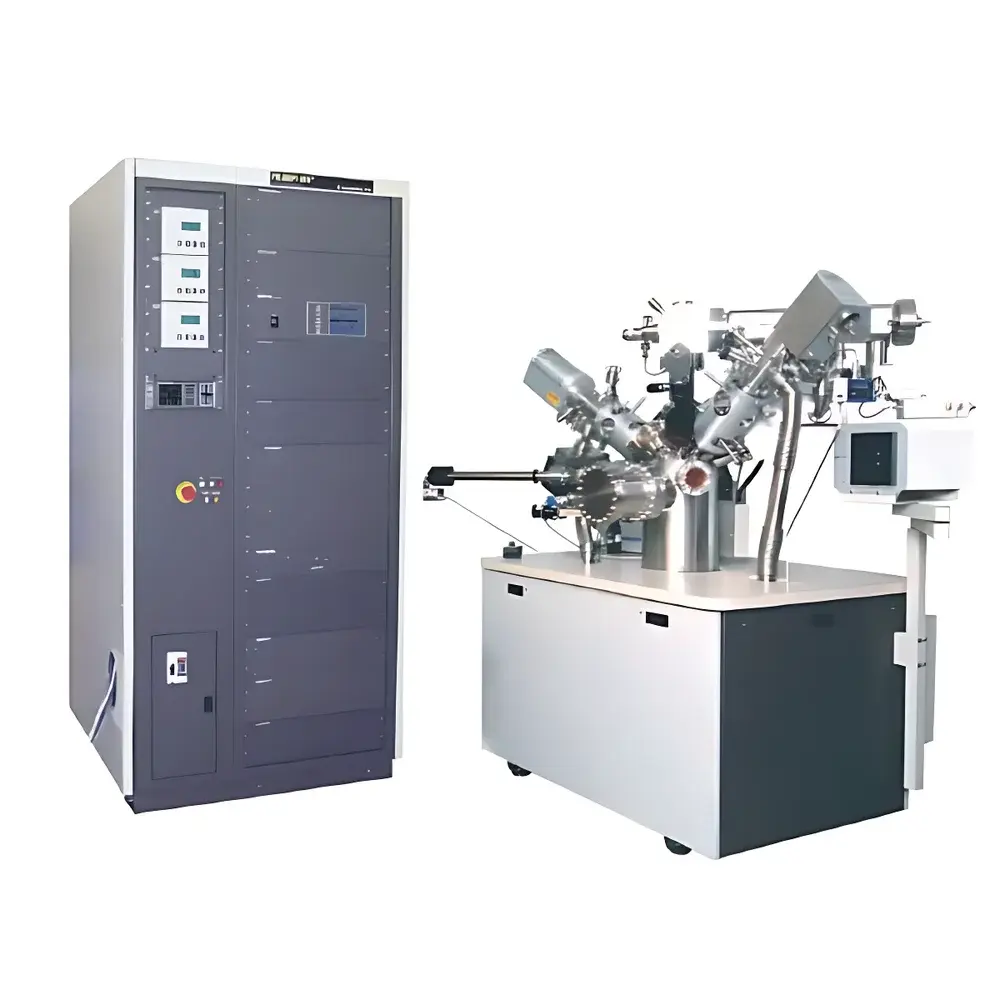
ULVAC-PHI ADEPT-1010 Quadrupole Dynamic Secondary Ion Mass Spectrometer
| Brand | ULVAC-PHI |
|---|---|
| Origin | Japan |
| Model | ADEPT-1010 |
| Instrument Type | Quadrupole SIMS |
| Net Weight | 1,350 kg |
| Shipping Weight | ~2,400 kg |
| Minimum Door Width | >110 cm |
| Minimum Door Height | >200 cm |
| Power Supply | 200–230 V AC, 50/60 Hz, 50 A (single-phase) |
| Grounding | Required |
| Dry Nitrogen Supply | Max. 27 kPa |
| Compressed Air | 0.55–0.70 MPa |
| Oxygen Cylinder | 1,400 PSIG, 99.999% purity |
| Static Magnetic Field | <1 G |
| AC Magnetic Field | <3 mG |
| Operating Temperature | 20°C ± 3°C |
| Relative Humidity | <50% |
| Heat Dissipation (Operational) | 3,300 W |
| Heat Dissipation (Bake-out) | 5,800 W |
Overview
The ULVAC-PHI ADEPT-1010 is a high-performance quadrupole-based dynamic Secondary Ion Mass Spectrometer (SIMS) engineered for quantitative depth profiling of semiconductor structures, thin-film interfaces, and trace-contaminant layers with sub-nanometer depth resolution. Unlike static SIMS systems optimized for surface molecular analysis, the ADEPT-1010 operates in dynamic mode—employing a high-current, focused primary ion beam (typically O+, Cs+, or Ga+) to continuously sputter material from the sample surface while simultaneously extracting, mass-analyzing, and detecting secondary ions generated from successive atomic layers. Its proprietary secondary ion extraction optics significantly enhance ion transmission efficiency, directly improving detection sensitivity—particularly critical for low-dose ion implant characterization and ultra-trace atmospheric contaminant mapping in device-grade silicon wafers.
Key Features
- High-efficiency secondary ion optical system featuring electrostatic lens design optimized for low-energy secondary ion collection and energy filtering—enabling improved signal-to-noise ratio and reduced matrix effects.
- Floating-potential primary ion gun architecture, minimizing charging artifacts on insulating substrates such as SiO2, HfO2, and polymer films—essential for accurate shallow-junction depth profiling in advanced CMOS and memory devices.
- Ultra-high vacuum (UHV) analytical chamber (<1×10⁻⁹ Torr base pressure), maintained by cryogenic and turbomolecular pumping, ensuring minimal background interference and enabling reliable detection of atmospheric contaminants at parts-per-trillion (ppt) levels.
- Automated high-precision XYZ stage with encoder feedback and thermal drift compensation—supporting repeatable positioning across multi-sample racks and enabling long-duration unattended runs.
- Integrated quadrupole mass analyzer with mass range up to m/z 300 and mass resolution (M/ΔM) ≥ 300 (10% valley definition), calibrated using certified reference materials traceable to NIST standards.
Sample Compatibility & Compliance
The ADEPT-1010 accommodates standard 100 mm, 150 mm, and 200 mm semiconductor wafers, as well as discrete solid samples up to 50 mm × 50 mm × 20 mm (L×W×H). It supports conductive, semiconductive, and insulating materials—including oxides, nitrides, III-V compounds, and organic thin films—without requiring conductive coating. The system complies with ISO/IEC 17025 requirements for calibration traceability and is configured to support GLP/GMP-aligned workflows, including audit-trail-enabled user authentication, electronic signature capability (per FDA 21 CFR Part 11), and instrument qualification documentation packages (IQ/OQ/PQ). All vacuum, gas delivery, and power subsystems meet IEC 61000-6-3 (EMC) and IEC 61010-1 (safety) standards.
Software & Data Management
Controlled via SIMetric™ software—a Windows-based platform developed exclusively for ULVAC-PHI SIMS instruments—the ADEPT-1010 delivers intuitive method setup, real-time spectral acquisition, and automated batch processing. SIMetric includes embedded algorithms for quantification using relative sensitivity factors (RSFs), matrix-matched standard calibration, and depth scale correction based on crater depth measurement (via integrated profilometry or external AFM correlation). Raw data are stored in vendor-neutral .csv and HDF5 formats; spectral libraries, calibration curves, and analysis protocols are version-controlled and exportable for cross-platform interoperability with MATLAB, Python (via PySPC), and commercial metrology suites (e.g., KLA Candela, Applied Materials ViewPoint). Audit logs record all operator actions, parameter changes, and instrument status events with timestamped, immutable entries.
Applications
- Quantitative depth profiling of dopant species (B, P, As, Sb) in sub-10 nm gate stacks and FinFET channel regions.
- Interface chemistry analysis at metal/oxide (e.g., TiN/HfO2) and 2D material heterojunctions (e.g., MoS2/h-BN).
- Contamination screening of cleanroom environments—detecting Na, K, Fe, Cu, and Cl impurities on wafer surfaces down to ≤1×10¹² atoms/cm2.
- Insulator depth profiling without charge neutralization artifacts—critical for DRAM capacitor dielectrics and ferroelectric memory layers.
- Process development support for atomic layer deposition (ALD), plasma-enhanced CVD, and ion implantation—validating dose uniformity, penetration depth, and transient diffusion behavior.
FAQ
What primary ion sources are supported on the ADEPT-1010?
The system is equipped with dual-source capability: a high-brightness oxygen ion source (O+) for enhanced positive secondary ion yield and a cesium ion source (Cs+) for improved negative ion sensitivity—both configurable for rastered or focused beam operation.
Is the ADEPT-1010 compatible with in-situ sample transfer from load-lock chambers?
Yes—optional UHV-compatible load-lock integration enables contamination-free sample exchange while maintaining base pressure integrity, supporting high-throughput production metrology environments.
How is depth resolution calibrated and verified?
Depth resolution is validated using certified multilayer reference standards (e.g., Si/SiO2/Si trilayers, TaN/TiN bilayers) and correlated with ex-situ cross-sectional TEM measurements. Routine verification employs SRM 2137 (NIST) for sputter rate consistency.
Can the ADEPT-1010 perform isotopic ratio analysis?
While optimized for elemental depth profiling rather than high-precision isotopic metrology, the quadrupole mass analyzer supports isotopic separation at unit mass resolution (e.g., 28Si/29Si, 16O/18O) with reproducibility better than ±2% RSD over 8-hour sessions under stabilized vacuum and temperature conditions.
What service and support options are available globally?
ULVAC-PHI provides factory-certified installation, preventive maintenance contracts, remote diagnostics, application engineering support, and annual performance verification services aligned with ISO/IEC 17025 technical requirements—available through authorized regional service centers in North America, Europe, and Asia-Pacific.





