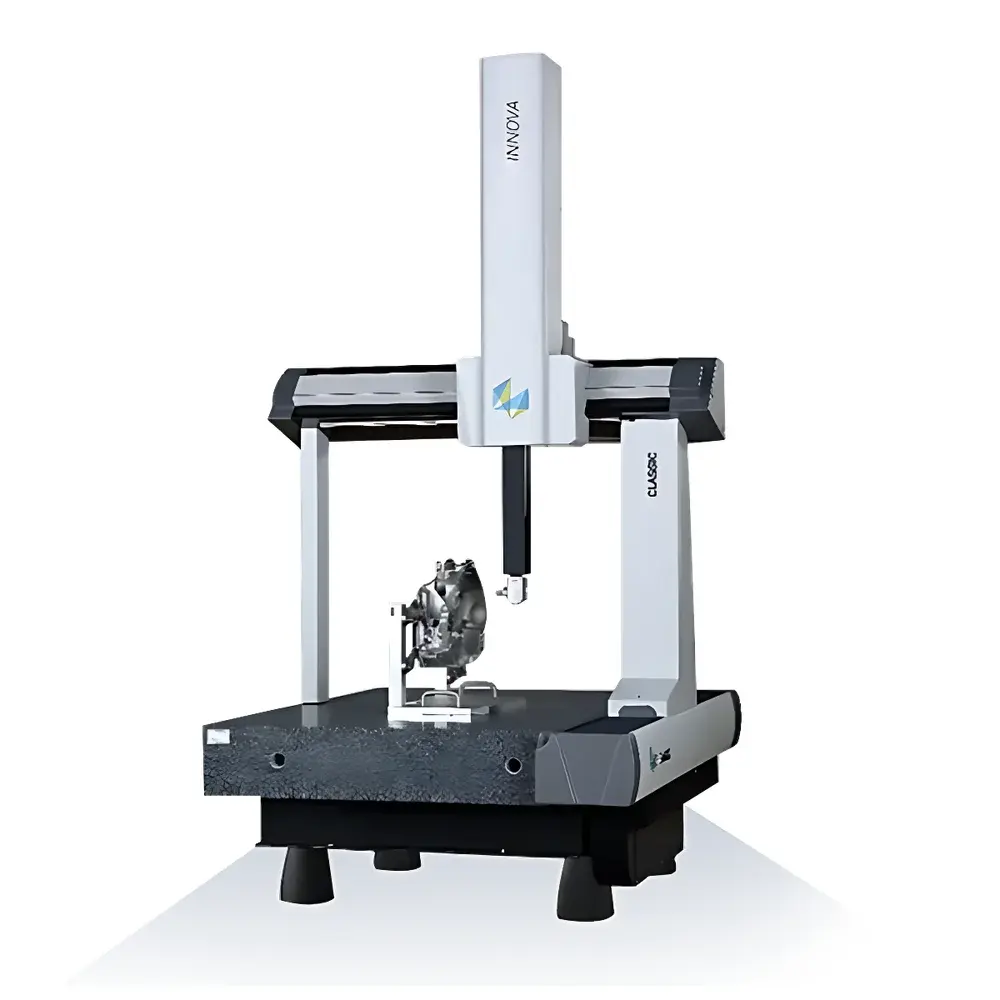
Hexagon INNOVA Educational Coordinate Measuring Machine (CMM)
| Brand | Hexagon |
|---|---|
| Origin | Shandong, China |
| Manufacturer Type | Authorized Distributor |
| Origin Category | Domestic |
| Model | INNOVA |
| Price Range | USD 56,000 – 140,000 (FOB) |
| Configuration | Bridge-Type |
| Operation Mode | Automatic |
| Orientation | Vertical |
| Measurement Principle | Non-Contact Optical Metrology (with optional tactile probing) |
| Measurement Volume | 600 × 800 × 600 mm to 1000 × 2100 × 800 mm |
| Standard Operating Temperature | −20 °C to +40 °C |
| Compliance | ISO 10360-2, ISO 15530-3, VDI/VDE 2617 Part 2 |
| Target Sectors | Mechanical Engineering, Automotive, Aerospace, Electronics, Mold & Die, Academic Research & Vocational Training |
Overview
The Hexagon INNOVA Educational Coordinate Measuring Machine is a purpose-engineered metrology platform designed explicitly for academic institutions, technical colleges, and vocational training centers. Built upon Hexagon’s decades of industrial CMM heritage, the INNOVA series integrates core geometric measurement principles—primarily based on high-precision optical triangulation and optionally augmented with kinematic tactile probing—into an accessible, pedagogically optimized architecture. Unlike production-floor CMMs prioritized for throughput or extreme sub-micron repeatability, the INNOVA balances metrological integrity with instructional transparency: its open mechanical layout, modular software interface, and dual-tier hardware configuration (INNOVA Classic and INNOVA Performance) allow students to observe, interrogate, and validate fundamental concepts in dimensional metrology—including traceability, uncertainty budgeting, probe calibration, and GD&T interpretation—within real-world engineering contexts.
Key Features
- Modular educational platform with two defined configurations: INNOVA Classic for foundational tactile probing and single-point coordinate acquisition; INNOVA Performance for advanced training in continuous scanning, surface deviation analysis, and freeform geometry evaluation.
- Bridge-type structural design featuring a rigid triangular beam construction—optimized for thermal stability and minimal deflection under dynamic loading conditions typical in classroom environments.
- High-accuracy linear motion system incorporating precision-ground dovetail guideways with closed-loop kinematic constraints, ensuring consistent orthogonality and long-term geometric fidelity across all axes.
- HEIDENHAIN linear encoders mounted with one-end fixed / one-end elastically suspended configuration—engineered to accommodate thermal expansion while preserving scale linearity per ISO 230-2 Annex B recommendations.
- Pneumatic counterbalance system integrated into the Z-axis carriage—reducing gravitational sag and improving vertical axis repeatability without introducing servo-induced thermal drift.
- Remote-mounted servo motors—physically isolated from the granite base and moving bridge structure—to minimize conductive and convective heat transfer, thereby maintaining thermal equilibrium during extended lab sessions.
Sample Compatibility & Compliance
The INNOVA supports a broad spectrum of educational and light-industrial workpieces: machined metallic components (aluminum, steel, brass), polymer prototypes, castings, and assembled subassemblies up to 2,100 mm in length. Its non-contact optical sensor option enables safe, high-speed acquisition of reflective or delicate surfaces—complementing tactile probing for hybrid metrology workflows. All INNOVA systems are supplied with full ISO 10360-2 (length measurement error) and ISO 15530-3 (calibration using calibrated artifacts) test reports. The system architecture adheres to VDI/VDE 2617 Part 2 for volumetric performance verification and supports GLP-compliant data logging when paired with Hexagon’s PC-DMIS Education Edition. While not certified for FDA 21 CFR Part 11 out-of-the-box, audit trails, electronic signatures, and user access control can be enabled via licensed software modules aligned with GMP-aligned academic quality assurance frameworks.
Software & Data Management
INNOVA systems ship standard with PC-DMIS Education Edition—a version of Hexagon’s industry-standard metrology software stripped of proprietary automation scripting but retaining full GD&T evaluation (ASME Y14.5 / ISO 1101), report generation, and CAD-based alignment tools. Students interact directly with measurement routines, datum establishment logic, and tolerance stack-up visualization—building procedural fluency before transitioning to production-grade deployments. All measurement data is stored in native .dmi format with embedded metadata (operator ID, timestamp, environmental log, probe qualification history). Export options include STEP AP214, IGES, CSV, and PDF reports compliant with institutional archiving policies. Software updates and curriculum-aligned tutorial packages are delivered through Hexagon’s Academic Support Portal, requiring annual institutional license renewal.
Applications
- Undergraduate and graduate laboratories in mechanical engineering, manufacturing science, and industrial metrology curricula.
- National and regional skills competitions—including WorldSkills China and National Vocational College Skills Challenges—where standardized geometric verification protocols are mandated.
- Industry-academia collaboration projects involving first-article inspection, process capability studies (Cp/Cpk), and reverse engineering of legacy parts.
- Vocational certification programs aligned with ISO/IEC 17025 competency requirements for metrology technicians.
- Research in metrology education methodology, including human-factor studies on CMM interface design and cognitive load during GD&T interpretation.
FAQ
Is the INNOVA CMM suitable for research-grade dimensional metrology beyond teaching?
Yes—while optimized for pedagogy, its bridge architecture, HEIDENHAIN encoders, and granite base meet ISO 10360-2 MPE requirements for medium-accuracy industrial applications. It is routinely deployed for supplier qualification, tooling verification, and R&D prototyping in SMEs.
Can third-party probes or sensors be integrated?
Only Hexagon-certified tactile probes (e.g., TP20, TP7) and optical sensors (e.g., HP-S-X1, T-Scan) are supported. Non-Hexagon peripherals void warranty and invalidate ISO compliance documentation.
What environmental infrastructure is required in a university lab?
A stable concrete floor with vibration isolation (≥ 10 Hz natural frequency), ambient temperature control within ±2 °C over 24 h, and humidity between 40–60 % RH are recommended. Climate-controlled labs are not mandatory but improve long-term calibration retention.
Does the system support automated part programming?
PC-DMIS Education Edition permits manual feature-based programming and CAD-guided alignment—but excludes offline robot simulation or batch-run automation features found in commercial licenses.
How is metrological traceability established for student projects?
Each INNOVA includes a NIST-traceable calibration certificate for the machine’s volumetric performance, plus a separate certificate for the included calibration sphere (certified per ISO 5725). Institutions may extend traceability via local metrology labs accredited to ISO/IEC 17025.