
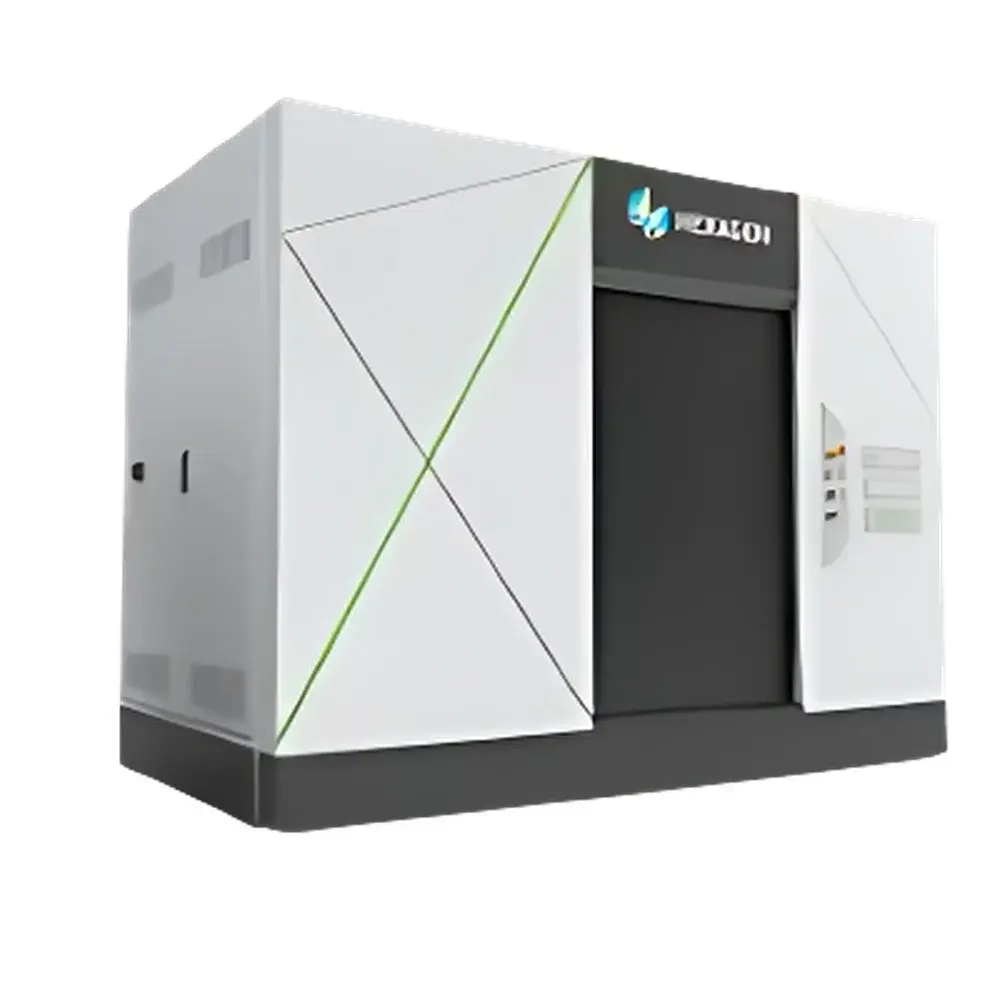
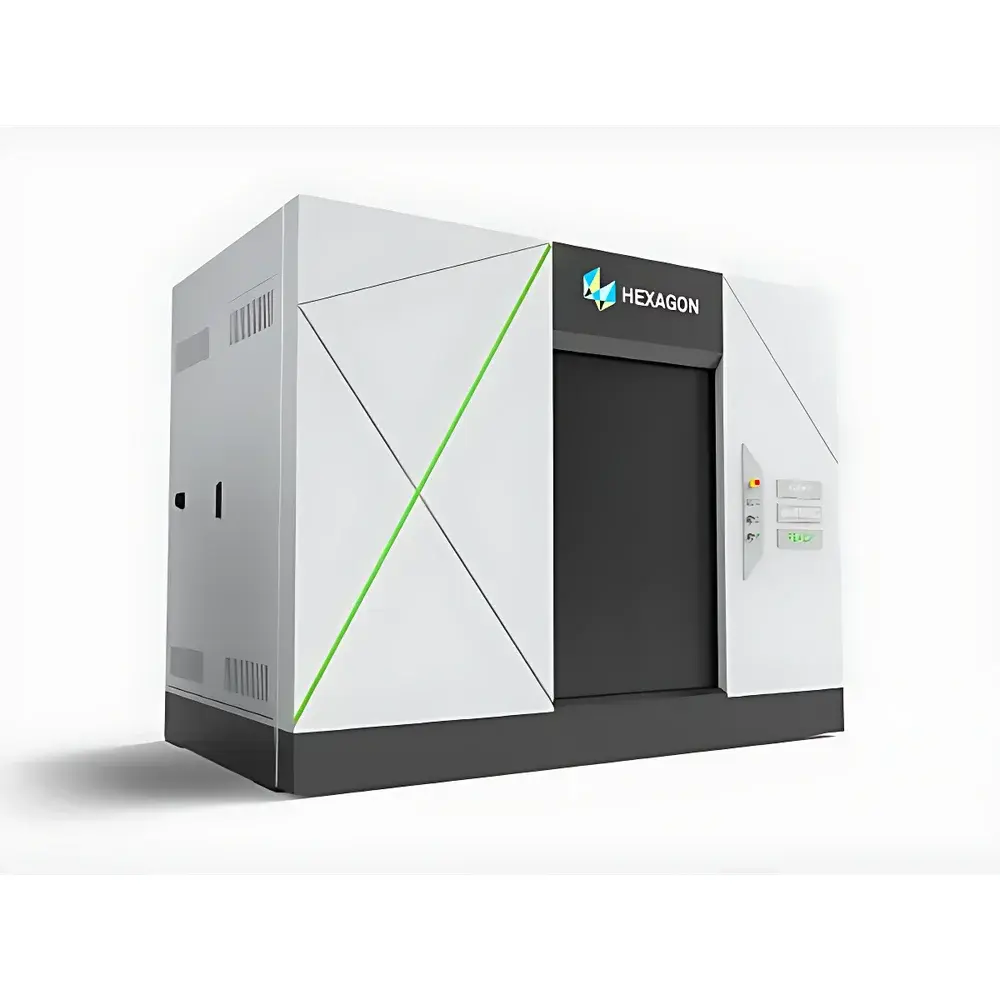
Hexagon Metrology Super Volume 225 Industrial Micro-CT System
| Brand | Hexagon |
|---|---|
| Origin | Shandong, China |
| Manufacturer Type | Authorized Distributor |
| Origin Category | Domestic (China) |
| Model | Super Volume 225 |
| Detector Type | High-Resolution CMOS Semiconductor Detector |
| Scanning Mode | Translation-Rotation (TR) |
| Spatial Resolution | 4 µm |
| Density Resolution | ≤0.1 µm (minimum detectable density variation) |
| X-ray Source | 225 kV Microfocus Tube |
| Penetration Capability | High (suitable for dense metals and composites) |
| Measurement Volume | 427 mm × 427 mm (max. field of view) |
| Dimensional Measurement Accuracy | (4.5 + L/50) µm (L in mm) |
| Density Measurement Accuracy | (4.5 + L/50) µm (L in mm) |
| Maximum Sample Weight | 10,500 kg |
| System Dimensions | 3520 mm × 2050 mm × 2700 mm |
| Radiation Shielding | Integrated self-shielding cabinet compliant with GBZ 117–2020 (Chinese national radiation safety standard) |
Overview
The Hexagon Metrology Super Volume 225 is a metrology-grade industrial micro-computed tomography (micro-CT) system engineered for non-destructive, volumetric dimensional metrology and internal defect analysis of medium-to-large industrial components. Operating on the principle of cone-beam X-ray computed tomography, it reconstructs high-fidelity 3D volumetric datasets from hundreds to thousands of projection images acquired via controlled translation-rotation (TR) motion. Unlike conventional surface-based metrology tools—such as coordinate measuring machines (CMMs), optical scanners, or vision systems—the Super Volume 225 penetrates opaque materials to quantify internal geometry, material discontinuities, and structural integrity without physical sectioning or sample destruction. Its 225 kV microfocus X-ray source delivers stable, high-brightness radiation with focal spot sizes <5 µm, enabling sub-micrometer contrast sensitivity and consistent signal-to-noise performance across heterogeneous samples—including aluminum die-castings, titanium aerospace brackets, carbon-fiber-reinforced polymers (CFRPs), and silicon-based electronic packages.
Key Features
- Metrology-Grade Mechanical Architecture: Monolithic granite base and column provide exceptional thermal stability, vibration damping, and long-term geometric integrity—critical for traceable CT metrology under ISO 15530-3 and VDI/VDE 2630 Part 1.3 compliance frameworks.
- High-Precision Motion Control: All axes equipped with Heidenhain high-resolution linear encoders (0.1 µm resolution), preloaded recirculating ball screws, and independent closed-loop servo drives synchronized via Hexagon’s proprietary real-time motion controller—identical in architecture to those used in high-end tactile CMMs.
- Adaptive Focal Spot-Detector Distance (FDD): Adjustable FDD range from 800 mm to 1500 mm enables optimization of magnification, geometric unsharpness, and exposure time per scan—essential for balancing resolution, throughput, and dose efficiency across diverse part geometries and densities.
- Multi-Modal Scanning Flexibility: Supports DR (digital radiography), fast circular, high-resolution circular, helical, limited-angle, tile-stitched, and extended-field-of-view acquisition protocols—enabling tailored workflows for both metrology validation and failure analysis applications.
- Radiation-Safe Enclosure: Fully integrated self-shielding cabinet meets GBZ 117–2020 requirements for occupational and public radiation safety, eliminating need for external bunker construction and reducing facility integration complexity.
Sample Compatibility & Compliance
The Super Volume 225 accommodates samples up to 10,500 kg and 427 mm × 427 mm cross-sectional area, supporting inspection of complex assemblies such as EV battery modules, turbine blades, additive-manufactured heat exchangers, and multi-material electronic enclosures. Its high-energy 225 kV source ensures reliable penetration through steel, Inconel, tungsten alloys, and thick-walled composites. The system supports full traceability per ISO/IEC 17025:2017 for accredited laboratories and includes built-in uncertainty estimation per VDI/VDE 2630 Part 1.3 Annex B. Calibration artifacts—including certified step gauges, sphere plates, and pore phantoms—are compatible with automated CT calibration routines. All measurement reports include metadata required for GLP/GMP documentation and FDA 21 CFR Part 11–compliant audit trails when integrated with Volume Graphics VGStudio MAX and Hexagon’s Xplore Insight acquisition suite.
Software & Data Management
Data acquisition is managed by Hexagon’s Xplore Insight—a deterministic, scriptable control platform supporting programmable scan parameter sets, hardware synchronization, and real-time projection monitoring. Reconstruction is performed using Xplore Recon, which implements iterative algorithms (SART, OS-SART) and GPU-accelerated filtered back-projection for artifact-suppressed, isotropic voxel volumes. Post-processing and metrology are executed within Volume Graphics VGStudio MAX (v4.0+), providing validated tools for GD&T evaluation (ISO 1101), porosity quantification (ASTM E1559, ISO 16232), wall thickness analysis, fiber orientation mapping, and reverse engineering with NURBS surface fitting. All software modules maintain full data lineage, version-controlled processing pipelines, and export to ASME Y14.5-compliant report formats including PDF, STEP AP242, and XML-based metrology exchange schemas.
Applications
- Dimensional verification of internal cooling channels, lattice structures, and conformal features in additively manufactured parts.
- Quantitative porosity and inclusion analysis in high-pressure die-cast automotive components per ISO 10042 and SAE J2159.
- Non-destructive validation of solder joint integrity, wire bond alignment, and delamination in power electronics and semiconductor packaging.
- Structural integrity assessment of composite layup fidelity, fiber misalignment, and interfacial debonding in aerospace primary structures.
- Failure root cause analysis—including crack propagation path mapping, fatigue initiation site localization, and residual stress-induced distortion modeling via digital volume correlation (DVC) workflows.
- As-built vs. as-designed comparison for simulation-driven design validation (e.g., thermal, fluid, or structural FEA model correction).
FAQ
Does the Super Volume 225 comply with international metrology standards for CT-based measurement?
Yes. It adheres to VDI/VDE 2630 Part 1.3 (2022) for CT metrology, supports uncertainty budgeting per ISO/IEC 17025:2017, and enables traceable measurements using certified reference standards.
Can it perform wall thickness analysis on complex castings with internal cores?
Yes. VGStudio MAX provides automated wall thickness mapping with customizable tolerance zones, minimum thickness reporting, and color-coded deviation overlays aligned to CAD models.
Is the system suitable for regulatory submissions in medical device or aerospace manufacturing?
Yes—when operated under documented SOPs and validated workflows, output data meets requirements for AS9100 Rev D, ISO 13485, and FDA QSR (21 CFR Part 820) for critical dimension verification.
What is the typical reconstruction time for a 2000-slice dataset at 4 µm voxel size?
Using dual NVIDIA A100 GPUs and Xplore Recon’s optimized reconstruction kernel, full-volume reconstruction averages 8–12 minutes depending on algorithm selection and regularization parameters.
How is system calibration maintained over time and environmental fluctuations?
The granite frame minimizes thermal drift; periodic verification uses traceable CT calibration phantoms with automated alignment and drift compensation routines embedded in Xplore Insight.



