
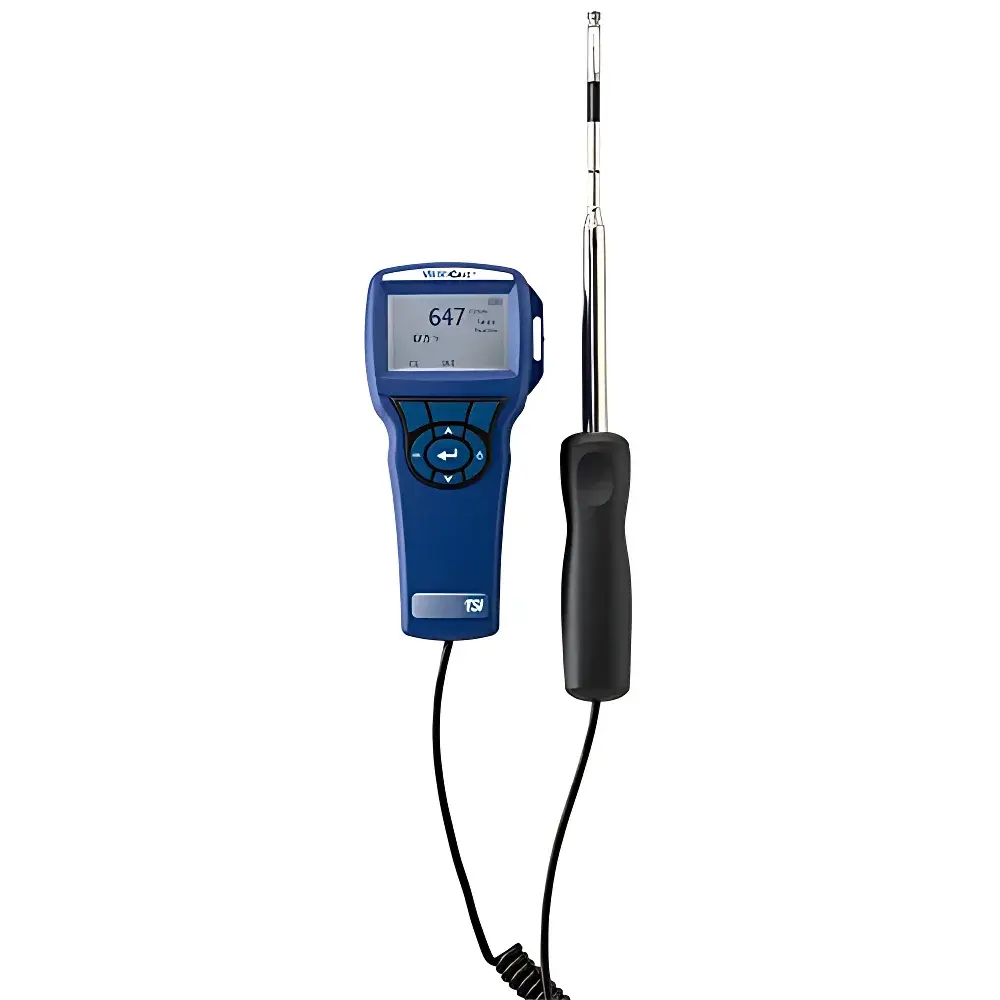
TSI Model 9535 Anemometer and Air Flow Meter
| Origin | USA |
|---|---|
| Manufacturer Type | Authorized Distributor |
| Origin Category | Imported |
| Model | 9535 |
| Pricing | Upon Request |
Overview
The TSI Model 9535 Anemometer and Air Flow Meter is a handheld, multi-parameter environmental measurement instrument engineered for precision, portability, and field-deployable reliability in HVAC commissioning, indoor air quality (IAQ) assessment, ventilation system balancing, and industrial hygiene applications. Based on hot-wire anemometry principles, the device measures airflow velocity via constant-temperature anemometer (CTA) sensor technology—ensuring high sensitivity and fast response time across turbulent and laminar flow regimes. Unlike single-function meters, the 9535 integrates real-time wind speed, temperature, and volumetric air flow computation into a unified platform, eliminating the need for manual conversions or secondary calculations. Its design adheres to fundamental metrological requirements for air movement instrumentation as referenced in ASHRAE Guideline 12–2020 and ISO 7726:2009 (Ergonomics of the thermal environment — Instruments for measuring physical quantities). The instrument operates within defined environmental limits to maintain traceable accuracy under typical laboratory, ductwork, and occupied-space conditions.
Key Features
- Simultaneous measurement of air velocity (0–30 m/s), temperature (–17.8 to 93.3 °C), and calculated volumetric flow rate
- Hot-wire CTA sensor with 1 ft/min (0.01 m/s) resolution and ±3% of reading or ±0.015 m/s accuracy (whichever is greater)
- Configurable duct dimension input (1–635 cm in 0.1 cm increments) enabling automatic volume flow derivation per ISO 12354-3 and ASTM D1212
- Real-time display of up to three parameters concurrently—velocity, temperature, and flow—on a backlit LCD interface
- Expandable probe architecture: telescoping straight probe (101.6 cm extended length) with 7.0 mm tip diameter for duct traverses and grille measurements
- Internal data logging capacity of 12,700 records across 100 user-defined groups, with programmable sampling intervals from 1 second to 1 hour
- Time-constant adjustment for dynamic response optimization in varying turbulence intensities
- Powered by four AA alkaline batteries (typical life >20 hours) or optional AC adapter; operational temperature range: 5–45 °C (host), –18–93 °C (sensor)
Sample Compatibility & Compliance
The Model 9535 is validated for use with standard rectangular, round, and oval duct geometries commonly encountered in commercial and institutional HVAC systems. It supports both actual and standard-cubic-foot-per-minute (SCFM) flow reporting, applying standardized correction factors per ANSI/ASHRAE Standard 111–2013. While not certified for hazardous locations (e.g., Class I Div 1), its construction meets IP42 ingress protection specifications for dust and drip resistance during routine field use. Calibration traceability is maintained to NIST-traceable standards through TSI’s accredited service program, supporting compliance with ISO/IEC 17025–2017 requirements for testing laboratories. The device satisfies documentation needs for GLP and GMP-aligned facility qualification protocols when used in conjunction with controlled calibration logs and audit trails generated via LogDat2™ software.
Software & Data Management
LogDat2™ desktop software (included) provides secure, structured data export in CSV, XLSX, and PDF formats. It enables full metadata tagging—including date/time stamps, operator ID, location notes, and probe configuration settings—for regulatory documentation workflows. The software supports 21 CFR Part 11–compliant user authentication, electronic signatures, and audit trail generation when deployed on validated Windows environments. Raw velocity and temperature time-series data can be post-processed to generate traverse maps, flow uniformity indices (per ASHRAE Fundamentals Chapter 42), and statistical summaries (mean, min/max, standard deviation). Exported datasets are compatible with third-party analysis platforms such as MATLAB, Python (pandas), and LabVIEW for advanced QA/QC modeling.
Applications
- HVAC system commissioning and TAB (Testing, Adjusting, Balancing) per NEBB Procedural Standards
- Occupied-space air change rate verification in healthcare facilities (per FGI Guidelines and CDC/NIOSH recommendations)
- Industrial exhaust hood face velocity validation per OSHA 1910.145 and ANSI Z9.5
- Filter bank leakage screening using comparative traverse methods
- Classroom and office IAQ surveys aligned with EPA Building Assessment Survey and Evaluation (BASE) protocols
- Validation of fume hood containment performance during certification cycles
FAQ
What is the difference between the Model 9535 and Model 9545?
The 9545 adds relative humidity (0–95% RH), dew point, and wet-bulb temperature measurement capabilities using a capacitive polymer sensor. All other core airflow and temperature specifications remain identical.
Can the Model 9535 measure airflow in round ducts smaller than 1 inch in diameter?
No—the minimum supported duct dimension is 1 inch (2.54 cm) due to sensor spatial averaging constraints and boundary layer interference effects at sub-inch scales.
Is the probe calibration traceable to NIST?
Yes—TSI provides factory calibration certificates with NIST-traceable uncertainty statements. Field recalibration services are available through TSI-accredited service centers.
Does the instrument support wireless data transmission?
No—the Model 9535 relies on USB connection via LogDat2™ for data retrieval. Wireless capability is introduced in the newer VelociCalc® Plus series (e.g., Model 9555).
How is volumetric flow calculated internally?
Flow (CFM or m³/h) is derived from the product of average velocity (ft/min or m/s), cross-sectional area (in² or m²), and applicable correction factors (e.g., standard vs. actual conditions, compressibility, and duct roughness assumptions).







