
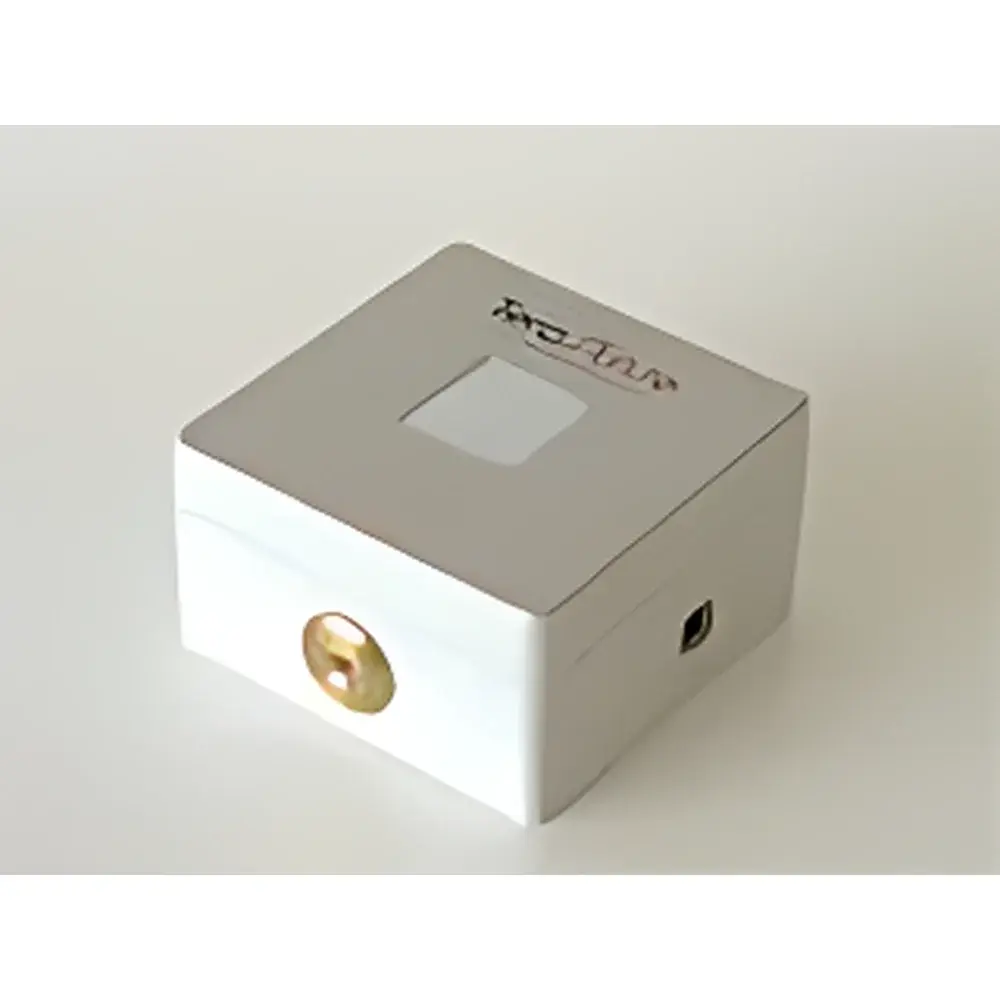
TeraSense Tera-256 / Tera-1024 / Tera-4096 Terahertz Imaging Camera
| Brand | TeraSense |
|---|---|
| Origin | USA |
| Model | Tera-256 / Tera-1024 / Tera-4096 |
| Frequency Range | 0.05–0.7 THz |
| Pixel Count | 256 (16×16) / 1024 (32×32) / 4096 (64×64) |
| Pixel Size | 1.5 × 1.5 mm |
| Responsivity | 50 kV/W |
| Noise Equivalent Power | 1 nW/Hz (Tera-256), 0.5 nW/Hz (Tera-1024 & Tera-4096) |
| Dimensions | 10×10×5.5 cm (Tera-256/Tera-1024), 20×20×10 cm (Tera-4096) |
| Power Supply | 5 V USB |
| Software | TeraSense Viewer |
Overview
The TeraSense Tera-256, Tera-1024, and Tera-4096 are uncooled, real-time terahertz (THz) imaging cameras engineered for scientific and industrial applications requiring non-ionizing, non-contact inspection in the 0.05–0.7 THz spectral band. These cameras operate on the principle of pyroelectric detection—leveraging microstructured silicon-based sensors with integrated broadband THz antennas—to convert incident THz radiation into measurable voltage signals without cryogenic cooling. Unlike time-domain spectroscopy (TDS) systems, these cameras deliver frame-rate imaging (up to 25 Hz native acquisition), enabling dynamic visualization of THz beam profiles, material transmission/reflection contrast, and spatially resolved absorption features. Their compact form factor, USB-powered architecture, and compatibility with standard optical THz setups make them suitable for integration into laboratory-grade THz characterization platforms, quality assurance workflows, and field-deployable screening systems.
Key Features
- Real-time imaging at up to 25 frames per second, supporting live beam profiling and transient event capture
- Three resolution variants: 16×16 (256 px), 32×32 (1024 px), and 64×64 (4096 px) pixel arrays—all with uniform 1.5 × 1.5 mm pixel pitch
- High responsivity of 50 kV/W across all models, ensuring robust signal-to-noise performance under low-intensity THz illumination
- Low noise equivalent power (NEP): 1 nW/Hz for Tera-256; improved to 0.5 nW/Hz for Tera-1024 and Tera-4096—enabling high-fidelity detection of weak THz signals
- USB 3.0 interface with 5 V bus power—no external power supply or cooling required
- Compact mechanical design: 10×10×5.5 cm for Tera-256 and Tera-1024; scaled to 20×20×10 cm for the 4096-pixel variant to accommodate larger sensor housing and thermal management
- Optimized for continuous-wave (CW) THz sources, including photoconductive antennas, quantum cascade lasers (QCLs), and backward-wave oscillators (BWOs)
Sample Compatibility & Compliance
The TeraSense THz cameras are compatible with a broad range of non-metallic and semi-transparent samples—including polymers, ceramics, pharmaceutical tablets, composite laminates, paper, textiles, and biological tissues—where THz radiation exhibits sufficient penetration depth and contrast. They support reflection-mode and transmission-mode configurations when paired with appropriate optical mounts and delay stages. While not certified as medical devices under FDA 510(k) or CE IVD directives, the systems comply with IEC 61326-1 for electromagnetic compatibility (EMC) and IEC 61010-1 for electrical safety in laboratory equipment. Data acquisition workflows can be configured to meet GLP-aligned documentation requirements, including timestamped metadata logging and raw frame export in TIFF or HDF5 formats for traceability in regulated environments.
Software & Data Management
The bundled TeraSense Viewer software provides cross-platform (Windows/macOS/Linux) control and visualization capabilities. It supports real-time image streaming, region-of-interest (ROI) analysis, line-profile extraction, false-color mapping, and frame averaging. Export options include 16-bit grayscale TIFF sequences, CSV intensity matrices, and metadata-rich HDF5 files compliant with the NeXus data format standard—facilitating interoperability with Python (NumPy, SciPy, h5py), MATLAB, and ImageJ/Fiji pipelines. The API (C/C++ and Python SDK included) enables custom automation for integration into automated inspection lines or synchronized multi-sensor experiments. Audit trails—recording acquisition parameters, timestamps, and user actions—are configurable to align with internal QA protocols, though native 21 CFR Part 11 electronic signature functionality is not embedded.
Applications
- THz Beam Profiling: Quantitative characterization of CW THz source spatial mode structure, divergence, and focal spot size—critical for optimizing coupling efficiency into waveguides or free-space optics
- Non-Destructive Testing (NDT): Detection of delaminations, voids, fiber misalignment, and moisture ingress in aerospace composites and battery separator films
- Pharmaceutical Quality Control: Thickness mapping and coating uniformity assessment of tablet film coatings; identification of crystalline phase heterogeneity via spectral absorption contrast
- Security Screening: Concealed object detection under clothing or packaging materials using differential THz absorption signatures
- Material Science Research: In situ monitoring of hydration dynamics in hydrogels, polymer curing kinetics, and carrier transport in 2D materials
- Oil & Lubricant Analysis: Detection of oxidation byproducts and particulate contamination through THz dielectric dispersion shifts
FAQ
What THz sources are compatible with these cameras?
These cameras are optimized for CW THz emitters operating between 0.05–0.7 THz, including photoconductive antennas pumped by femtosecond lasers, solid-state BWOs, and room-temperature QCLs. Pulsed THz-TDS systems require gated detection and are not supported.
Is external cooling required?
No—these are uncooled pyroelectric detectors. Thermal stabilization is achieved passively via aluminum housing and internal heat sinking; no Peltier or liquid nitrogen cooling is needed.
Can the cameras be used in vacuum or controlled-atmosphere chambers?
Yes, provided optical access is maintained via THz-transparent windows (e.g., high-resistivity silicon or polyethylene). The USB interface and compact housing allow straightforward integration into environmental enclosures.
How is calibration performed?
Factory calibration includes relative pixel response uniformity correction and NEP verification against NIST-traceable blackbody sources. End-users may perform optional flat-field correction using a uniform THz source.
What is the maximum working distance for imaging?
Effective working distance depends on source power and optics. With f/2 off-axis parabolic mirrors and a 1 mW CW source, usable imaging distances range from 10 cm to 1.5 m; diffraction-limited resolution degrades beyond ~50 cm without reimaging optics.




