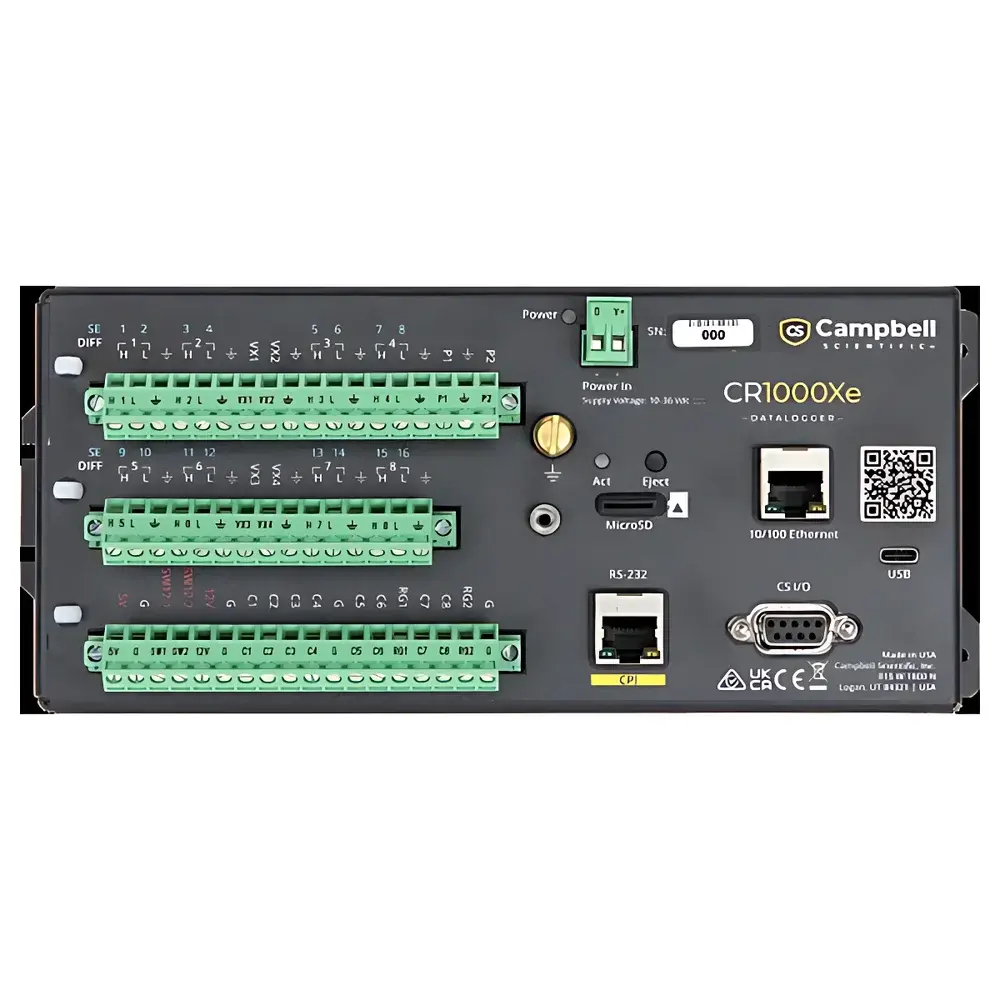
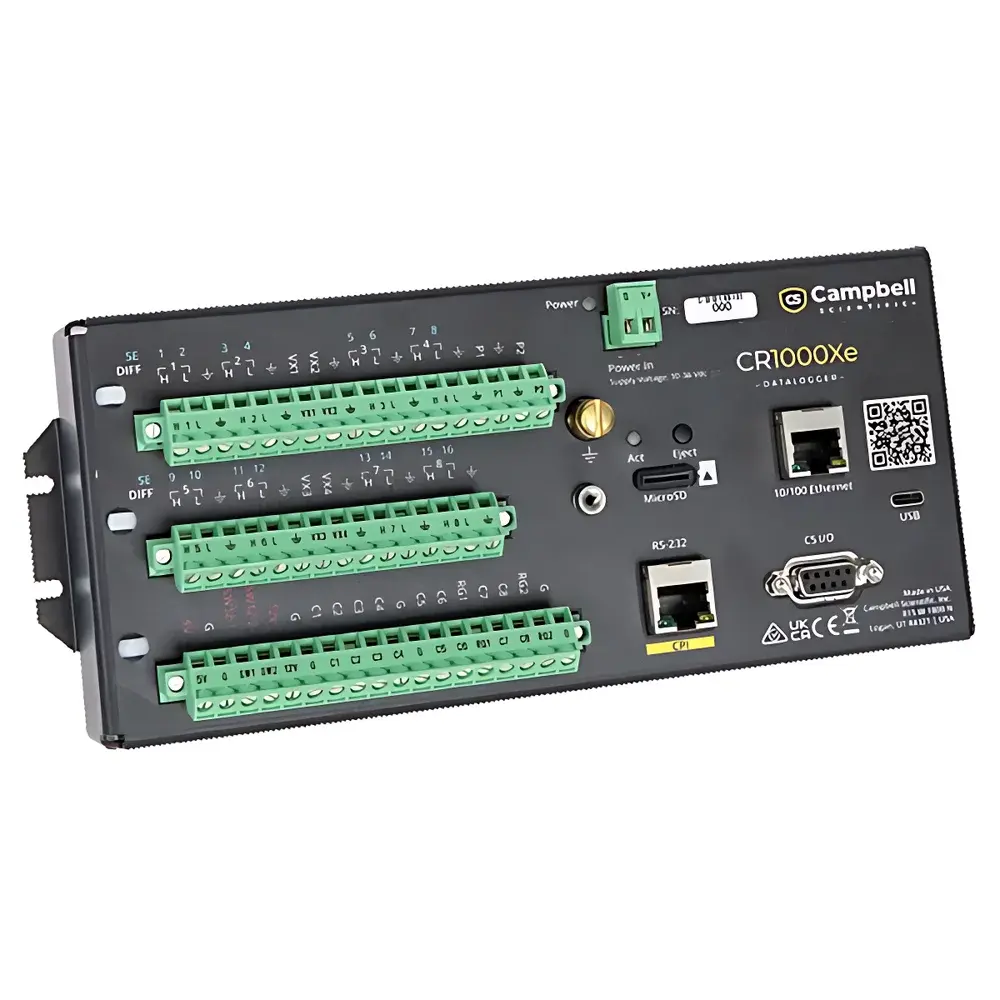
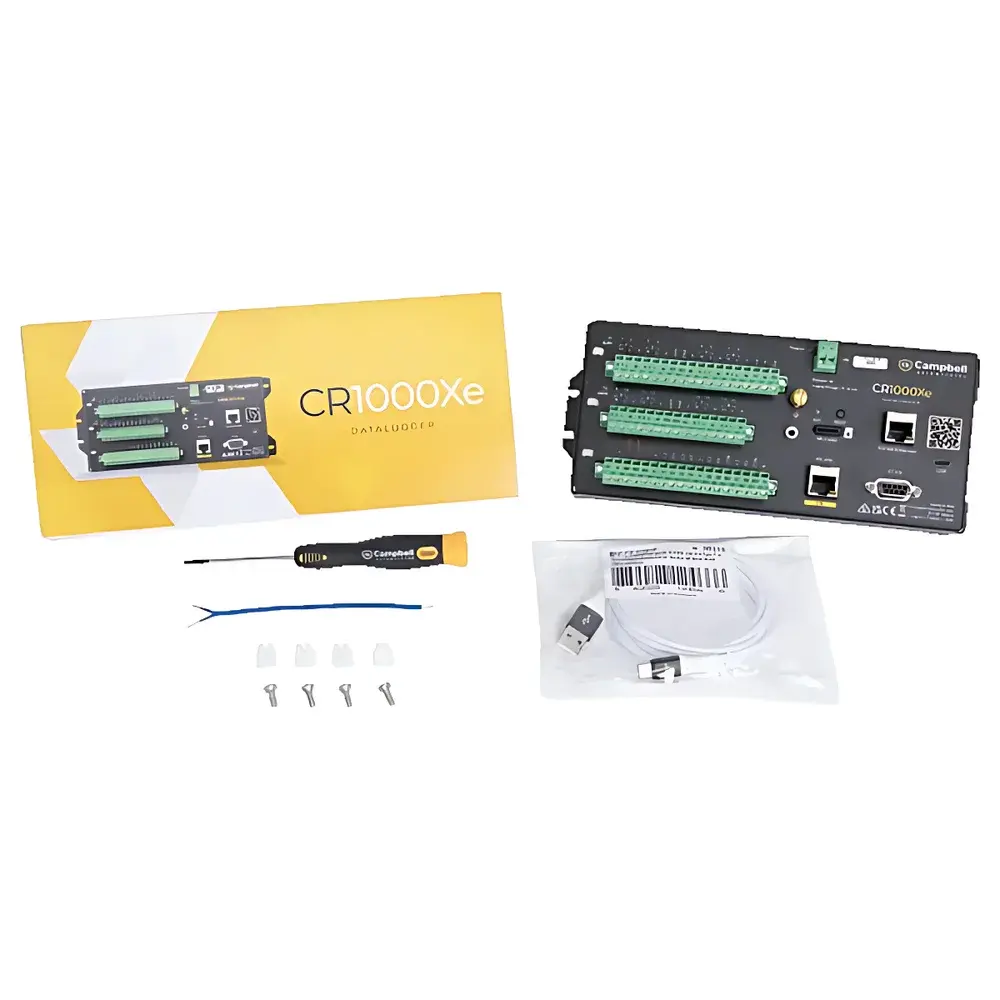
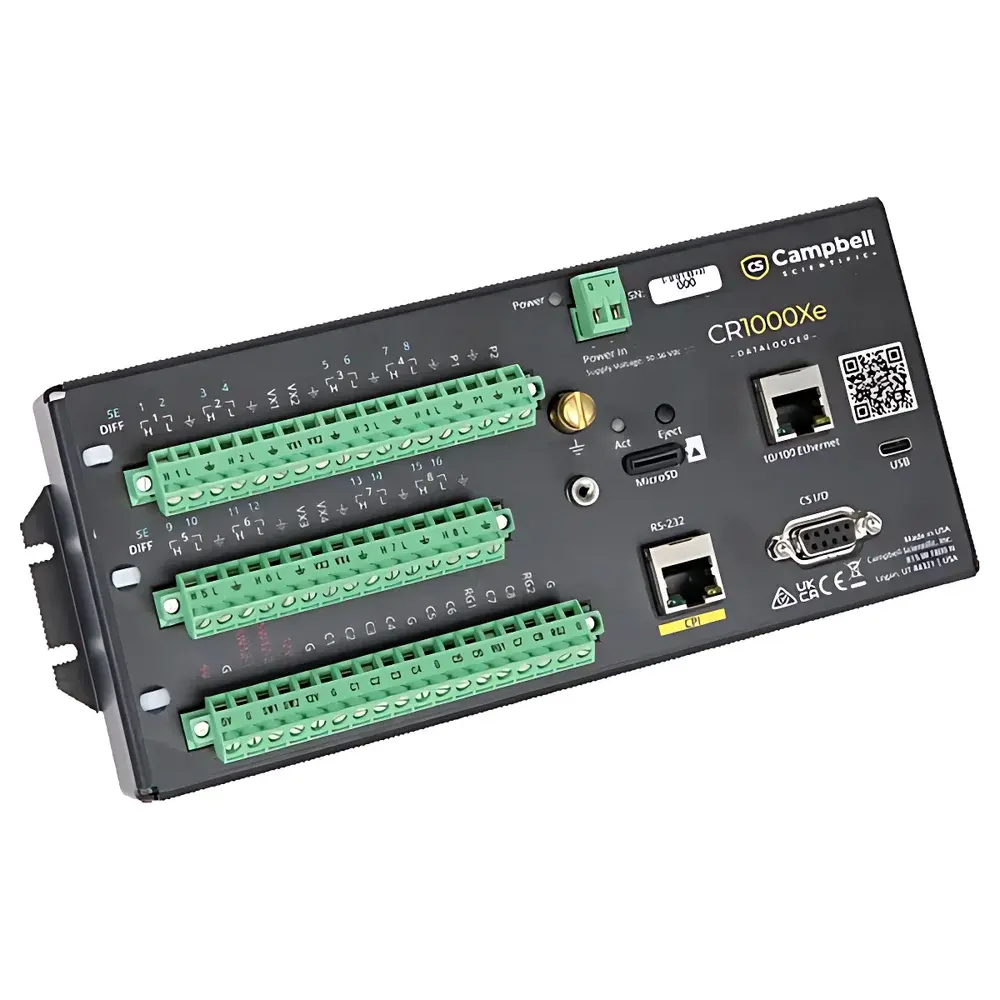
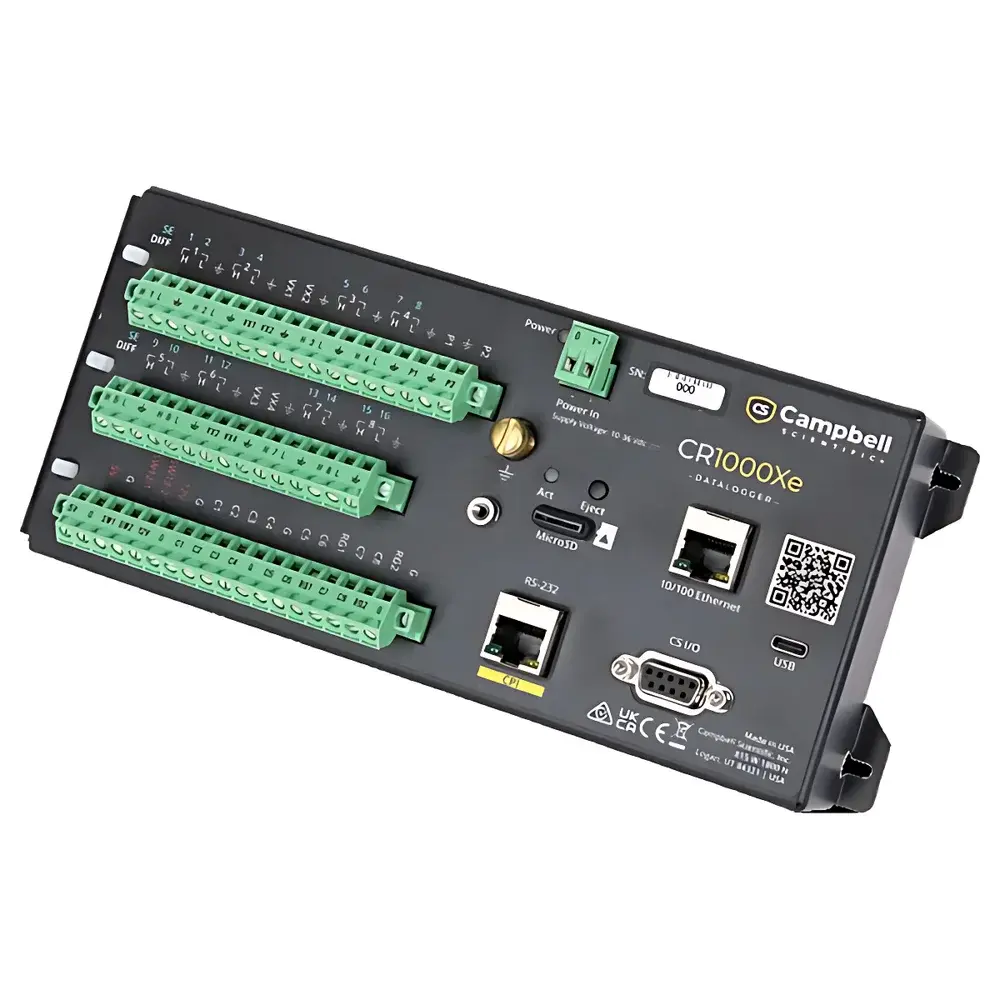
Campbell CR1000Xe Data Acquisition System
| Key | Brand: Campbell |
|---|---|
| Origin | USA |
| Model | CR1000Xe |
| Operating Temperature (Standard) | -40 to +70°C |
| Operating Temperature (Extended) | -55 to +85°C |
| Analog Inputs | 16 single-ended or 8 differential, plus 2 dedicated 0–20 mA / 4–20 mA current inputs |
| ADC Resolution | 24-bit |
| Max Scan Rate | 100 Hz |
| Communication Interfaces | Ethernet, USB Micro-B, RS-232/RS-485/RS-422, CPI, CS I/O, SDI-12, I²C, SPI |
| Data Storage | 4 MB SRAM + 72 MB flash + microSD slot (up to 16 GB) |
| Power Input | 10–36 VDC |
| Real-Time Clock Accuracy | ±3 min/year (GPS optional for ±10 µs) |
| Enclosure | Anodized aluminum with RF-shielded stainless steel electronics housing |
| Dimensions | 23.8 × 10.1 × 6.2 cm |
| Weight | 0.86 kg |
Overview
The Campbell CR1000Xe Data Acquisition System is a high-integrity, low-power environmental monitoring platform engineered for long-term, unattended operation in remote and harsh field conditions. Built upon Campbell Scientific’s proven architecture, the CR1000Xe employs precision 24-bit analog-to-digital conversion and deterministic scan-based measurement scheduling to deliver traceable, repeatable sensor data across meteorological, hydrological, air quality, wind resource, and water quality applications. Its core measurement principle relies on synchronized excitation, signal conditioning, and digitization of analog, digital, pulse, and serial sensor outputs—enabling simultaneous acquisition from thermistors, pressure transducers, anemometers, gas analyzers, turbidity sensors, and distributed smart modules via CPI and PakBus protocols. Designed for compliance with long-term environmental monitoring standards—including those referenced in ASTM D5092 (groundwater monitoring), ISO 14001 (environmental management systems), and EPA Method 100.1 (ambient air quality)—the CR1000Xe integrates hardware-level electromagnetic interference (EMI) shielding, battery-backed real-time clock (RTC), and non-volatile memory architecture to ensure data continuity during power interruption or extended network outages.
Key Features
- Industrial-grade operating temperature range: -40°C to +70°C standard; extended range up to -55°C to +85°C with derated performance specifications
- 24-bit sigma-delta ADC with calibrated accuracy of ±(0.04% of reading + offset) at 0–40°C, supporting high-fidelity resolution of microvolt-level sensor signals
- Dual 0–20 mA / 4–20 mA current input channels—eliminating external shunt resistors for direct integration of industrial process sensors
- Integrated CPI port for native communication with GRANITE™ series intelligent sensors and distributed measurement modules, enabling scalable system expansion without protocol translation
- Embedded web server with HTTPS/TLS v1.2 support, permitting secure remote configuration, real-time status monitoring, and firmware updates via standard web browsers
- Full PakBus networking stack with automatic routing, node discovery, and store-and-forward capabilities—essential for meshed telemetry deployments over radio, cellular, or satellite links
- MicroSD card interface supporting hot-swappable storage up to 16 GB, compliant with FAT32 and exFAT file systems for archival-grade data logging
- Programmable scan rates up to 100 Hz per channel, with configurable timing resolution down to 1 µs for transient event capture (e.g., lightning-induced surges, rapid water level fluctuations)
- Regulated 12 VDC output (2 terminals + CS I/O pin 8) capable of powering peripheral modems, cameras, or valve actuators with load regulation < ±1%
- Comprehensive digital I/O suite: eight configurable C-series terminals supporting UART, SDI-12, SPI, I²C, PWM, edge-triggered counting, and high-frequency pulse measurement up to 1 MHz
Sample Compatibility & Compliance
The CR1000Xe interfaces with a broad spectrum of analog, digital, and smart sensors used in environmental and infrastructure monitoring. It natively supports SDI-12, Modbus RTU/TCP, NMEA 0183, DNP3, NTCIP, and MQTT—facilitating interoperability with third-party OEM sensors and SCADA systems. Its analog input design complies with IEC 61000-4-5 (surge immunity) and IEC 61000-4-4 (electrical fast transient immunity), while the sealed stainless-steel internal shield meets MIL-STD-461G RS103 requirements for radiated emissions suppression. The device is CE-marked and RoHS-compliant. For regulated environments—including US EPA-certified ambient monitoring networks and ISO/IEC 17025-accredited laboratories—the CR1000Xe supports audit-ready data integrity through timestamped, signed data files, immutable firmware version logging, and optional GPS-synchronized time stamping (±10 µs uncertainty), satisfying traceability requirements under 21 CFR Part 11 when deployed with validated software workflows.
Software & Data Management
Programming and configuration are performed using Campbell Scientific’s PC-based LoggerNet software, which provides script validation, automated calibration coefficient management, and scheduled data retrieval via FTP(S), SFTP, or HTTP(S). All CR1000Xe units execute programs written in CRBasic—a deterministic, compiled language optimized for embedded control and real-time data reduction. Onboard processing enables linearization, statistical aggregation (min/max/mean/std dev), unit conversion, and conditional logic execution prior to storage—reducing downstream bandwidth and computational load. Data files adhere to TOA5 format (tab-delimited ASCII), ensuring compatibility with MATLAB, Python (Pandas), R, and commercial GIS platforms. Optional LoggerLink mobile app enables field diagnostics via Bluetooth Low Energy (BLE) pairing. Firmware updates are cryptographically signed and verified before installation, enforcing supply-chain integrity per NIST SP 800-193 guidelines.
Applications
- Meteorological networks (ASOS, AWOS, MESONet) requiring multi-parameter synchronization across temperature, humidity, solar radiation, and precipitation gauges
- Hydrological monitoring stations measuring stage, flow velocity, dissolved oxygen, pH, conductivity, and turbidity in rivers, reservoirs, and wastewater treatment plants
- Wind resource assessment campaigns integrating cup/anemometer arrays, wind vanes, and ultrasonic sensors with turbine control interlocks
- Air quality monitoring systems deploying electrochemical, optical, and metal oxide semiconductor (MOS) gas sensors for NO₂, O₃, PM₂.₅, and VOCs
- Geotechnical instrumentation networks using vibrating-wire piezometers, inclinometers, and strain gauges in dam safety and landslide early-warning systems
- Smart infrastructure projects—such as bridge health monitoring—leveraging distributed GRANITE™ nodes connected via CPI to central CR1000Xe hubs
FAQ
Does the CR1000Xe support TLS 1.2 encryption for secure data transmission?
Yes. The CR1000Xe implements FIPS 140-2 validated cryptographic libraries and supports TLS 1.2 with server-authenticated HTTPS, SFTP, and SMTP/TLS for end-to-end encrypted communications.
Can the CR1000Xe operate independently without a continuous network connection?
Yes. It functions autonomously with onboard program execution, local data storage (SRAM + flash + microSD), and scheduled scan logic—requiring no external host for basic measurement and control operations.
What is the maximum achievable sampling rate for high-speed analog signals?
The CR1000Xe supports up to 100 Hz aggregate scan rate across all enabled analog channels. Individual channel sampling can be accelerated using FastScan mode, achieving >300 Hz for selected inputs with reduced resolution trade-offs.
Is GPS time synchronization available as a factory option or field-upgradable?
GPS synchronization is supported via optional external GPS receivers (e.g., GPSPAK or TMD-1) connected to the CS I/O port. No firmware modification is required; time correction is applied automatically upon valid NMEA GPRMC/GPGGA sentence receipt.
How does the CR1000Xe handle power failure recovery and data continuity?
All critical runtime parameters—including program state, RTC, and last-scan timestamps—are preserved in battery-backed SRAM. Upon power restoration, the system resumes scanning from the exact point of interruption without data loss or reinitialization delay.