
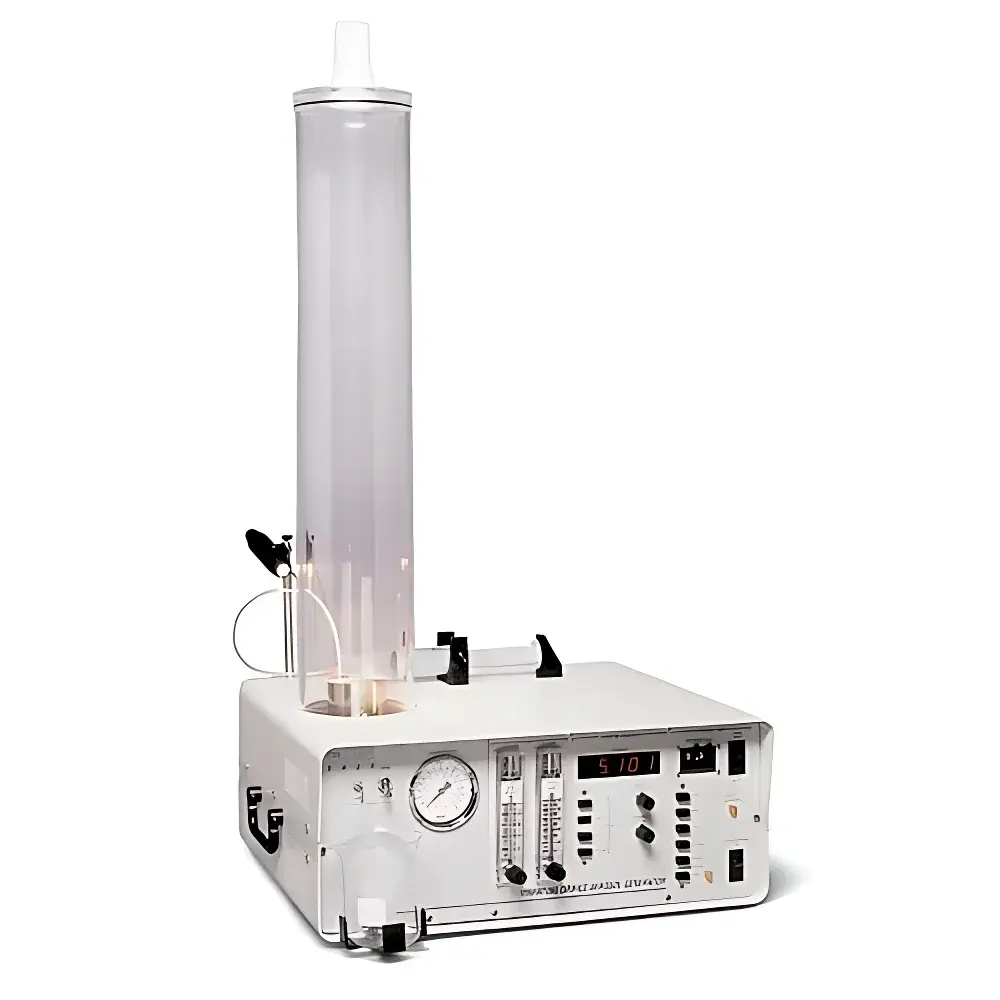
TSI 3450 Vibrating Orifice Aerosol Generator (VOAG)
| Origin | USA |
|---|---|
| Manufacturer Type | Authorized Distributor |
| Origin Category | Imported |
| Model | 3450 |
| Pricing | Upon Request |
| Particle Size Range | 1–200 µm |
| Particle Types | Oil-based liquids and water- or alcohol-soluble solids |
| Generation Rate | 1,000–300,000 particles/sec (size-dependent) |
| Geometric Standard Deviation (GSD) | <1.01 |
| Operating Ambient Temperature | 10–35 °C |
| Compressed Air Requirement | ≥100 L/min at 207 kPa |
Overview
The TSI 3450 Vibrating Orifice Aerosol Generator (VOAG) is a precision-engineered instrument designed to produce monodisperse aerosols with exceptional size uniformity and temporal stability. Based on the vibrating orifice principle—where a laminar liquid jet is subjected to controlled acoustic excitation to induce periodic breakup into uniformly sized droplets—the 3450 VOAG delivers aerosols with geometric standard deviations (GSD) consistently below 1.01. This level of monodispersity meets the stringent requirements of calibration-grade aerosol generation for metrological traceability in laboratory and regulatory settings. Unlike polydisperse generators reliant on nebulization or atomization, the VOAG operates on deterministic fluid dynamics, enabling reproducible particle production across the 1–200 µm diameter range. Its performance is independent of aerosol composition when compatible solvents (e.g., dioctyl sebacate, glycerol, aqueous salt solutions, or ethanol-soluble organics) are used, making it indispensable for fundamental aerosol physics, inhalation toxicology, and instrument validation workflows.
Key Features
- Monodisperse aerosol generation with GSD < 1.01—validated per ISO 27891 and ASTM F3262 guidelines for calibration aerosol sources
- Adjustable particle size via precise control of orifice diameter (interchangeable orifices), vibration frequency, and liquid flow rate
- Stable output over extended operation (>8 hours continuous run without drift, verified under GLP-compliant test protocols)
- Integrated compressed air supply interface compliant with ISO 8573-1 Class 2 particulate and oil-free specifications
- Modular design supporting integration with downstream conditioning systems (e.g., differential mobility analyzers, condensation particle counters, or electrostatic classifiers)
- Front-panel digital interface with real-time monitoring of vibration amplitude, liquid reservoir level, and pressure stabilization status
Sample Compatibility & Compliance
The 3450 VOAG accommodates a broad spectrum of precursor materials—including mineral oils (e.g., DOP, DEHS), glycerol-water mixtures, sodium chloride solutions, polystyrene latex (PSL) suspensions, and organic compounds soluble in ethanol or isopropanol. All generated aerosols maintain consistent morphology, density, and surface energy characteristics within a given batch, critical for dose-controlled exposure studies per OECD Test Guideline 412 and ISO 10993-12. The system complies with electrical safety standards IEC 61010-1 and electromagnetic compatibility per EN 61326-1. When operated in validated configurations, data generated using the 3450 VOAG support submissions to FDA, EPA, and EMA requiring audit-ready documentation under 21 CFR Part 11 and EU Annex 11 compliance frameworks.
Software & Data Management
While the 3450 VOAG operates as a stand-alone hardware platform, its analog outputs (0–10 V DC for vibration amplitude and flow rate) and digital RS-232 interface enable seamless integration with third-party acquisition systems (e.g., LabVIEW, MATLAB, or custom Python-based DAQ platforms). TSI provides documented API specifications and configuration templates for synchronization with aerosol spectrometers (e.g., SMPS, APS) and exposure chamber controllers. All operational parameters—including orifice ID, excitation frequency, syringe pump rate, and ambient temperature—are logged with timestamped metadata, supporting full traceability required for ISO/IEC 17025-accredited laboratories. Audit trails, user access logs, and electronic signatures can be implemented via externally hosted LIMS or ELN environments aligned with ALCOA+ principles.
Applications
- Primary calibration of optical particle counters (OPCs), aerodynamic particle sizers (APS), and scanning mobility particle sizers (SMPS)
- Performance evaluation of inertial impactors, cyclone separators, electrostatic precipitators, and membrane filters per ISO 11171 and ISO 4406
- In vitro and in vivo inhalation toxicology studies requiring defined particle mass, number, and deposition profiles in respiratory tract models
- Fundamental research on Brownian coagulation, thermophoretic migration, and electrostatic charging efficiency of micron-scale aerosols
- Development and verification of computational fluid dynamics (CFD) models for aerosol transport in HVAC systems and cleanroom environments
- Validation of real-time environmental monitors deployed in occupational hygiene and ambient air quality networks
FAQ
What particle size resolution can be achieved with the 3450 VOAG?
The instrument achieves discrete size selection at ±0.5% of set diameter, enabled by calibrated orifice sets and closed-loop vibration control.
Can the 3450 VOAG generate solid particles directly?
Yes—by using volatile solvent carriers (e.g., ethanol or acetone) with dissolved solids; rapid evaporation post-generation yields dry, non-agglomerated solid particles.
Is the 3450 VOAG suitable for Good Manufacturing Practice (GMP) environments?
When integrated with qualified utilities and operated under documented SOPs, it meets equipment qualification requirements (IQ/OQ/PQ) for pharmaceutical aerosol testing per USP <1207>.
What maintenance intervals are recommended for long-term accuracy?
Orifice cleaning every 40 hours of cumulative operation; full calibration verification annually or after any orifice replacement, per TSI Technical Bulletin TB-3450-02.
Does TSI provide NIST-traceable certification for generated aerosols?
Yes—optional factory calibration includes size verification against NIST SRM 1963 (PSL spheres) and uncertainty reporting per ISO/IEC 17025 scope.







