
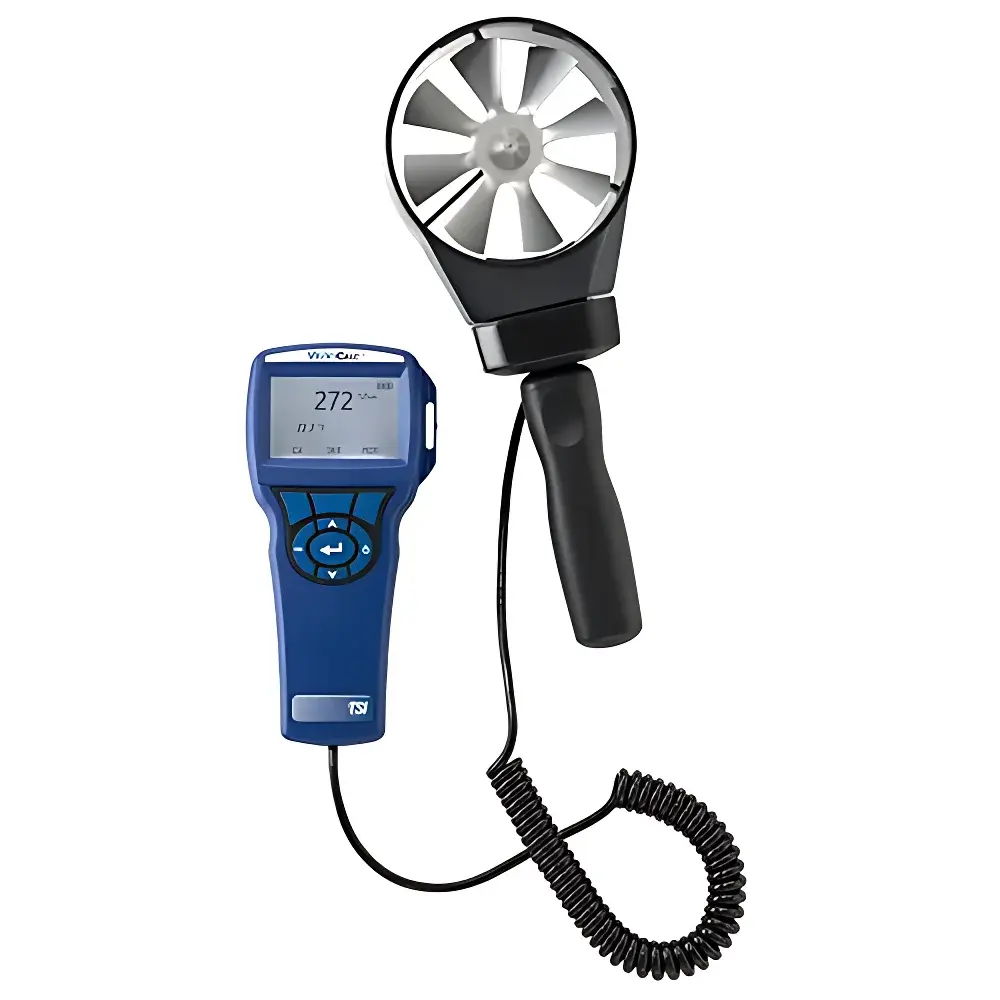
TSI VelociCalc® 5725 Vane Anemometer & Air Flow Meter
| Origin | USA |
|---|---|
| Manufacturer Type | Authorized Distributor |
| Origin Category | Imported |
| Model | 5725 |
| Instrument Type | Vane Anemometer |
| Velocity Range | 0.25–30 m/s (50–6000 ft/min) |
| Accuracy (Velocity) | ±1.0% of reading or ±0.02 m/s (±4 ft/min), whichever is greater |
| Temperature Range | 0–60 °C (32–140 °F) |
| Temperature Accuracy | ±0.5 °C (±2 °F) |
| Temperature Resolution | 0.1 °C (0.1 °F) |
| Duct Area Range | 0–16 m² (0–173.6 ft²) |
| Volume Flow Calculation | Enabled via user-input duct geometry/area |
| Operating Temp (Instrument) | 5–45 °C |
| Operating Temp (Probe) | 0–60 °C |
| Storage Temp | −20–60 °C |
| Data Memory | 12,700 readings + 100 data sets |
| Sampling Interval | 1 s – 1 h |
| User-Defined Time Constant | Yes |
| Display | Real-time velocity, temperature, min/max, and rolling average |
| Probe | 100 mm (4 in.) bidirectional vane |
| Dimensions | 8.4 × 17.8 × 4.4 cm |
| Weight (with battery) | 270 g |
| Power | One 9V alkaline or NiCd battery |
Overview
The TSI VelociCalc® 5725 Vane Anemometer & Air Flow Meter is a precision-engineered instrument designed for quantitative HVAC system commissioning, indoor air quality (IAQ) assessment, and environmental airflow verification in commercial, institutional, and laboratory settings. It operates on the principle of rotational torque measurement: airflow imparts angular momentum to a calibrated 100 mm (4 in.) bidirectional vane rotor, whose angular velocity is converted into linear air velocity via factory-traceable calibration against NIST-traceable wind tunnel standards. Unlike thermal anemometers, the vane design provides robust performance in turbulent, low-velocity, and thermally unstable airstreams—particularly across cooling/heating coils, diffusers, grilles, and filter banks where flow profiles are non-uniform and Reynolds numbers vary significantly. The device computes volumetric flow rate in real time by applying user-defined duct geometry (rectangular, round, or irregular cross-section) and area input, enabling compliance-driven reporting for ASHRAE Standard 111, ISO 16813, and EN 13779 ventilation verification protocols.
Key Features
- Bidirectional 100 mm vane probe enables simultaneous supply and exhaust airflow characterization without probe reorientation
- Real-time dual-parameter display: air velocity (m/s or ft/min) and temperature (°C or °F), with min/max tracking and rolling average calculation
- Sweep mode functionality for rapid spatial averaging across large zones—ideal for grille or register surveys per ANSI/ASHRAE Guideline 12
- User-configurable time constant (0.1–30 s) to optimize dynamic response for laminar vs. turbulent flow regimes
- Onboard statistical engine computes mean, standard deviation, and confidence intervals for multi-point datasets
- Automated data logging with timestamped storage of up to 12,700 readings across 100 independent groups
- Optional 914 mm (36 in.) telescoping probe and TSI-certified flow hood adapters extend application flexibility for duct traverses and hood-based capture velocity measurements
- Rugged, ergonomic housing (8.4 × 17.8 × 4.4 cm) with IP54-rated ingress protection for field use in mechanical rooms and rooftop units
Sample Compatibility & Compliance
The VelociCalc 5725 is validated for use with standard HVAC components including aluminum or stainless steel diffusers, fiberglass or HEPA filters, finned-tube heat exchangers, and perforated grilles. Its vane geometry and low starting threshold (<0.25 m/s) ensure reliable operation in low-flow applications such as underfloor air distribution (UFAD) systems and cleanroom return air plenums. The instrument meets IEC 61000-4 electromagnetic compatibility requirements and complies with CE marking directives. Calibration certificates include traceability to NIST SRM 1920a (air velocity) and SRM 1968 (temperature). For regulated environments—including pharmaceutical manufacturing (FDA 21 CFR Part 11) and clinical laboratories—the device supports audit-ready data export (CSV via USB) with full metadata (operator ID, location tag, timestamp, probe serial number) and optional password-protected configuration locking.
Software & Data Management
Data acquisition and post-processing are supported through TSI’s TrakPro™ Lite software (Windows-compatible), which imports logged datasets for graphical trend analysis, duct balance reporting, and ASHRAE 62.1 ventilation rate validation. All stored records include embedded calibration expiration dates, probe identification, and environmental conditions at time of capture. The firmware implements GLP-compliant data integrity safeguards: write-once memory architecture prevents post-collection editing, and each data group carries a SHA-256 hash for forensic verification. Export formats include CSV (for Excel or LIMS integration) and PDF summary reports with customizable headers, unit preferences, and signature fields for QA sign-off.
Applications
- HVAC system balancing and TAB (Testing, Adjusting, and Balancing) per NEBB Procedural Standards
- Filter face velocity mapping and uniformity assessment per ISO 14644-3
- Exhaust hood face velocity verification per ANSI Z9.5 and OSHA 1910.145
- Room air change rate calculation in healthcare facilities (ASHRAE 170) and labs (ANSI Z9.5)
- Commissioning documentation for LEED IEQ Credit 1 and BREEAM HEA 02
- Baseline IAQ surveys prior to occupancy and post-renovation revalidation
- Educational use in building science and environmental engineering curricula
FAQ
Does the VelociCalc 5725 require annual recalibration?
Yes. TSI recommends annual recalibration against NIST-traceable standards to maintain stated accuracy specifications. Field verification using a handheld reference anemometer is advised before critical measurements.
Can the device calculate airflow in round ducts with variable diameter?
It calculates volumetric flow based on user-entered cross-sectional area. For tapered or conical ducts, users must input the effective area at the measurement plane; the instrument does not interpolate geometry.
Is the 9V battery rechargeable?
The unit accepts either alkaline or NiCd 9V batteries. Rechargeable NiCd cells are supported but require external charging; the instrument itself does not provide charging circuitry.
What is the minimum measurable velocity with the standard probe?
The specified lower limit is 0.25 m/s (50 ft/min), verified per ISO 7726 Annex B under controlled wind tunnel conditions with ≤5% turbulence intensity.
Can data be exported directly to a SCADA or BMS platform?
Direct OPC or Modbus integration is not supported. However, CSV exports can be ingested by most BMS data historians via scheduled file polling or middleware gateways.







