
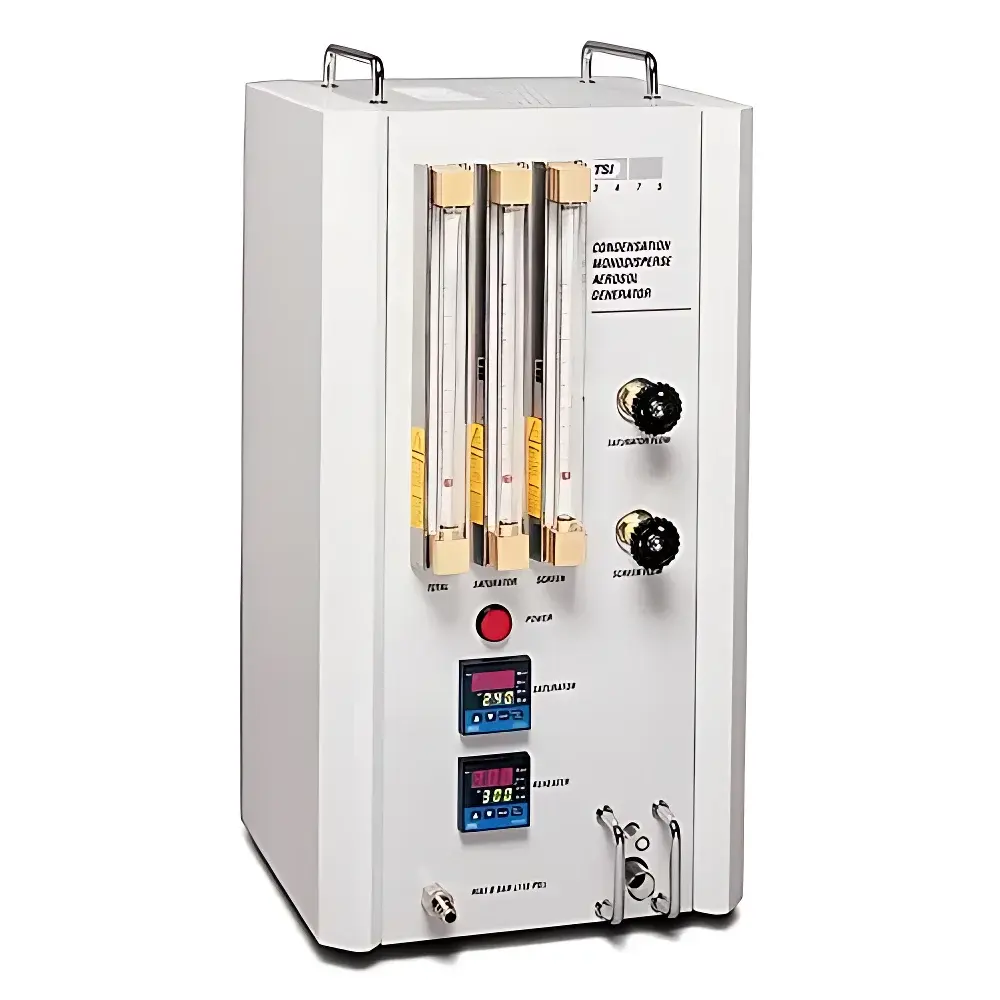
TSI 3475-CMAG Condensation Monodisperse Aerosol Generator
| Origin | USA |
|---|---|
| Manufacturer Type | Authorized Distributor |
| Origin Category | Imported |
| Model | 3475 |
| Pricing | Available Upon Request |
Overview
The TSI 3475-CMAG Condensation Monodisperse Aerosol Generator is a precision-engineered instrument designed for the reliable, repeatable generation of highly uniform, near-monodisperse aerosol particles via thermally driven condensation nucleation. Operating on the principle of controlled vapor supersaturation followed by homogeneous nucleation and subsequent growth in a laminar diffusion battery, the 3475-CMAG produces spherical, nearly charge-neutral particles with exceptional size fidelity and low geometric standard deviation (σg). This physical mechanism ensures traceable particle size distribution independent of spray or atomization artifacts—critical for metrological applications requiring NIST-traceable calibration standards. The system is optimized for laboratory-based aerosol science, inhalation toxicology, filtration testing, and optical instrumentation validation where particle size accuracy, concentration stability, and compositional flexibility are non-negotiable.
Key Features
- Condensation-based monodisperse generation—eliminates polydispersity inherent to nebulizers or atomizers
- Adjustable particle diameter from 0.1 µm to 9 µm, depending on working fluid (e.g., 0.1–8 µm for DEHS/DOP; 0.1–4 µm for carnauba wax; 0.1–9 µm for stearic acid)
- Particle number concentration exceeding 1 × 10⁶ cm⁻³ at nominal flow conditions
- Geometric standard deviation σg < 1.10 for particles 0.5–8 µm; σg < 1.25 for sub-0.5 µm particles—meeting ISO 27891 and ASTM F2101 requirements for monodispersity verification
- Stable laminar output flow of 3.5–4.0 L/min, compatible with downstream dilution systems, impactors, and real-time particle sizers (e.g., SMPS, APS)
- Compatible with non-toxic working fluids including diethylhexyl sebacate (DEHS), dioctyl phthalate (DOP), and certified reference materials such as Emery 3004
- Supports solid-phase precursors (carnauba wax, paraffin, stearic acid) for thermally stable, non-volatile test aerosols
- Compact benchtop architecture with modular heater-cooler zones, enabling rapid thermal equilibration and minimal warm-up time (< 15 min)
- Designed for integration into GLP-compliant exposure chambers, ISO 16890 filter test rigs, and USP aerosol delivery validation setups
Sample Compatibility & Compliance
The 3475-CMAG accommodates both liquid and solid-phase precursor materials, supporting regulatory and method-specific requirements across environmental, pharmaceutical, and occupational health domains. Liquid agents include DEHS (a widely accepted DOP substitute per ISO 16890 and EN 1822), while solid waxes enable generation of particles resistant to evaporation under elevated humidity or extended residence times. All generated aerosols are compatible with fluorescence tagging (e.g., using coumarin 6) and radiolabeling (e.g., ⁹⁹mTc-DTPA) for biodistribution studies. The system conforms to key international standards governing aerosol generation and characterization, including ISO 27891 (monodisperse aerosol generation), ASTM F2101 (bacterial filtration efficiency testing), and ISO 16890 (air filter classification). It supports audit-ready operation under FDA 21 CFR Part 11 when paired with validated data acquisition software.
Software & Data Management
While the 3475-CMAG operates via analog front-panel controls for temperature, sheath flow, and saturator setpoints, it is fully compatible with TSI’s integrated data acquisition ecosystem—including the Aerosol Instrument Manager (AIM) software suite. AIM enables synchronized logging of generator parameters (heater temperatures, pressure differentials, flow rates) alongside downstream instruments (CPCs, OPS, APS). All logged data include embedded timestamps, operator ID fields, and configurable metadata tags, satisfying ALCOA+ principles (Attributable, Legible, Contemporaneous, Original, Accurate, Complete, Consistent, Enduring, Available) for GMP/GLP environments. Audit trails, electronic signatures, and role-based access control are supported through optional AIM Enterprise licensing.
Applications
- Human and animal inhalation exposure studies requiring precise dose–response characterization
- Filter media efficiency evaluation per ISO 16890, EN 1822, and ASME AG-1
- Calibration and performance verification of optical particle counters (OPCs), scanning mobility particle sizers (SMPS), and aerodynamic particle sizers (APS)
- Smoke detector sensitivity testing per UL 217 and EN 54-7
- Seed particle generation for wind tunnel visualization and laser Doppler anemometry (LDA)
- Aerosol deposition modeling in respiratory tract replicas (e.g., Next-Generation Impactor, Alberta Idealized Throat)
- Development and validation of aerosol-based drug delivery systems under USP
FAQ
What compressed gas is required for operation?
The 3475-CMAG requires clean, dry, oil-free nitrogen at 116 psi (800 kPa) supply pressure. Compressed air may be used only if rigorously filtered to ISO 8573-1 Class 1:2:1 specifications.
Can the 3475-CMAG generate particles below 100 nm?
Yes—it achieves stable nucleation down to 0.1 µm (100 nm) with DEHS or DOP; sub-100 nm generation is not supported due to inherent limitations of condensation growth kinetics in this configuration.
Is the system suitable for cleanroom or ISO Class 5 environments?
The unit itself is not classified for direct cleanroom use, but its output aerosol stream can be introduced into ISO Class 5 or higher environments via HEPA-filtered sheath air and validated transfer tubing.
Does TSI provide NIST-traceable calibration documentation?
TSI supplies factory calibration reports referencing NIST-traceable reference instruments (e.g., TSI 3080 DMA, 3775 CPC); full metrological traceability packages are available upon request for regulated users.
What maintenance intervals are recommended?
Daily visual inspection of saturator wick integrity; quarterly replacement of wicks and O-rings; annual recalibration of temperature sensors and mass flow controllers per TSI Service Bulletin SB-3475-01.
Related Products







