
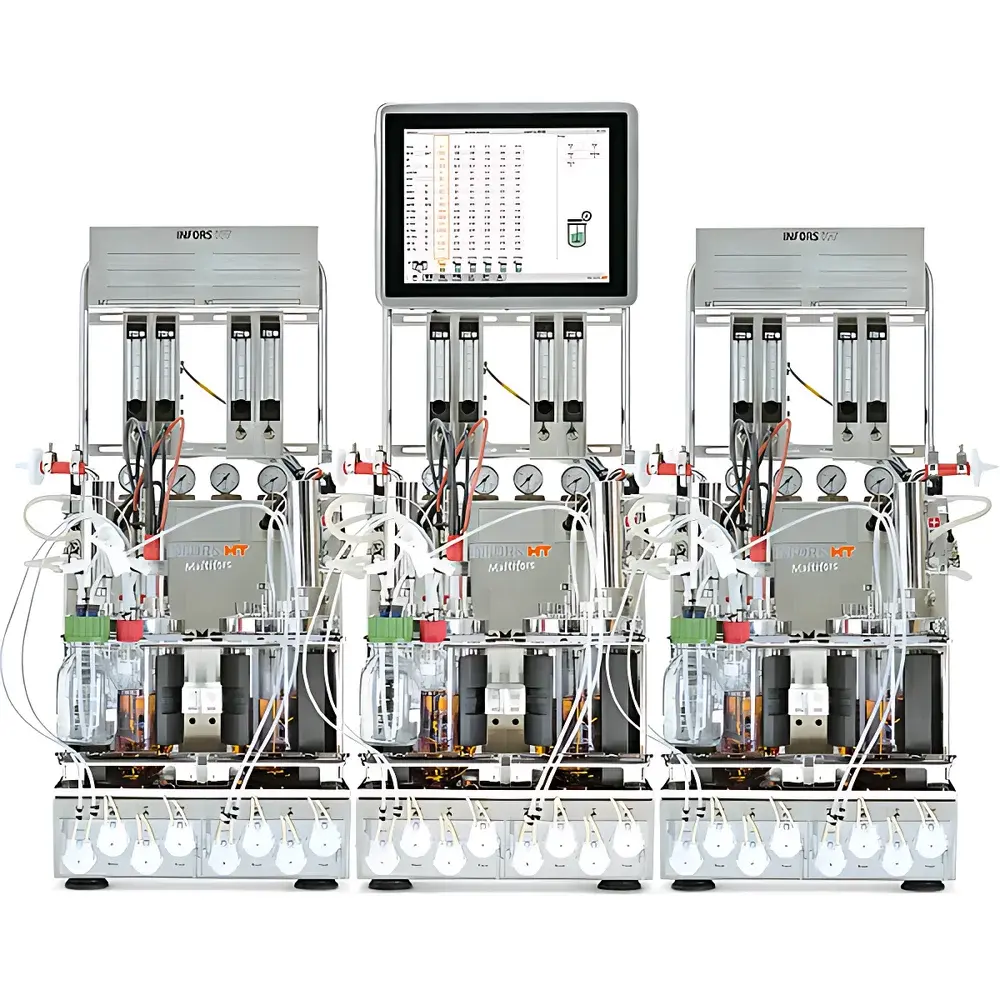
INFORS Multifors Parallel Bioreactor System
| Brand | INFORS |
|---|---|
| Origin | Switzerland |
| Model | Multifors |
| Temperature Range | +5 °C above coolant temperature to 70 °C |
| Working Volume per Vessel | 150–750 mL |
| Number of Parallel Vessels | 2 to 12 |
| Vessel Material | Borosilicate Glass |
| Sterilization Method | Integrated Off-line Autoclaving |
| Stirring Drive | Magnetic Coupling, 100–1600 rpm |
| Aeration | Open-loop Gas Supply, Up to 4 Rotameters or Mass Flow Controllers (MFCs), Max. 2 vvm |
| Peristaltic Pumps | 3 Digital + 1 Analog (adjustable speed) |
| pH Sensors | Optional Mettler Toledo Analog (2–12) or Hamilton Digital (0–14) |
| pO₂ Sensors | Optional Mettler Toledo Analog (0–150 % air saturation) or Hamilton Digital (0.05–300 %) |
| Data Communication | OPC XML-DA via Ethernet |
| Expandable Parameters | Up to 24 Total (including optional external modules for balance, redox, pCO₂, conductivity, optical density [Optek], and off-gas analysis) |
Overview
The INFORS Multifors Parallel Bioreactor System is an engineered platform for high-throughput, reproducible microbial and mammalian cell culture under strictly controlled physiological conditions. Based on over three decades of parallel bioprocess development—originating with the pioneering Sixfors system introduced in 1989—the Multifors represents a mature evolution optimized for scalability, modularity, and regulatory-compliant operation. It operates on classical stirred-tank bioreactor principles: magnetic drive agitation ensures hermetic sealing and eliminates shaft leakage risks; open-loop gas delivery supports precise O₂/CO₂/N₂ blending via calibrated rotameters or mass flow controllers; and temperature control is achieved through jacketed vessels connected to an external chiller unit, enabling stable operation from +5 °C above coolant temperature up to 70 °C. Designed for both R&D process development and early-stage scale-up studies, the system accommodates working volumes from 150 mL to 750 mL per vessel, with configurations ranging from dual-vessel screening to fully synchronized 12-vessel parallel experiments.
Key Features
- Modular architecture supporting 2–12 independent bioreactors in a single footprint, with standardized mechanical and electrical interfaces for seamless expansion.
- Borosilicate glass vessels certified for autoclave sterilization (off-line), ensuring full compliance with ISO 13408-1 and EU GMP Annex 1 requirements for sterile process validation.
- Magnetic coupling stirrer delivering 100–1600 rpm with torque monitoring capability—enabling consistent shear stress profiling across parallel runs.
- Dual-sensor compatibility for critical parameters: analog and digital pH/pO₂ electrodes from Mettler Toledo and Hamilton, respectively, offering traceable calibration and long-term stability.
- Integrated peristaltic pump suite comprising three digitally controlled pumps and one analog pump (with optional expansion module), supporting automated feeding, base/acid addition, and harvest protocols.
- Ethernet-based OPC XML-DA communication protocol enabling native integration into SCADA, MES, and LIMS environments compliant with ISA-88/ISA-95 and FDA 21 CFR Part 11 data integrity standards.
Sample Compatibility & Compliance
The Multifors system is validated for use with aerobic and microaerobic bacterial cultures (e.g., E. coli, Bacillus spp.), yeasts (S. cerevisiae, P. pastoris), filamentous fungi, and suspension-adapted mammalian cells (CHO, HEK293). Its glass construction resists chemical degradation during CIP/SIP cycles and permits visual inspection of foam formation, pellet morphology, and phase separation. All sensor interfaces meet IEC 61508 functional safety guidelines, and firmware supports audit-trail-enabled operation per GLP and GMP Annex 11 requirements. The system has been referenced in more than 5,000 peer-reviewed publications—many cited in ASTM E2500-13 (verification of pharmaceutical manufacturing equipment) and ISO 20966-1:2021 (bioprocess analytical technology frameworks).
Software & Data Management
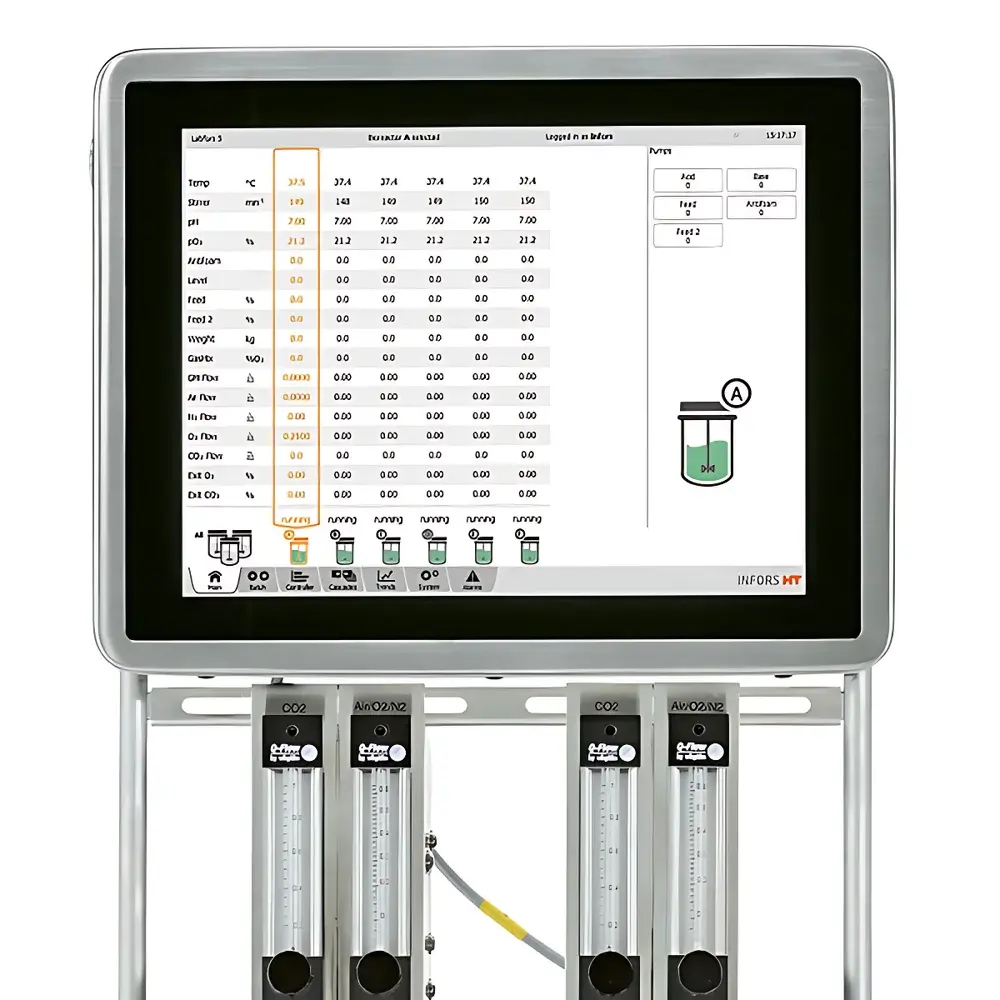
Control and data acquisition are managed through INFORS’ EVE software platform, which provides real-time visualization of all vessel parameters—including temperature, pH, pO₂, agitation, gas flow rates, and pump actuation states—on a centralized touchscreen interface or remote workstation. EVE supports user-defined control strategies (e.g., cascade pH-stat, DO-stat, exponential feed profiles), automatic event logging, and export of time-series datasets in CSV, Excel, and HDF5 formats. Raw data files include embedded metadata (operator ID, timestamp, calibration history) satisfying ALCOA+ principles. Optional add-ons include electronic batch record (EBR) templates aligned with Annex 11, and integration with DeltaV, Siemens Desigo, or LabArchives for end-to-end digital lab documentation.
Applications
- Strain selection and media optimization across combinatorial carbon/nitrogen sources, inducer concentrations, and pH setpoints.
- Bioprocess characterization for QbD (Quality by Design) submissions, including DoE-based mapping of critical process parameters (CPPs) against critical quality attributes (CQAs).
- Accelerated comparability studies between upstream process changes (e.g., seed train modifications, harvest timing adjustments).
- Continuous perfusion culture setup using integrated weight-based feedback loops and real-time viability monitoring via optional optical density modules.
- Regulatory filing support: generation of robust, auditable datasets for IND, BLA, and MAA dossiers requiring demonstration of process consistency and control strategy validation.
FAQ
Can the Multifors system be validated for GMP manufacturing environments?
Yes—its design basis, material certifications (DIN ISO 3585 glass, USP Class VI elastomers), and software architecture support IQ/OQ/PQ execution per ASTM E2500-13 and EU GMP Annex 15.
Is remote monitoring and control supported outside the local network?
EVE software supports secure remote access via TLS-encrypted VPN tunnels; however, direct internet exposure is not recommended per IEC 62443-3-3 cybersecurity guidelines.
What level of support is provided for sensor calibration and maintenance?
INFORS offers NIST-traceable calibration kits, on-site service contracts, and annual preventive maintenance programs including electrode performance verification and stirrer torque calibration.
How does the system handle deviations during automated runs?
EVE implements configurable alarm thresholds with multi-level escalation (visual/audio alerts, email/SMS notifications, and automatic hold/pause actions), all logged with immutable timestamps and operator acknowledgment requirements.
Are third-party sensors (e.g., pCO₂, conductivity) fully integrated into EVE’s control logic?
Yes—via standardized 4–20 mA or Modbus RTU interfaces; all external inputs appear as native parameters within EVE’s trend viewer and can trigger control actions or alarms.
Related Products




