
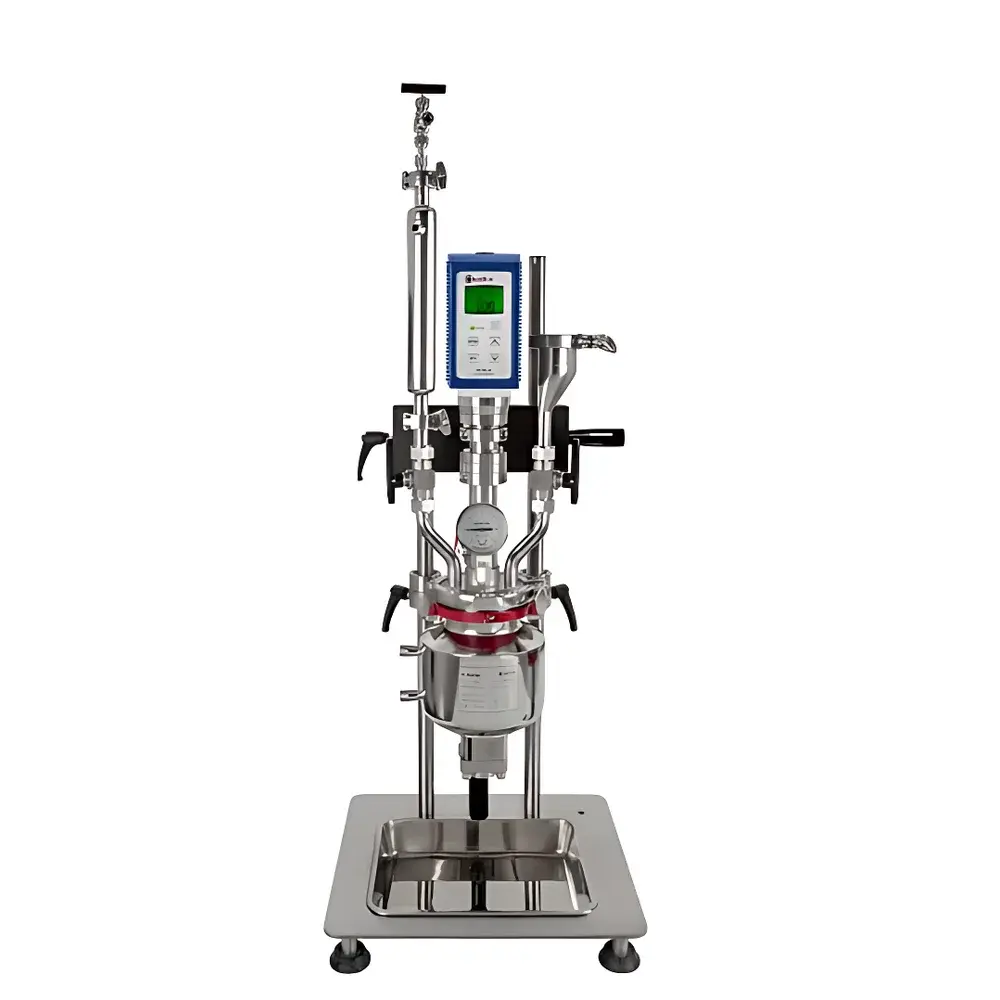
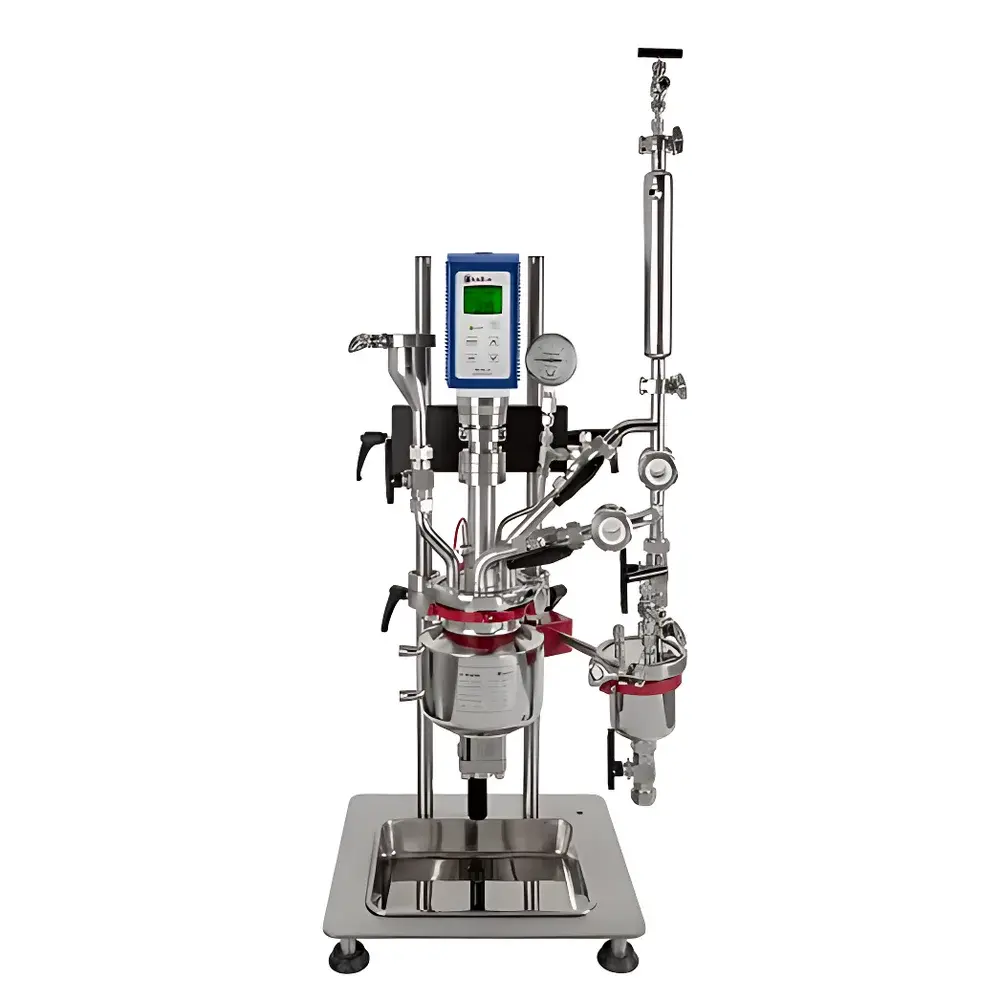
ChemTron NR-500 / NR-1000 / NR-2000 Medium-Pressure Laboratory Reactor
| Brand | ChemTron |
|---|---|
| Origin | Germany |
| Model | NR-500 / NR-1000 / NR-2000 |
| Vessel Material | Stainless Steel (AISI 316) or Hastelloy C-276 |
| Design Pressure | Up to 25 bar |
| Operating Temperature | ≤300 °C (stainless/Hastelloy), ≤230 °C (with PTFE liner) |
| Nominal Volume | 500 mL / 1000 mL / 2000 mL |
| Sealing Options | PTFE, FKM (Viton®), FFKM (Kalrez®) O-rings |
| Vacuum & Pressure Rating | Full vacuum to +25 bar |
| Optional Features | Bottom discharge valve, PTFE liner, magnetic coupling drive (RV-100), jacketed heating/cooling, temperature sensor port, pressure transducer interface, rupture disc safety system |
Overview
The ChemTron NR-500, NR-1000, and NR-2000 medium-pressure laboratory reactors are engineered for precise, reproducible chemical synthesis and process development under controlled elevated pressure and temperature conditions. Designed in accordance with DIN 28139 and ASME BPVC Section VIII Div. 1 guidelines for small-scale pressure vessels, these reactors operate on a robust mechanical sealing principle—utilizing dual-cone static seals and high-integrity O-ring compression via a chain-driven quick-clamp closure system. Unlike autoclave-style screw-closure designs, the NR series eliminates torque-dependent variability, ensuring consistent gasket loading and repeatable leak-tight performance across hundreds of thermal–pressure cycles. The reactor body and lid are precision-machined from certified AISI 316 stainless steel or Hastelloy C-276, enabling compatibility with aggressive reagents including halogenated solvents, strong acids, and oxidizing media. Each unit is supplied with a certified burst disc rated at 25 bar, integrated into the lid assembly per PED 2014/68/EU requirements, and validated for safe operation up to its maximum allowable working pressure (MAWP).
Key Features
- Quick-action chain clamp closure: Tool-free assembly/disassembly with uniform radial clamping force; achieves >95% seal compression repeatability (measured per ISO 3601-3)
- Modular lid configuration: Seven standardized ports (including three 8 mm NPT threaded openings) support simultaneous integration of temperature sensors, pressure transducers, gas inlets, sampling lines, and reflux condensers
- Material flexibility: Standard wetted parts in AISI 316 stainless steel; optional Hastelloy C-276 construction for chloride-rich or highly reducing environments; PTFE-lined variants available for pH <2 or HF-containing systems
- Temperature control compatibility: Supports external heating via Julabo circulator jackets, electric heating mantles (WB20C), or internal heating/cooling coils (6 mm OD, SS316 or Hastelloy)
- Magnetic drive coupling (RV-100-SS): Hermetically sealed, maintenance-free shaft transmission with zero dynamic leakage risk; rated for continuous operation at 300 °C and 25 bar
- Bottom discharge valve (standard on all models): Needle-type PTFE-seated valve with fine metering capability and full drainability—critical for catalyst recovery and high-value product isolation
Sample Compatibility & Compliance
The NR series accommodates heterogeneous, homogeneous, and catalytic reactions involving solids, liquids, and gases—including hydrogenation, oxidation, nitration, and polymerization. Its corrosion-resistant construction meets ASTM G31 immersion testing standards for stainless steel and ASTM B117 salt-spray resistance for Hastelloy variants. All pressure-retaining components undergo 1.5× MAWP hydrostatic proof testing and receive individual CE marking per PED 2014/68/EU Annex I. Documentation includes material test reports (MTRs), traceable calibration certificates for pressure gauges, and FAT (Factory Acceptance Test) records aligned with ISO 9001:2015. For regulated environments, the system supports audit-ready data integrity when paired with compliant digital pressure/temperature loggers meeting FDA 21 CFR Part 11 requirements.
Software & Data Management
While the base NR reactor operates as a stand-alone hardware platform, it integrates seamlessly with third-party process monitoring systems via analog (4–20 mA) and digital (RS485 Modbus RTU) interfaces. Optional pressure and temperature transducers provide real-time signals compatible with LabVIEW, DeltaV, or Siemens Desigo CCMS platforms. All recorded parameters—including ramp rate, hold time, pressure deviation, and thermal overshoot—are timestamped and stored with user-defined metadata tags. When used with validated data acquisition software, the system satisfies GLP/GMP documentation requirements, including electronic signature enforcement, change control logs, and automated backup to network-attached storage (NAS) devices.
Applications
- High-yield small-batch synthesis of pharmaceutical intermediates under inert or reactive atmospheres (e.g., H₂, CO, NH₃)
- Kinetic studies requiring precise pressure–temperature–time profiling (e.g., Arrhenius parameter determination)
- Catalyst screening and lifetime evaluation under accelerated aging conditions
- Hydrothermal carbonization and subcritical water chemistry experiments
- Development of continuous-flow precursors using batch-to-continuous translation protocols
- Teaching laboratories for advanced reaction engineering curricula (e.g., residence time distribution analysis, heat transfer coefficient measurement)
FAQ
What is the maximum recommended operating temperature when using a PTFE liner?
The PTFE liner limits continuous operation to 230 °C. Exceeding this threshold risks liner deformation, loss of dimensional stability, and compromised seal integrity.
Can the NR reactor be used under vacuum conditions?
Yes—the vessel is rated for full vacuum (≤0.1 mbar abs) up to its maximum positive pressure rating of 25 bar, provided the O-ring material (e.g., FFKM) is selected for low-permeability vacuum service.
Is the bottom discharge valve suitable for abrasive slurries?
The standard needle valve uses a PTFE seat; for highly abrasive suspensions, an optional Hastelloy-seat variant with hardened tungsten carbide insert is available upon request.
How is temperature uniformity verified inside the reactor?
ChemTron provides optional calibrated Pt100 sensor inserts with axial positioning guides; users may perform temperature mapping per ASTM E2251 using multiple probes at defined radial and vertical locations.
Are spare parts and technical documentation available globally?
All critical spares—including O-rings (FKM/FFKM/PTFE), rupture discs, magnetic couplings, and lid gaskets—are stocked in regional distribution centers (USA, Germany, Singapore); English-language operation manuals, P&IDs, and maintenance SOPs are delivered digitally with each unit.



