
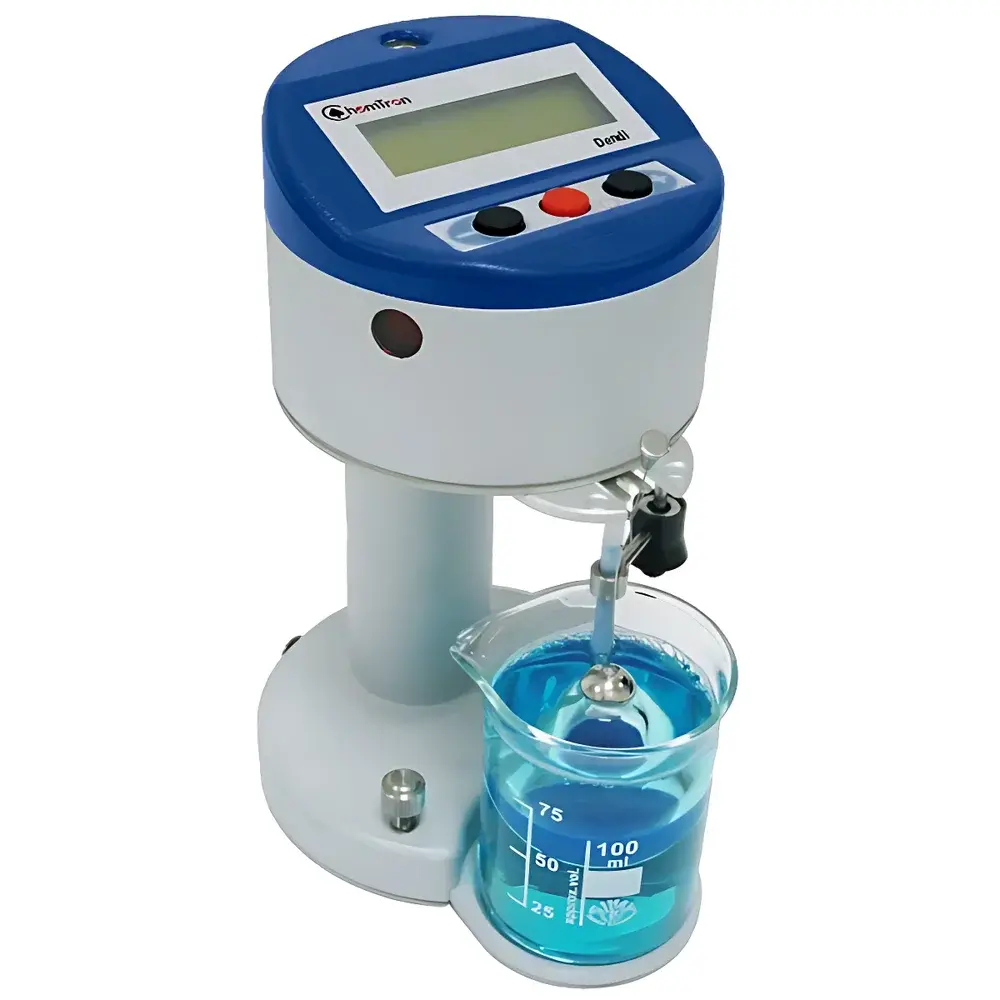
ChemTron DenDi Desktop & Portable Density Meter
| Brand | ChemTron |
|---|---|
| Origin | Germany |
| Model | DenDi |
| Instrument Type | Laboratory Benchtop Digital Density Meter |
| Measurement Principle | Archimedean Buoyancy (Oscillating U-tube not used |
| Density Range | 0 to 3 g/cm³ (0 to 3000 kg/m³) |
| Accuracy | ±0.0005 g/cm³ (±0.5 kg/m³) |
| Repeatability | ±0.00025 g/cm³ (±0.25 kg/m³) |
| Resolution | 0.0001 g/cm³ (0.1 kg/m³) |
| Temperature Range | +15 °C to +30 °C |
| Temperature Accuracy | ±0.01 °C |
| Sample Volume | 100 mL |
| Power Supply | Rechargeable NiMH 9 V / 150 mAh battery (up to 12 h operation) |
| Dimensions (H × L × W) | 135 × 100 × 190 mm |
| Weight | 1.3 kg |
| Compliance | ASTM D1298, ASTM D4052 (for reference correlation), ISO 12185 (petroleum density), DIN 51757, EN ISO 279 |
| Data Storage | 998 timestamped measurements onboard |
| Interface | Infrared (IrDA) for PC and thermal printer connectivity |
| Display | Backlit LCD with multi-unit real-time readout |
Overview
The ChemTron DenDi Desktop & Portable Density Meter is a precision-engineered, dual-mode instrument designed for high-accuracy density determination of liquids in both laboratory and field environments. Unlike oscillating U-tube densimeters, the DenDi operates on the fundamental principle of Archimedean buoyancy: a calibrated float—fabricated from stainless steel or borosilicate glass with precisely known mass and volume—is fully immersed in the sample. The gravitational and buoyant forces acting on the float are measured via an integrated high-resolution analytical balance mechanism. This hydrostatic weighing approach delivers traceable, SI-aligned density values without reliance on vibration frequency calibration or complex fluid dynamics modeling. The system is factory-calibrated using air and double-distilled water at defined reference temperatures, ensuring metrological consistency across installations. Its compact benchtop footprint (135 × 100 × 190 mm) and integrated rechargeable power supply support seamless transition between QC lab workflows and on-site process verification—particularly valuable in upstream oil & gas, dairy quality control, beverage alcohol certification, and cosmetic formulation labs.
Key Features
- True dual-use architecture: functions as both a fixed laboratory instrument and a battery-powered portable unit (12 h runtime, 1.3 kg weight, included carry case)
- High-resolution density measurement: 0.0001 g/cm³ resolution with ±0.0005 g/cm³ accuracy and ±0.00025 g/cm³ repeatability
- Integrated Pt100 temperature sensor with ±0.01 °C accuracy and automatic temperature compensation (ATC) per ASTM D1250 and ISO 91-1
- Multi-parameter real-time calculation: simultaneous display of density (g/cm³, kg/m³, lb/gal, lb/ft³), relative density (SG), API gravity, °Bx (Brix), alcohol % vol, °P (Plato), and temperature (°C/°F)
- One-button, two-step operation: minimal user training required; no consumables or moving parts subject to wear
- Onboard data storage: 998 timestamped measurements with date/time stamping, accessible via infrared interface
- Compliance-ready design: supports audit trails when paired with optional Windows software (21 CFR Part 11-compliant configuration available)
Sample Compatibility & Compliance
The DenDi is validated for use with low-to-moderate viscosity liquids (e.g., ethanol-water mixtures, milk, fruit juices, crude oils, lubricants, paint solvents, and cosmetic emulsions). It requires only 100 mL of sample per measurement—compatible with standard volumetric cylinders and easy to clean between runs. The instrument conforms to key international standards including ASTM D1298 (manual hydrometer method equivalence), ASTM D4052 (reference correlation for digital densimeters), ISO 12185 (crude oil and petroleum products), DIN 51757 (petroleum fuels), and EN ISO 279 (foodstuffs). Its calibration protocol—based on air and certified double-distilled water—aligns with ISO/IEC 17025 requirements for accredited testing laboratories. For regulated environments (e.g., pharmaceutical excipient release or fuel blending certification), the optional Windows software enables electronic signatures, user access control, and full GLP/GMP audit trail generation.
Software & Data Management
The DenDi communicates via IrDA infrared interface to PCs and thermal printers—no cables or drivers required. The optional ChemTron Density Manager software (Windows 10/11 compatible) provides advanced data handling: customizable report templates (PDF/CSV/XLSX), statistical analysis (mean, SD, RSD, trend charts), batch ID assignment, and integration with LIMS systems. All raw measurements—including temperature-stamped density, calculated concentration, and operator ID—are stored with immutable timestamps. When configured with role-based authentication and electronic signature modules, the software meets FDA 21 CFR Part 11 requirements for electronic records and signatures in regulated industries. Data export supports automated archiving to network drives or cloud repositories, facilitating routine QA documentation and regulatory submissions.
Applications
- Petroleum & biofuels: API gravity, base stock density, blend verification per ASTM D1250
- Beverage industry: alcohol % vol certification (EN 15038), Brix correction for juice concentrates, Plato for wort analysis
- Dairy & food: fat content estimation via density correlation, milk adulteration screening, syrup consistency control
- Chemicals & coatings: solvent purity verification, resin formulation QC, paint density specification compliance (ISO 2811)
- Pharmaceuticals: excipient density screening, cleaning solution concentration monitoring, USP density validation support
FAQ
What physical principle does the DenDi use for density measurement?
It applies Archimedean buoyancy: a precision float is suspended in the sample, and the resulting force equilibrium is measured by a micro-balance system.
Can the DenDi measure samples above 30 °C?
No—the operational temperature range is strictly +15 °C to +30 °C. External thermostatic control or pre-conditioning is required for out-of-range samples.
Is calibration traceable to national standards?
Yes—calibration uses air (density calculated per CIPM-2007) and double-distilled water (certified conductivity ≤ 1 µS/cm), enabling traceability to NIST SRM 1691 or equivalent.
Does the instrument require periodic recalibration?
Annual verification against certified reference materials is recommended; daily zeroing and two-point calibration (air/water) maintain ongoing accuracy.
How is data integrity ensured during IR transmission?
All IrDA transfers include CRC-16 error checking; corrupted packets are automatically retransmitted, and software logs all communication events.



