
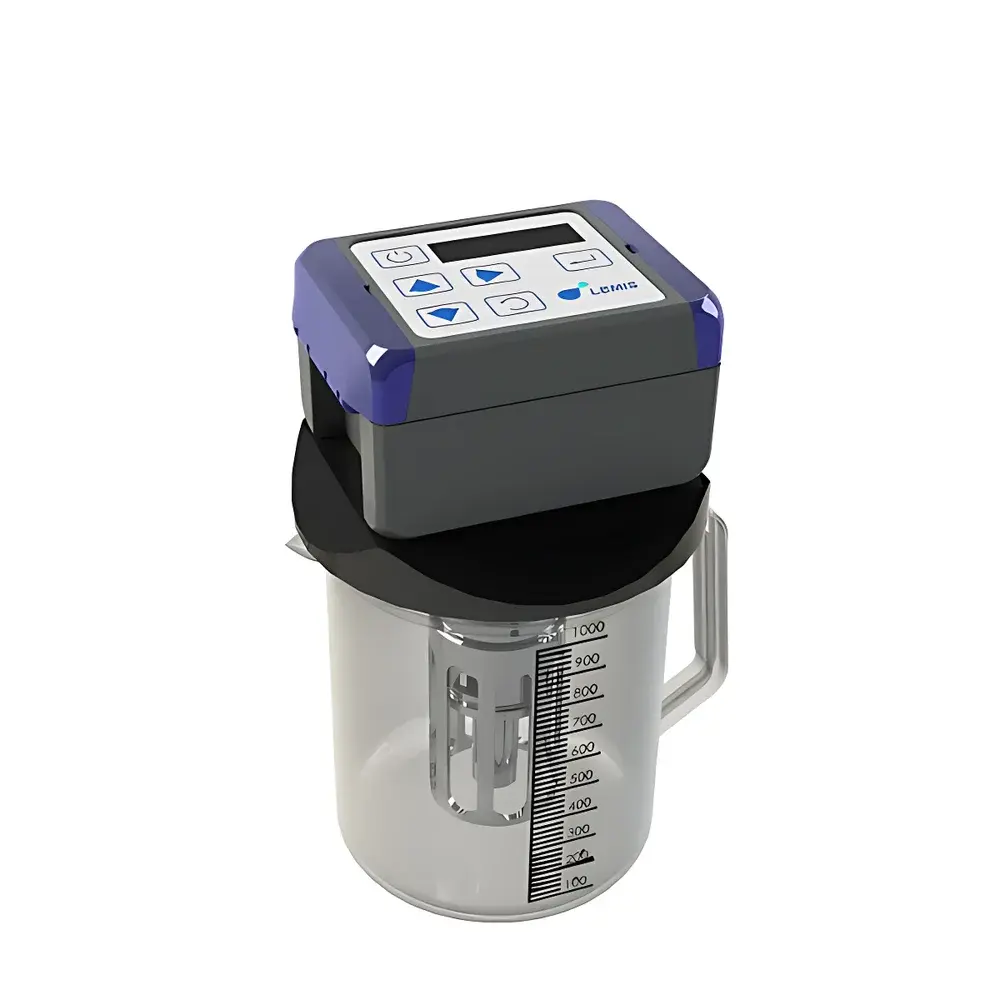
ChemTron DM-250.5 Handheld Digital Density Meter
| Brand | ChemTron |
|---|---|
| Origin | Germany |
| Model | DM-250.5 |
| Instrument Type | Portable Buoyancy-Based Density Meter |
| Application | Liquid Density Measurement |
| Density Range | 0 to 3 g/cm³ (0 to 3000 kg/m³) |
| Density Accuracy | ±0.0003 g/cm³ (±0.3 kg/m³) |
| Repeatability | ±0.00015 g/cm³ (±0.15 kg/m³) |
| Resolution | 0.0001 g/cm³ (0.1 kg/m³) |
| Temperature Range (Measurement) | −30 °C to +50 °C |
| Temperature Accuracy | ±0.1 °C |
| Operating Ambient Temperature | −40 °C to +85 °C |
| Viscosity Compensation Limit | up to 2000 cP |
| Intrinsic Safety Certification | ATEX II (2G) EEx ib [ia] IIB T4 (Controller), ATEX II 1G EEx ia IIB T4 (Sensor) |
| Communication | Bluetooth v5.0, Internal Data Storage |
Overview
The ChemTron DM-250.5 Handheld Digital Density Meter is an intrinsically safe, portable density measurement instrument engineered for high-precision, on-site liquid density determination without sample extraction. It operates on the principle of hydrostatic buoyancy (Archimedean principle), employing a temperature-compensated oscillating U-tube sensor with integrated platinum resistance thermometer (Pt100) for simultaneous density and temperature acquisition. Designed specifically for hazardous and remote industrial environments—including oil terminals, ethanol fermentation tanks, chemical process lines, and pharmaceutical clean utilities—the DM-250.5 delivers laboratory-grade metrological performance in a ruggedized field-deployable form factor. Its fully sealed, IP67-rated housing and extended ambient operating range (−40 °C to +85 °C) ensure operational integrity under extreme outdoor conditions, while its certified intrinsic safety architecture enables direct use in Zone 1 (gas) and Zone 0 (sensor) classified areas per ATEX and IECEx directives.
Key Features
- Intrinsically safe design compliant with ATEX II (2G) EEx ib [ia] IIB T4 (controller) and ATEX II 1G EEx ia IIB T4 (sensor), certified for use in explosive atmospheres containing Group IIB gases (e.g., hydrogen, ethylene, propane)
- Real-time automatic temperature compensation using dual-point Pt100 sensing—eliminates manual correction and ensures traceable density values referenced to 20 °C per ISO 12185 and ASTM D4052
- Integrated Bluetooth 5.0 module enabling wireless data transmission to mobile devices or Windows-based PCs; supports secure pairing and encrypted data exchange
- Onboard non-volatile memory stores up to 10,000 measurement records with timestamp, temperature, density, operator ID, and location metadata (GPS optional via paired smartphone)
- Rugged aluminum-magnesium alloy chassis with shock-absorbing elastomer overmold; tested to MIL-STD-810G for drop, vibration, and thermal cycling durability
- Viscosity-adaptive algorithm compensates for fluid damping effects up to 2000 cP, maintaining accuracy across Newtonian and mildly non-Newtonian liquids (e.g., crude oils, glycerol-water blends, syrups)
Sample Compatibility & Compliance
The DM-250.5 is validated for direct immersion measurement of homogeneous, non-aerated liquids including hydrocarbons, alcohols, aqueous solutions, edible oils, pharmaceutical solvents, and cosmetic emulsions. It is not intended for slurries, suspensions, or highly volatile low-boiling-point fluids (<35 °C flash point) unless vapor containment protocols are implemented. Regulatory compliance includes full alignment with ISO/IEC 17025:2017 calibration traceability requirements when used with ChemTron-certified reference standards (NIST-traceable mineral oil and water mixtures). Device firmware and data logging routines support audit-ready operation under FDA 21 CFR Part 11 (electronic records/signatures) and EU Annex 11 (computerized systems) when deployed in GMP-regulated environments. Calibration verification intervals are defined per ISO 9001:2015 clause 7.1.5.2 and may be adjusted based on usage frequency and criticality per internal SOPs.
Software & Data Management
The instrument interfaces with ChemTron DensityLink™ PC software (Windows 10/11, 64-bit) and the ChemTron FieldSync™ mobile application (iOS/Android). DensityLink provides full GLP-compliant reporting, customizable certificate generation (including uncertainty budgets per GUM), batch trend analysis, and integration with LIMS via CSV/XML export or OPC UA server interface. FieldSync enables offline measurement logging, photo annotation of sampling points, geotagging, and preconfigured test templates aligned with ASTM D1298 (crude oil), ASTM D4052 (distillates), or USP (pharmaceutical density specifications). All stored data include immutable audit trails: user login, calibration event logs, firmware version stamps, and cryptographic hash signatures for integrity verification.
Applications
- Petroleum & refining: Real-time density profiling of crude slugs, bunker fuel certification (ISO 8217), pipeline interface detection, and custody transfer verification at loading arms
- Biofuels: Ethanol blend verification (E10–E85), fermentation broth monitoring, and biodiesel (FAME) quality control per EN 14214
- Food & beverage: Brix/density correlation for juice concentration, alcohol content estimation in wines and spirits, and syrup consistency grading
- Pharmaceuticals: Excipient density screening, solvent purity checks (e.g., IPA, ethanol), and density-based identity testing of liquid APIs per USP monographs
- Chemicals & cosmetics: Batch release testing of surfactant solutions, glycol-based antifreezes, and fragrance oil formulations where density serves as a primary QC parameter
FAQ
What calibration standards are required for routine verification?
Certified density reference liquids traceable to NIST or PTB—such as water (0.998203 g/cm³ at 20 °C), kerosene (0.785–0.810 g/cm³), and bromobenzene (1.495 g/cm³)—are recommended for daily zero and span checks. ChemTron supplies CRM-certified kits with uncertainty ≤ ±0.00005 g/cm³.
Can the DM-250.5 measure density of corrosive media such as concentrated acids or caustics?
Yes—when equipped with optional Hastelloy C-276 wetted parts (sensor tip and immersion sleeve); standard configuration uses 316L stainless steel, suitable for pH 2–12 and non-oxidizing media only.
Is temperature-controlled sample conditioning required before measurement?
No—its built-in Peltier-assisted thermal stabilization (±0.05 °C control) and real-time compensation eliminate the need for external baths or equilibration time.
How is measurement uncertainty calculated and reported?
Uncertainty is computed per GUM (JCGM 100:2008) incorporating contributions from sensor repeatability, temperature measurement error, calibration standard uncertainty, and viscosity-induced damping correction—automatically embedded in exported reports.
Does the device support multi-language UI and regulatory documentation packages?
Yes—UI languages include English, German, French, Spanish, Chinese, and Japanese; full technical documentation (Declaration of Conformity, EC Type Examination Certificate, calibration manual, and risk assessment report) is provided in English and EU official languages upon request.



