
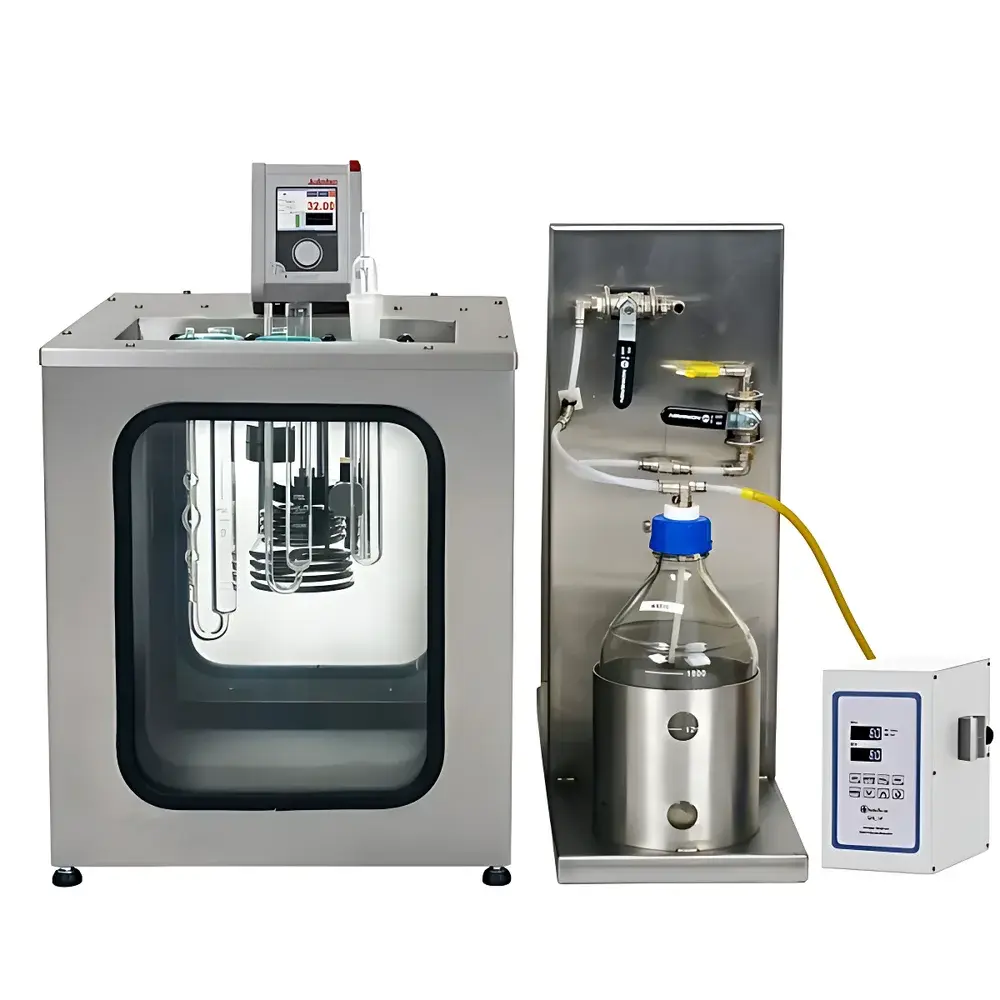
ChemTron VACS-EN12596 Asphalt Vacuum Capillary Viscometer
| Brand | ChemTron |
|---|---|
| Origin | Germany |
| Model | VACS-EN12596 |
| Instrument Type | Fixed Rotational Viscometer (Capillary Vacuum Method) |
| Compliance | ASTM D2171, EN 12596 |
| Operating Environment | Ambient Temperature |
| Vacuum Control | Digital Vacuum Controller with Membrane Pump |
| Temperature Stability | ±0.1 °C (when used with TCB-7 bath) |
| Sample Measurement Principle | Capillary Efflux Time under Controlled Vacuum |
Overview
The ChemTron VACS-EN12596 Asphalt Vacuum Capillary Viscometer is a precision-engineered system designed for the standardized determination of kinematic viscosity of bituminous binders using the vacuum capillary efflux method. It operates in strict accordance with ASTM D2171 (Standard Test Method for Viscosity of Asphalt Cement by Vacuum Capillary Viscometer) and EN 12596 (Bitumen and Bituminous Binders — Determination of Kinematic Viscosity of Penetration Grade Bitumens). Unlike rotational rheometers that measure dynamic viscosity under shear, this instrument quantifies kinematic viscosity (mm²/s) via gravitational flow through calibrated glass capillaries under precisely regulated vacuum conditions—ensuring high reproducibility across laboratories and alignment with global pavement material specifications.
Key Features
- Digital vacuum controller with real-time pressure display and adjustable setpoint (range: 0–100 kPa absolute), enabling stable, repeatable vacuum levels during efflux timing.
- Integrated membrane vacuum pump with oil-free operation, low noise (<52 dB(A)), and maintenance-free design—suitable for continuous use in QC labs.
- Multi-port vacuum manifold for simultaneous connection of up to four capillary viscometers, supporting parallel testing or calibration verification.
- Compact benchtop footprint (W × D × H: 420 × 350 × 280 mm), optimized for space-constrained asphalt testing laboratories.
- Pre-configured vacuum tubing, borosilicate glass U-tube manometer, and UKAS-traceable calibration certificate included with each VACS-EN12596 system.
- Compatible with ISO/IEC 17025-compliant quality workflows: all vacuum and temperature parameters are recordable and exportable for audit-ready documentation.
Sample Compatibility & Compliance
The VACS-EN12596 is validated for penetration-grade bitumens, oxidized bitumens, and polymer-modified bitumens (PMBs) meeting EN 13924, EN 14023, and AASHTO M226 requirements. Capillary viscometers (e.g., types 1673 and 1677 per EN 12596 Annex A) are selected based on expected viscosity range (typically 100–100,000 mm²/s at 60 °C). The system supports both manual and semi-automated timing protocols; when paired with PR5600T digital thermometer and TCB-7 thermostatic bath (Rt.+5 °C to 60 °C or 135 °C), it achieves thermal stability ≤ ±0.05 °C over 30-minute equilibration—meeting the temperature tolerance criteria specified in Clause 6.2 of EN 12596. All components comply with CE marking directives and RoHS 2011/65/EU.
Software & Data Management
While the core VACS-EN12596 operates as a hardware-controlled analog measurement platform, its digital vacuum controller provides RS-232 output for integration into LIMS or custom data acquisition systems. Users may log vacuum pressure, ambient temperature, efflux time, and operator ID via timestamped CSV exports. For GLP/GMP environments, optional software modules support 21 CFR Part 11-compliant electronic signatures, audit trails, and user access control—enabling full traceability from sample loading to final kinematic viscosity calculation (ν = C × t, where C is capillary constant in mm²/s² and t is efflux time in seconds). Calibration records—including UKAS certificate number, date, and uncertainty budget—are stored separately per instrument configuration.
Applications
- Quality control of paving-grade bitumen prior to asphalt plant batching.
- Verification of viscosity compliance for contractual specifications (e.g., EN 13924 Class 30/40, 40/60, 70/100).
- Research evaluation of aging effects (RTFOT, PAV) on binder rheology.
- Supporting EN 13108-1 Annex E procedures for hot-mix asphalt design.
- Third-party certification testing accredited to ISO/IEC 17025:2017.
- Training and inter-laboratory comparison studies under EURAMET CG-18 guidelines.
FAQ
Which capillary viscometers are certified for use with the VACS-EN12596 system?
The system is validated for EN 12596-compliant capillaries including type 1673 (for viscosities 100–10,000 mm²/s) and type 1677 (for 1,000–100,000 mm²/s), both supplied with individual calibration constants traceable to NPL or PTB.
Can the VACS-EN12596 be used for testing at temperatures above 60 °C?
Yes—when configured with the TCB-7H bath (Rt.+5 °C to 135 °C) and high-temperature capillaries (e.g., type 1850/A1 stand), the system supports viscosity testing at 135 °C per ASTM D4402 for polymer-modified binders.
Is vacuum calibration required before each test series?
Per EN 12596 Section 7.3, daily verification of vacuum accuracy using a certified reference manometer is recommended; full recalibration of the digital controller is required annually or after 500 operating hours.
How is temperature uniformity verified across the capillary bulb?
Temperature uniformity is assessed per EN 12596 Annex B using at least three PT100 probes placed at top/mid/bottom positions within the bath; deviation must remain ≤0.1 °C during measurement.
Does the system support automated efflux timing?
The base VACS-EN12596 uses manual stopwatch timing per standard procedure; however, optional photoelectric sensor kits (e.g., VACS-TIMELINK) enable automatic start/stop triggering synchronized with meniscus passage detection.



