
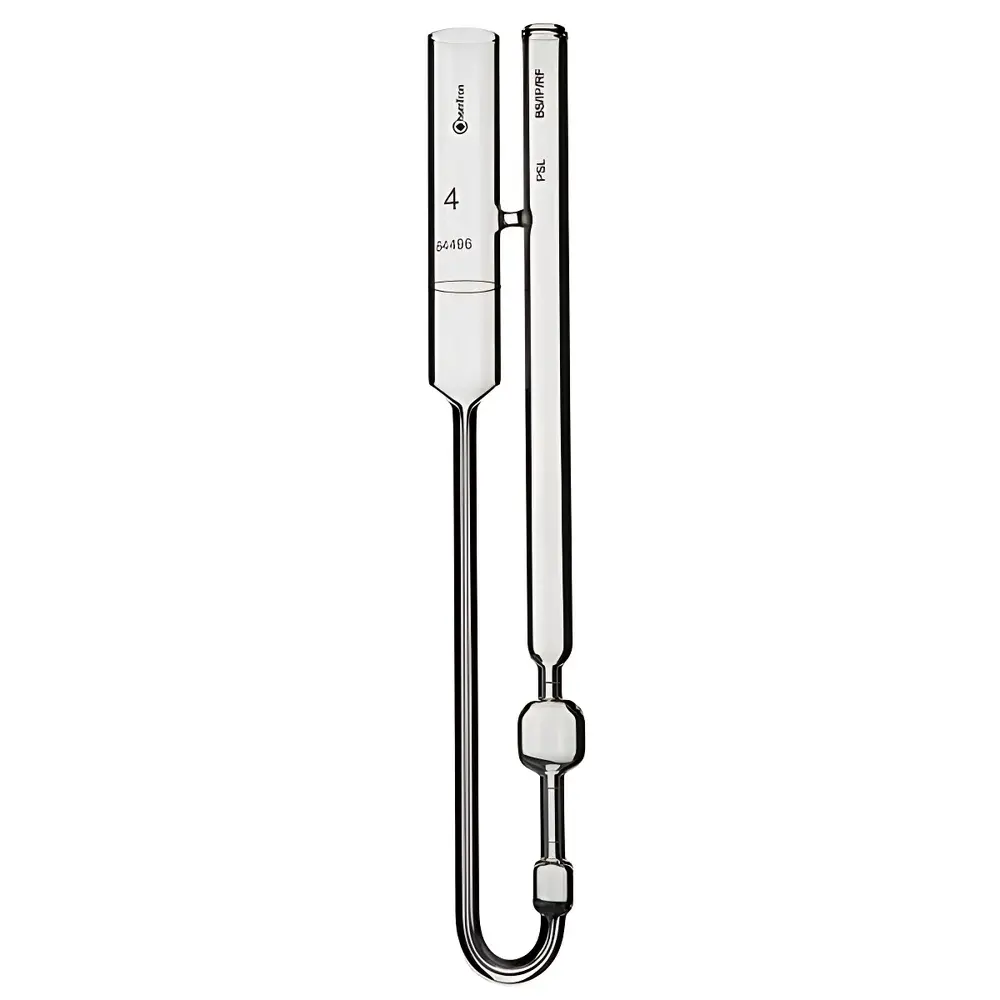
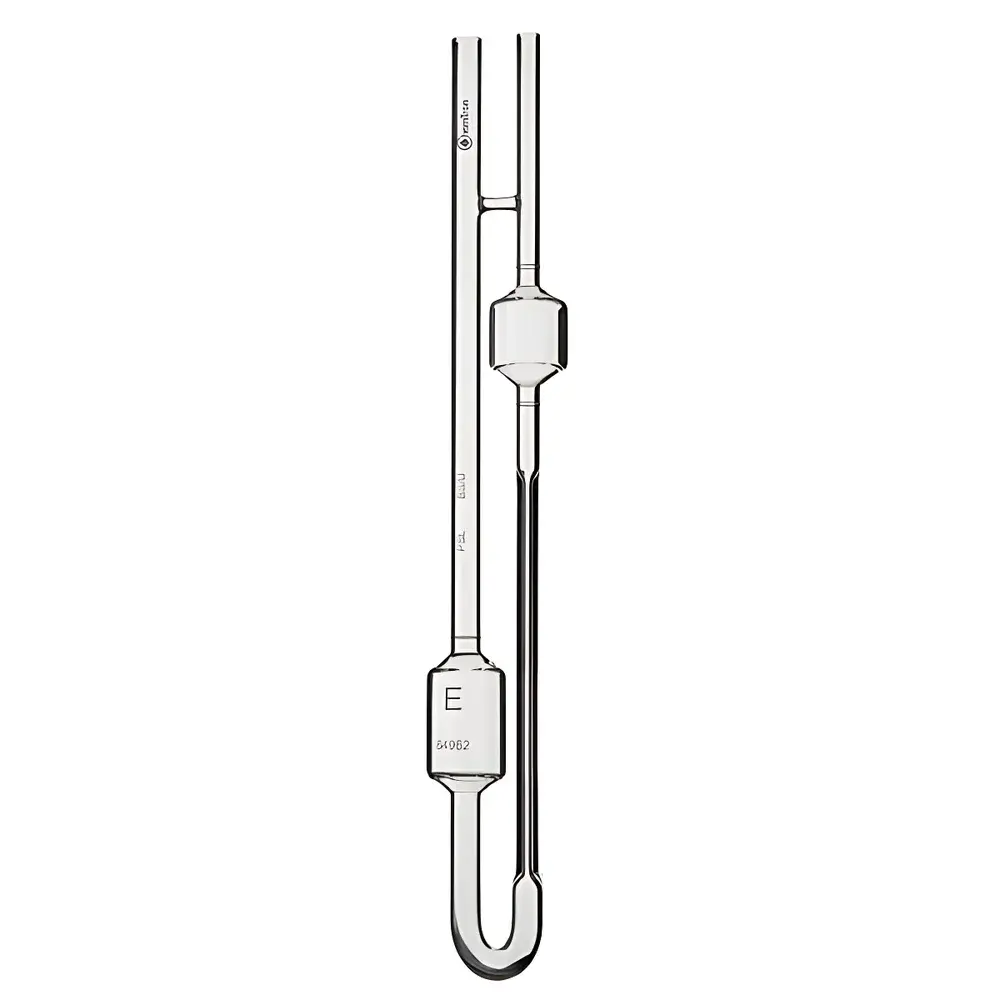
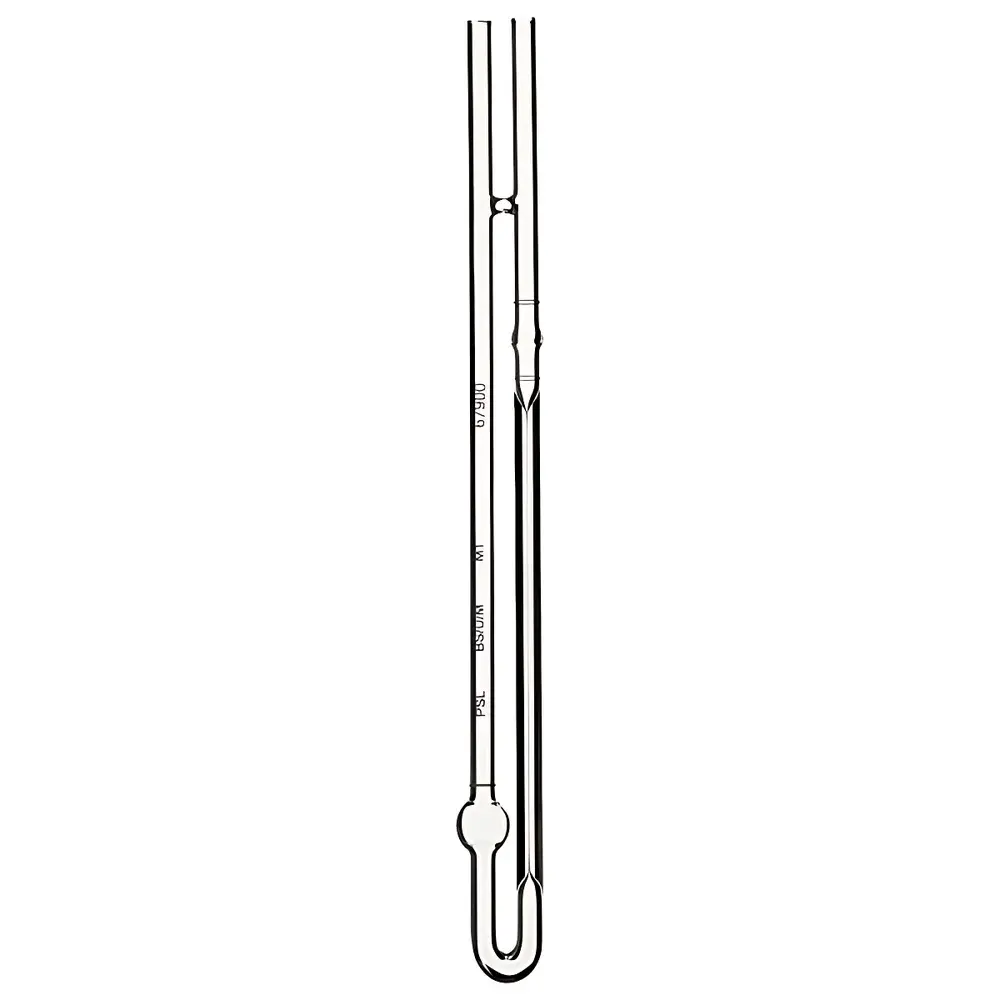
ChemTron U-Tube Viscometer Series (Models 1637, 1619, 1622)
| Brand | ChemTron |
|---|---|
| Origin | Germany |
| Instrument Type | Capillary Viscometer (U-Tube, Reverse-Flow & Standard) |
| Calibration | ISO/IEC 17025-accredited |
| Viscosity Range | 0.2 – 300,000 mm²/s |
| Fill Volume | 4 – 40 mL |
| Tube Length | 250 – 300 mm |
| Portability | Benchtop / Manual Operation |
| Compliance | ASTM D445, ISO 3104, IP 71, BS EN ISO 3104, USP <911> |
Overview
The ChemTron U-Tube Viscometer Series comprises three precision-engineered capillary viscometer families—Model 1637 (reverse-flow U-tube), Model 1619 (standard U-tube), and Model 1622 (micro-volume U-tube)—designed for kinematic viscosity measurement of liquids under gravity-driven laminar flow conditions. Based on the fundamental Poiseuille principle, these instruments determine kinematic viscosity (ν, in mm²/s, equivalent to cSt) by measuring the efflux time of a fixed volume of liquid through a calibrated capillary under controlled temperature (typically 20 °C, 25 °C, or 40 °C per ASTM D445). Each tube is individually calibrated in accordance with ISO/IEC 17025 requirements and assigned a certified K-value (mm²/s²), enabling direct calculation: ν = K × t, where t is the measured efflux time in seconds. The series supports routine QC testing in petroleum refineries, lubricant formulation labs, chemical manufacturing, and pharmaceutical excipient characterization—where traceable, operator-independent viscosity data are essential for batch release and specification compliance.
Key Features
- Three distinct U-tube configurations: reverse-flow (1637) for opaque or particulate-laden samples; standard U-tube (1619) optimized for clear oils and solvents; micro-volume design (1622) requiring only 4 mL for high-value or limited-availability samples.
- Full ISO/IEC 17025 calibration traceability: each viscometer bears a unique K-value engraved on the bulb and documented in its certificate of calibration, including uncertainty budget and reference standard traceability to NIST or PTB.
- Modular support system: dedicated holders (1836/A1, 1818/A1–A2, 1821/A1) ensure precise vertical alignment and thermal stability during immersion in constant-temperature baths—critical for repeatability per ASTM D445 Section 7.2.
- Wide dynamic range coverage: 11 calibrated ranges for Model 1637 (0.6–300,000 mm²/s), 9 ranges for Model 1619 (0.3–10,000 mm²/s), and 5 micro-ranges for Model 1622 (0.2–100 mm²/s), eliminating cross-range interpolation errors.
- Robust borosilicate glass construction (DIN 7080-compliant), chemically resistant to hydrocarbons, mineral oils, esters, and common organic solvents—validated for long-term use in GLP-regulated environments.
Sample Compatibility & Compliance
These viscometers accommodate Newtonian and near-Newtonian liquids across diverse industrial matrices: base oils, transformer fluids, biodiesel blends, polymer solutions (dilute), glycols, and pharmaceutical silicone oils. The reverse-flow 1637 design enables reliable measurement of dark or turbid samples (e.g., asphaltene-containing fuels or pigmented resins) without optical interference. All models comply with ASTM D445 (Standard Test Method for Kinematic Viscosity of Transparent and Opaque Liquids), ISO 3104 (Petroleum products — Determination of kinematic viscosity and calculation of dynamic viscosity), IP 71, and BS EN ISO 3104. When operated within validated bath temperature stability (±0.02 °C) and using certified stopwatch or automated timing systems, results meet FDA 21 CFR Part 11 data integrity expectations for regulated submissions.
Software & Data Management
While inherently manual, ChemTron U-tube viscometers integrate seamlessly into digital QA workflows. Efflux times recorded via ISO 17025-validated electronic timers (e.g., Sartorius TIM5xx or Lovibond VISCO Timer) can be exported to LIMS or ELN platforms. ChemTron provides Excel-based calculation templates preloaded with K-values and uncertainty propagation formulas aligned with GUM (JCGM 100:2008). For laboratories implementing electronic records, the calibration certificates include machine-readable QR codes linking to secure PDF archives—supporting audit readiness for ISO 9001, ISO 17025, and GMP inspections.
Applications
- Petroleum & Lubricants: Kinematic viscosity grading of engine oils (SAE J300), hydraulic fluids (ISO VG classes), and crude assay fractions.
- Chemical Manufacturing: Quality control of ethylene glycol, propylene glycol, and polyol intermediates per ASTM D1120.
- Pharmaceuticals: Viscosity verification of silicone oils used as lubricants in prefilled syringes (USP ) and parenteral excipients.
- Academic Research: Teaching fluid mechanics principles, calibrating rotational viscometers, and validating CFD models of capillary flow.
- Renewables: Biodiesel (FAME) viscosity compliance testing against EN 14214 limits (3.5–5.0 mm²/s at 40 °C).
FAQ
What is the difference between reverse-flow (1637) and standard U-tube (1619) designs?
The 1637 reverse-flow configuration directs sample flow upward through the capillary, allowing visual timing initiation at the upper meniscus—ideal for opaque liquids where the lower meniscus is obscured. The 1619 follows conventional downward flow and requires transparent samples for accurate meniscus detection.
Can these viscometers be used for non-Newtonian fluids?
No. U-tube capillary viscometers assume Newtonian behavior and laminar flow (Re < 2000). For shear-thinning or thixotropic materials, rotational rheometry per ISO 3219 or ASTM D2196 is required.
How often must recalibration be performed?
Per ISO/IEC 17025 Clause 6.6, recalibration is recommended annually—or after mechanical shock, exposure to aggressive solvents, or observed drift exceeding ±0.5% of K-value—using accredited providers with traceable standards.
Is temperature control mandatory?
Yes. Kinematic viscosity is highly temperature-dependent (±1 °C induces ~2–5% error). ASTM D445 mandates thermostatted bath operation with stability ≤ ±0.02 °C for Grade A accuracy.
Do ChemTron U-tubes meet GLP requirements for regulated labs?
Yes—when used with documented procedures, calibrated timers, trained operators, and archived original efflux time records alongside certified K-values and bath calibration logs, they satisfy OECD GLP Principles and FDA inspection criteria for viscosity testing.



