
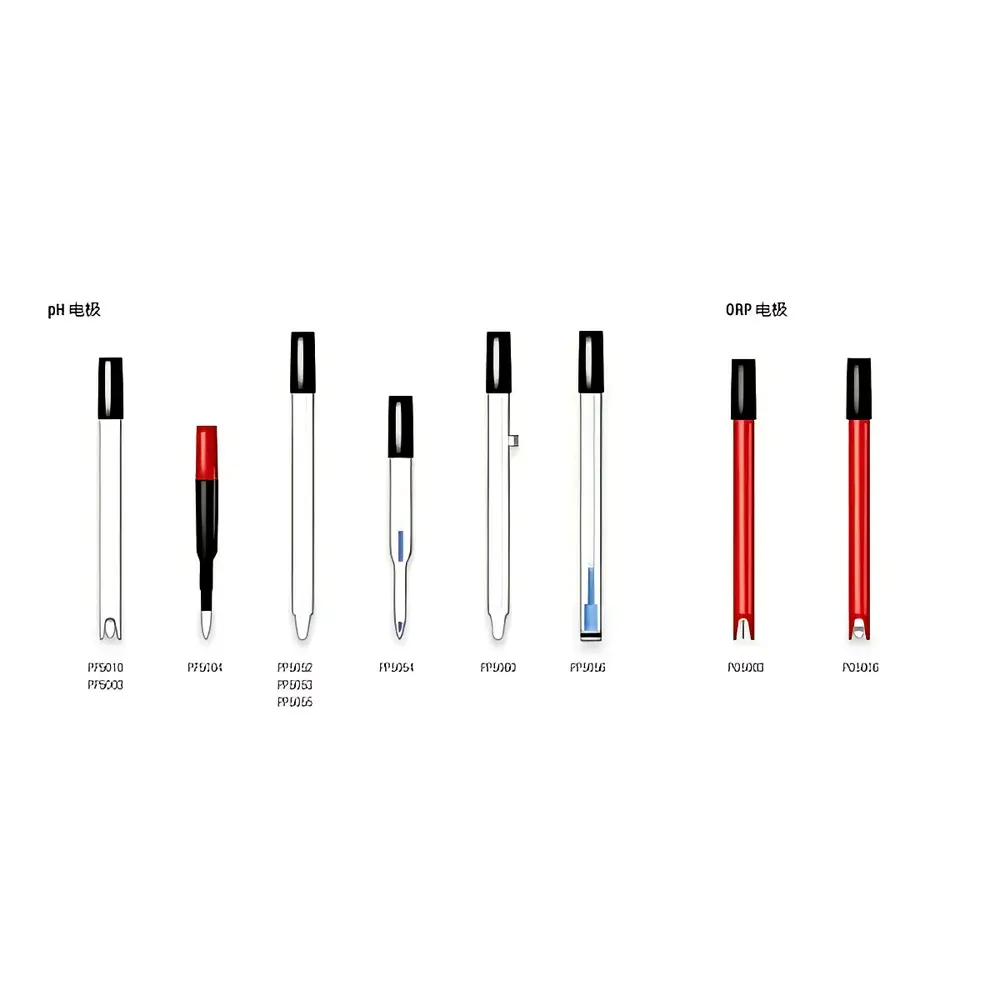
ChemTron pH & ORP Electrodes Series
| Brand | ChemTron |
|---|---|
| Origin | Germany |
| Type | pH and ORP Composite Electrodes |
| Connection | BNC |
| Cable Length | 1 m |
| Housing Material | Plastic or Glass (model-dependent) |
| Temperature Range | −5 °C to 130 °C (varies by model) |
| pH Range | 0–14 pH |
| ORP Range | ±1200 mV |
| Pressure Rating | Up to 6 bar (glass models) |
| Compliance | CE, RoHS, ISO/IEC 17025-compatible calibration traceability |
Overview
ChemTron pH & ORP Electrodes are a modular family of high-precision electrochemical sensing elements engineered for reliable, reproducible potentiometric measurement in diverse analytical environments. Based on the Nernst equation principle, these electrodes generate a stable, millivolt-level potential difference proportional to hydrogen ion activity (pH) or redox potential (ORP) in aqueous and semi-aqueous media. Designed and manufactured in Germany, each electrode integrates a reference system (Ag/AgCl or double-junction configuration) with a sensing element—either a pH-sensitive glass membrane or a platinum or gold ORP sensor—optimized for specific sample matrices. The series supports both routine laboratory quality control and demanding industrial process monitoring, with variants validated for use under elevated temperature, pressure, low ionic strength, or heterogeneous physical states.
Key Features
- Modular design with application-specific configurations: plastic-bodied electrodes for cost-effective general use; glass-bodied variants for enhanced chemical resistance, thermal stability, and pressure tolerance up to 6 bar.
- Multiple junction and filling systems—including gel-filled, liquid-filled, and double-junction reference compartments—to minimize contamination and junction clogging in viscous, protein-rich, or sulfide-laden samples.
- Specialized geometries: conical tip for surface measurement (e.g., skin, food surfaces), spear-tip for direct insertion into semi-solids (cheese, meat, sludge), and flat-surface sensors for non-invasive contact applications.
- Integrated NTC temperature sensors (e.g., PP5010, PP5055) enable automatic temperature compensation (ATC) when paired with compatible ChemTron or third-party meters supporting analog or digital RTD input.
- BNC connector standardization ensures seamless interoperability with benchtop and portable pH/ORP meters across major manufacturers (e.g., Mettler Toledo, Hanna, Thermo Fisher, Oakton).
- All electrodes ship with protective storage caps containing KCl-based electrolyte solution to maintain hydration and junction integrity during idle periods.
Sample Compatibility & Compliance
ChemTron electrodes address challenging sample types through purpose-built construction: PP5053 and PP5054 models feature reinforced membranes and optimized liquid junctions for high-viscosity liquids (e.g., syrups, slurries, dairy products); PP5055 operates continuously at temperatures up to 130 °C for sterilization-cycle monitoring or hot-process streams; PP5057 incorporates low-resistance glass and high-conductivity electrolyte for accurate measurement in deionized water, rainwater, or ultrapure process water (conductivity < 5 µS/cm). All models comply with CE marking requirements and RoHS directives. While not certified medical devices, surface-contact variants (PP5056) meet ISO 10993-5 biocompatibility screening criteria for short-term non-invasive use. Electrode calibration and performance verification align with ASTM D1293 (pH of water), ISO 7888 (electrochemical pH measurement), and USP (pH measurement in pharmaceutical preparations).
Software & Data Management
Though standalone sensors, ChemTron pH & ORP electrodes interface seamlessly with data-acquisition-capable meters supporting GLP/GMP-compliant logging. When used with ChemTron-compatible instruments (e.g., HP3040, BP3001), electrodes support full audit trail functionality—including timestamped calibration records, slope/mV offset history, and user-defined electrode ID tagging—meeting FDA 21 CFR Part 11 requirements for electronic records where instrument firmware enables secure user authentication and electronic signatures. Raw mV outputs are traceable to NIST-traceable pH buffer standards (e.g., NIST SRM 186, 187), and certificate-of-conformance documentation includes batch-specific calibration data against primary standards.
Applications
- Environmental monitoring: wastewater treatment plants (sludge pH/ORP profiling), surface water quality assessment, leachate analysis.
- Food & beverage QA/QC: cheese ripening control, meat pH post-mortem, brewing fermentation tracking, juice acidity verification.
- Pharmaceutical manufacturing: buffer preparation validation, cleaning-in-place (CIP) endpoint detection, lyophilization cycle monitoring.
- Academic research: electrochemical kinetics studies, corrosion potential mapping, soil redox potential profiling.
- Industrial process control: electroplating bath management, boiler feedwater alkalinity control, bioreactor redox state optimization.
FAQ
What is the recommended storage solution for ChemTron pH electrodes?
Electrodes should be stored upright in a dedicated storage cap filled with 3 mol/L KCl solution (or manufacturer-recommended storage fluid). Never store in distilled or deionized water, as it causes leaching of the internal electrolyte and irreversible junction drying.
Can I use the same electrode for both pH and ORP measurements?
Yes—most ChemTron composite electrodes integrate a dual-function design: the glass membrane measures pH, while the integrated platinum or gold pin serves as the ORP indicator. However, dedicated ORP-only electrodes (e.g., Pt or Au rod types) offer superior long-term stability for continuous redox monitoring.
How often should I recalibrate my electrode?
Calibration frequency depends on application stringency. For GLP-regulated labs, daily two-point calibration (pH 4.01 and 7.00 or 10.01) is standard. In process environments, calibration before each batch or shift is recommended. Slope verification (>95% at 25 °C) and asymmetry potential checks (<±30 mV) should accompany every calibration.
Which electrode is suitable for measuring pH in edible oils?
Standard aqueous electrodes are incompatible with non-aqueous media. For oil-phase pH estimation (e.g., acid value proxy), ChemTron recommends the PP5003 or PP5052 with ethanol/water extraction pretreatment per AOAC 965.33, followed by measurement in the aqueous extract phase.
Do ChemTron electrodes support autoclaving?
Only the PP5055 high-temperature model is rated for intermittent exposure up to 130 °C—but it is not designed for full autoclave cycles (121 °C, 15 psi, 20 min). Sterilization must follow manufacturer-specified thermal ramping protocols to avoid thermal shock-induced glass fracture or seal failure.





