
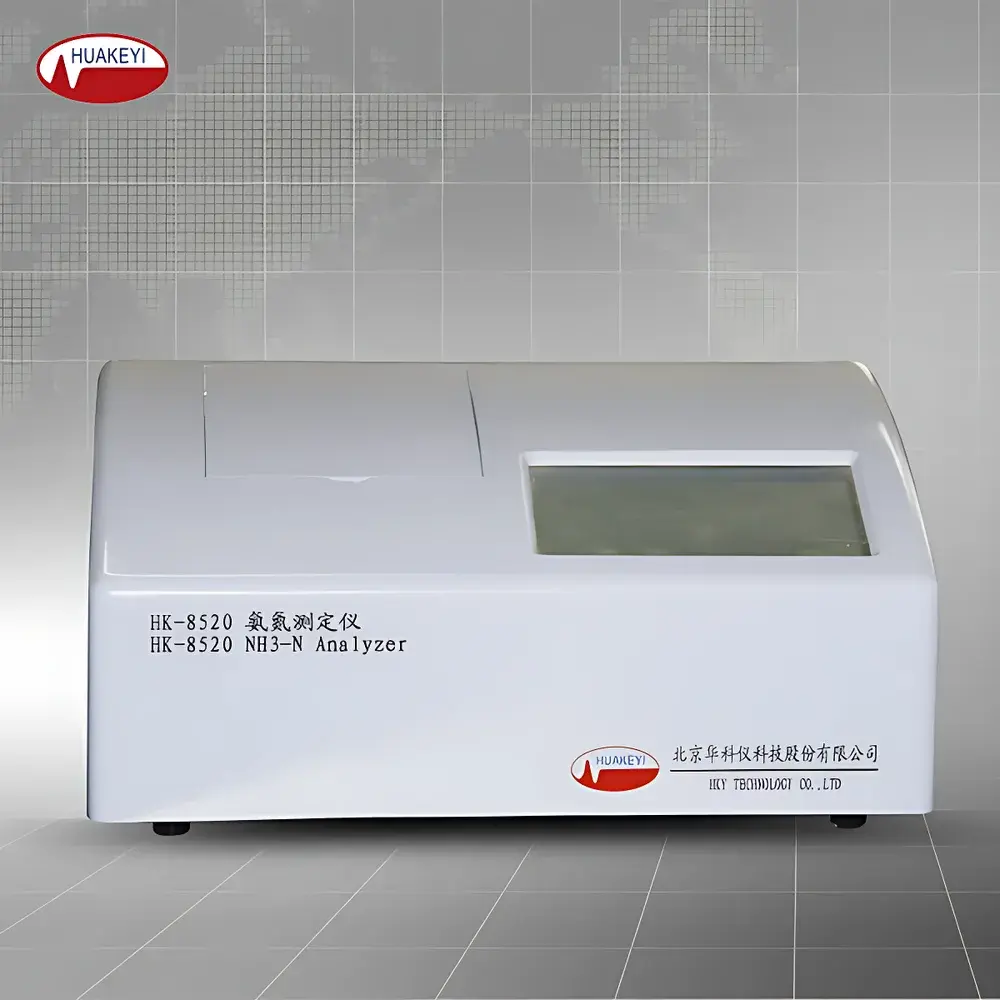
Huakeyi HK-8520 Ammonia Nitrogen Analyzer
| Brand | Huakeyi |
|---|---|
| Origin | Beijing, China |
| Manufacturer Type | Authorized Distributor |
| Product Origin | Domestic (China) |
| Model | HK-8520 |
| Instrument Type | Benchtop Laboratory Analyzer |
| Measurement Principle | Nessler Reagent Spectrophotometry (in accordance with HJ 535–2009) |
| Measurement Range | 0–50 mg/L NH₃–N (extendable to 60 mg/L via built-in dilution algorithm) |
| Detection Limit | 0.1 mg/L |
| Accuracy | ±(5% of reading + 0.1 mg/L) |
| Repeatability | ±5% RSD |
| Measurement Time | 15–20 min per sample |
| Batch Capacity | 16 samples |
| Display | 7-inch capacitive touchscreen (Chinese/English switchable) |
| Data Storage | Up to 100,000 records (measurements, calibrations, system logs) |
| Interface | USB 2.0 for data export |
| Temperature Control | Integrated thermostatic cuvette chamber |
| Light Source | Imported monochromatic LED (peak wavelength ~420 nm) |
| Optical System | Patented dual-beam ratio-metric photometric path |
| Calibration Options | 1-, 2-, or multi-point calibration with user-defined standards |
| Auto-Stabilization Detection | Real-time signal convergence assessment |
| Dimensions | 390 × 248 × 175 mm |
| Weight | 5 kg |
| Power Supply | AC 100–240 V, 50–60 Hz |
| Power Consumption | ≤10 W |
Overview
The Huakeyi HK-8520 Ammonia Nitrogen Analyzer is a benchtop spectrophotometric instrument engineered for precise, trace-level quantification of ammonia nitrogen (NH₃–N) in aqueous matrices. It implements the standardized Nessler reagent method per Chinese Environmental Protection Standard HJ 535–2009 — a colorimetric technique in which free ammonia or ammonium ions react with alkaline mercuric potassium iodide (Nessler’s reagent) to form a stable yellow-brown colloidal complex. The absorbance of this complex at approximately 420 nm is directly proportional to the NH₃–N concentration. Designed for routine compliance monitoring and research-grade analysis, the HK-8520 delivers reliable performance across diverse water types: potable water, wastewater effluents, surface and groundwater, industrial process streams, and aquaculture systems. Its measurement range (0–50 mg/L, extendable to 60 mg/L via programmable dilution logic) and sub-mg/L detection limit (0.1 mg/L) meet regulatory thresholds for environmental discharge permits and drinking water safety verification.
Key Features
- 7-inch high-resolution capacitive touchscreen with intuitive GUI supporting both English and Chinese language modes
- Integrated thermostatic cuvette compartment maintaining optical path stability against ambient temperature fluctuations
- Monochromatic LED light source (420 nm nominal peak) ensuring spectral purity, low thermal drift, and extended service life
- Proprietary dual-beam ratio-metric optical architecture minimizing photometric error from lamp aging or stray light
- Flexible calibration protocols: 1-point, 2-point, or multi-point with user-defined standard concentrations
- Auto-stabilization detection algorithm confirming photometric equilibrium before data acquisition
- Onboard dilution calculation engine enabling seamless extension of upper measurement limit without manual recalibration
- USB 2.0 interface for secure export of measurement datasets, calibration logs, and system event histories
- Non-volatile memory storing up to 100,000 timestamped records — including raw absorbance values, derived concentrations, calibration parameters, and operator IDs
Sample Compatibility & Compliance
The HK-8520 is validated for use with clarified, low-turbidity aqueous samples meeting standard pretreatment requirements outlined in HJ 535–2009: filtration through 0.45 µm membrane, pH adjustment to 10.0–11.0 prior to reagent addition, and interference mitigation (e.g., masking of heavy metals with tartaric acid). It supports direct analysis of municipal drinking water, secondary-treated wastewater, river and lake water, and cooling tower make-up water. While not certified to ISO/IEC 17025 or accredited under CNAS, the instrument’s metrological traceability aligns with national verification procedures for environmental testing equipment (JJG 975–2012). Its design incorporates functional safeguards consistent with GLP-aligned laboratory workflows, including audit-trail-capable data logging and user-accessible calibration history.
Software & Data Management
The embedded firmware provides full lifecycle data governance: all measurements are automatically time- and date-stamped, associated with operator login credentials, and archived with metadata (cuvette ID, calibration curve ID, reagent lot number if entered). Exported CSV files contain raw absorbance, corrected absorbance, calculated concentration, uncertainty estimate (±5% RSD + 0.1 mg/L), and QC flags (e.g., “out-of-linear-range”, “calibration-expired”). No cloud connectivity or remote access capabilities are implemented — data sovereignty remains fully under laboratory control. Firmware updates are delivered via USB drive with version-controlled release notes and change logs compliant with internal validation protocols.
Applications
- Regulatory compliance testing for wastewater discharge permits (e.g., GB 8978–1996, DB11/307–2013)
- Drinking water quality surveillance per GB 5749–2022 (National Sanitary Standard for Drinking Water)
- Process monitoring in municipal wastewater treatment plants (nitrification/denitrification unit control)
- Ecological risk assessment of eutrophic lakes and reservoirs
- Industrial effluent screening in chemical, pharmaceutical, and food processing facilities
- Academic research on nitrogen cycling kinetics and inhibitor efficacy studies
- Calibration verification of online ammonia sensors using grab-sample reference analysis
FAQ
What regulatory standard does the HK-8520 implement for ammonia nitrogen determination?
It conforms to HJ 535–2009, the official Chinese standard for the Nessler reagent spectrophotometric method.
Can the instrument measure samples with turbidity or suspended solids?
No — samples must be filtered through a 0.45 µm membrane prior to analysis to prevent scattering-induced photometric error.
Is the HK-8520 compliant with FDA 21 CFR Part 11 or EU Annex 11?
It does not include electronic signature, role-based access control, or audit trail features required for Part 11 compliance; it is intended for non-GMP environmental labs.
How is calibration traceability maintained?
Users must prepare calibration standards from NIST-traceable NH₄Cl stock solutions; the instrument stores calibration coefficients but does not certify traceability itself.
Does the analyzer support automatic reagent dispensing?
No — reagents are added manually using calibrated pipettes; the HK-8520 performs only photometric measurement and data computation.
Related Products







