
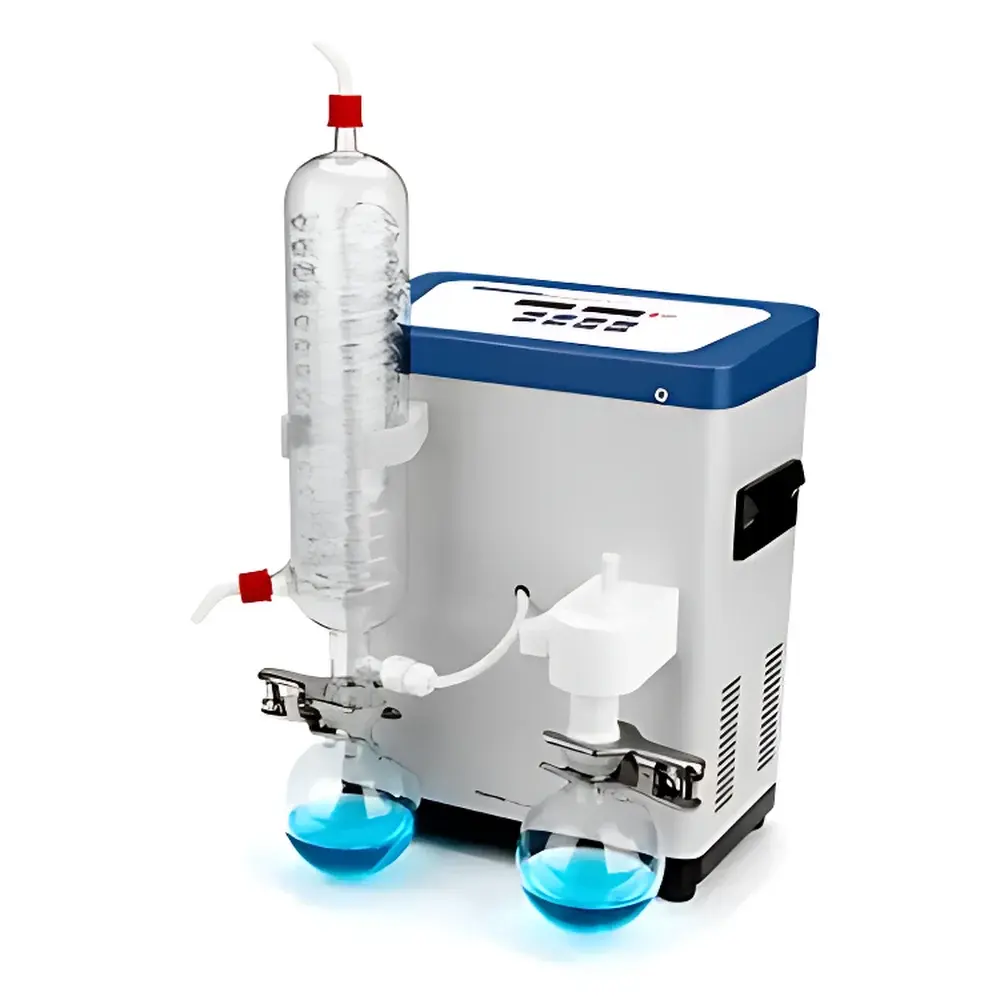
ChemTron CSC.4 / CSC.6 Corrosion-Resistant Solvent Recovery Diaphragm Vacuum Pump
| Brand | ChemTron |
|---|---|
| Origin | Germany |
| Pump Type | Oil-Free Diaphragm Vacuum Pump |
| Model | CSC.4 / CSC.6 |
| Ultimate Vacuum | 2–4 mbar |
| Maximum Flow Rate | 34 L/min |
| Power Consumption | 245 W |
| Inlet/Outlet Port OD | 10 mm |
| Control System | Digital Programmable Vacuum Controller |
Overview
The ChemTron CSC.4 and CSC.6 are precision-engineered, oil-free diaphragm vacuum pumps designed specifically for solvent recovery applications in analytical, pharmaceutical, and synthetic chemistry laboratories. Built upon a corrosion-resistant architecture—including fluoropolymer-coated diaphragms, PTFE-sealed valves, and chemically inert wetted materials—the CSC series safely handles aggressive organic solvents (e.g., acetone, dichloromethane, THF, ethyl acetate), acidic vapors, and mildly corrosive condensates commonly encountered during rotary evaporation, distillation, and concentration workflows. Unlike traditional oil-lubricated pumps, these units eliminate cross-contamination risk and oil backstreaming, ensuring sample integrity and compliance with ISO 17025 and GLP laboratory practices. The integrated digital programmable vacuum controller enables closed-loop pressure regulation: users define a target vacuum setpoint (in mbar), and the pump automatically modulates operation—starting, throttling, or stopping—to maintain that value with high reproducibility. This intelligent control strategy reduces mechanical wear, extends diaphragm service life by up to 3× compared to continuous-run operation, and lowers acoustic emissions to ≤52 dB(A) at 1 m—supporting quiet, energy-efficient lab environments.
Key Features
- Corrosion-resistant fluid path: All wetted components—including diaphragm, valves, and chamber—are constructed from chemically stable polymers (EPDM/PTFE composites and fluorinated elastomers) rated for continuous exposure to Class II and III solvents per ASTM D471.
- Digital vacuum controller with real-time display: Shows actual vacuum level (0.1–100 mbar range), setpoint, and operational status; supports ramp-and-hold profiles and manual override.
- Energy-optimized duty cycling: Pump deactivates automatically upon reaching the user-defined vacuum threshold, minimizing power draw and thermal load without compromising process repeatability.
- Oil-free, maintenance-light design: No lubrication required; diaphragm replacement is tool-free and achievable in <5 minutes using standard lab tools.
- Compact footprint and stackable mounting: Dimensions (W × D × H): 220 × 180 × 240 mm; compatible with benchtop rotary evaporators (e.g., Buchi R-300, IKA RV 10) via standard 10 mm hose barb connections.
Sample Compatibility & Compliance
The CSC series is validated for use with volatile organic compounds (VOCs) and halogenated solvents under ambient temperature conditions (15–30 °C). It complies with IEC 61000-6-3 (EMC emission limits) and meets CE marking requirements for laboratory equipment. While not intrinsically safe for Zone 1 hazardous areas, it is suitable for general-purpose solvent recovery in fume hoods meeting ANSI/AIHA Z9.5 ventilation standards. The pump’s pressure control logic supports audit-ready operation when paired with electronic lab notebooks (ELNs) that log timestamped vacuum setpoints and runtime data—facilitating alignment with FDA 21 CFR Part 11 data integrity expectations where system-generated records are retained.
Software & Data Management
No proprietary software installation is required. The built-in controller stores up to 10 user-defined vacuum programs (each with setpoint, ramp rate, and hold time) and retains last-used parameters after power cycle. RS-232 output (optional adapter) enables integration with third-party lab automation platforms (e.g., LabVIEW, DeltaV) for centralized vacuum monitoring and SOP-driven sequence execution. All vacuum events—including start/stop timestamps, achieved setpoint deviation (±0.3 mbar typical), and cumulative runtime—are accessible via front-panel navigation or serial query, supporting preventive maintenance scheduling and GLP-compliant instrument usage logs.
Applications
- Routine solvent recovery from rotary evaporation condensates in QC/QA labs.
- Controlled vacuum application during fractional distillation of acid-sensitive intermediates.
- Low-pressure drying of moisture-sensitive catalysts and metal-organic frameworks (MOFs).
- Vacuum-assisted filtration of corrosive filtrates (e.g., HF-containing etch solutions, post-synthesis wash streams).
- Integration into automated parallel synthesis workstations requiring stable, programmable vacuum levels across multiple reaction vessels.
FAQ
What solvents are compatible with the CSC series?
Commonly used organic solvents—including acetone, methanol, acetonitrile, chloroform, and ethyl acetate—are fully compatible. Avoid prolonged exposure to strong oxidizers (e.g., concentrated nitric acid vapor) or unsaturated aldehydes (e.g., acrolein) unless verified via material compatibility charts.
Can the pump operate continuously at ultimate vacuum?
No—continuous operation at ≤2 mbar is not recommended. The controller’s auto-stop function is engineered to prevent overheating and premature diaphragm fatigue; sustained deep vacuum should be achieved only during short-duration process steps.
Is calibration required for the vacuum sensor?
The integrated piezoresistive sensor is factory-calibrated and does not require routine recalibration. Users may perform verification checks using a traceable reference gauge (e.g., MKS Baratron) at intervals aligned with internal QA protocols.
How often should the diaphragm be replaced?
Under typical solvent recovery duty (≤4 hr/day, intermittent cycling), diaphragm service life exceeds 12,000 hours. Replacement is indicated when flow rate drops >15% at nominal voltage or audible valve chatter increases significantly.
Does the pump meet ISO 8573-1 Class 0 air purity requirements?
As an oil-free vacuum source—not a compressed air generator—ISO 8573-1 does not apply. However, its exhaust is particle-free and hydrocarbon-free, satisfying ISO 8573-1 Class 1 particulate and Class 0 oil aerosol criteria for downstream vacuum line cleanliness.



