
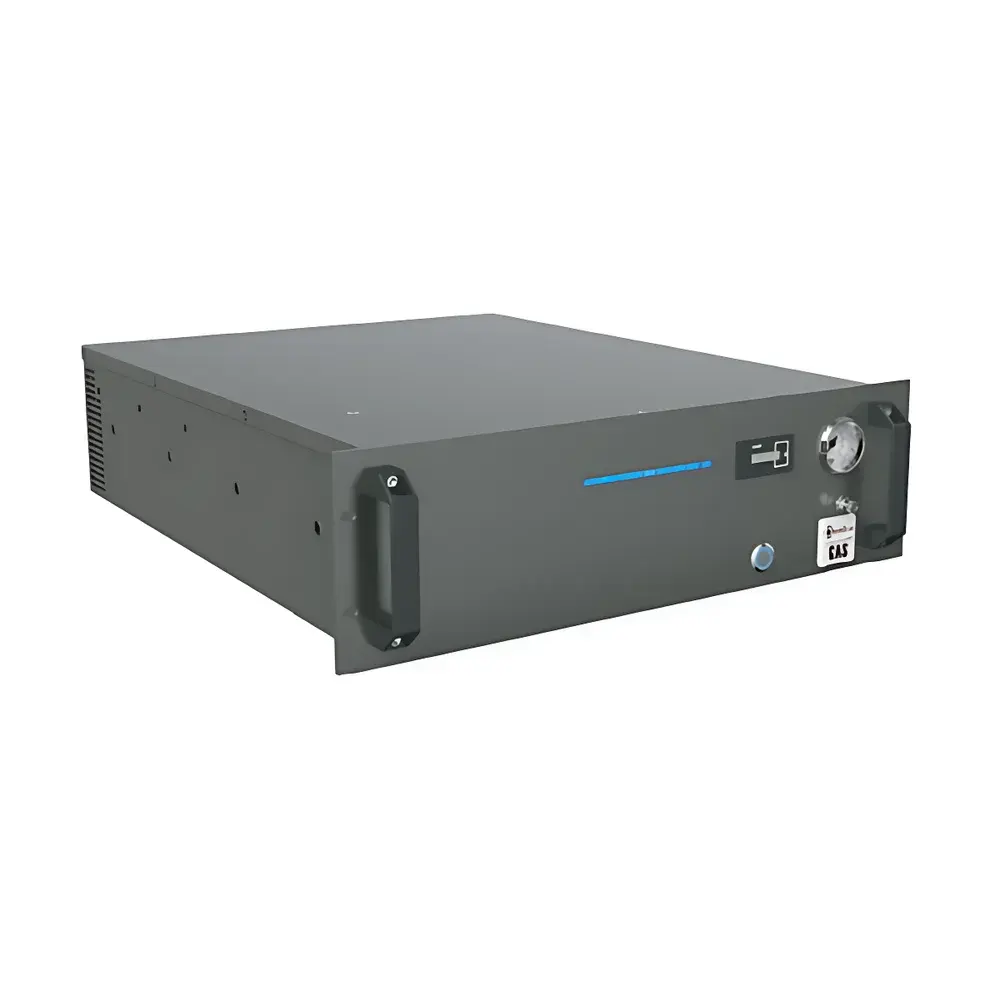
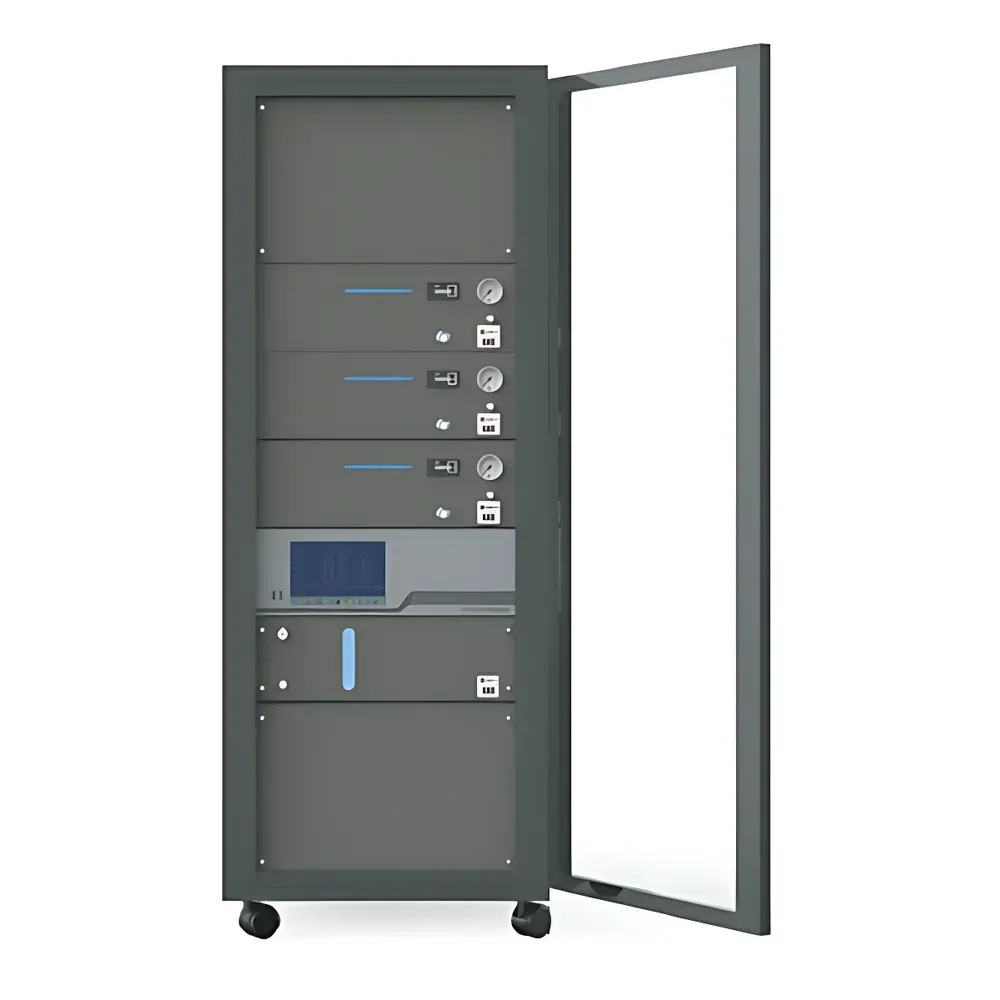
ChemTron HP PLUS RACK High-Purity Nitrogen Generator
| Brand | ChemTron |
|---|---|
| Origin | Germany |
| Model | HP PLUS RACK |
| Nitrogen Generation Principle | CPSA (Compressed Pressure Swing Adsorption) |
| Output Flow Rate | 500 mL/min |
| Output Pressure | 5 bar (75 psig) ±0.05 bar |
| Nitrogen Purity | 99.999% |
| Dew Point | < −50 °C |
| Power Consumption | 270 W |
| Noise Level | 46 dB(A) |
| Dimensions | 19″ W × 3U H × 500 mm D |
| Input Air Requirements | 7–10 bar, oil-free and dry air per ISO 8573-1:2010 Class 1.2.1 |
Overview
The ChemTron HP PLUS RACK High-Purity Nitrogen Generator is an engineered solution for laboratories requiring continuous, on-demand nitrogen gas with ultra-high purity (99.999%) and exceptional stability. Utilizing Compressed Pressure Swing Adsorption (CPSA) technology, this generator separates nitrogen from compressed ambient air via selective adsorption on advanced carbon molecular sieves—without high-pressure storage vessels or cryogenic processes. Unlike traditional nitrogen cylinders, the HP PLUS RACK eliminates logistical constraints associated with gas delivery, handling, and regulatory compliance for pressurized containers. Its rack-mountable 19″ industrial form factor integrates seamlessly into analytical instrument enclosures or centralized utility cabinets, supporting uninterrupted 24/7 operation in regulated environments such as QC labs, pharmaceutical R&D, and materials characterization facilities.
Key Features
- Integrated air compression system (standard configuration) ensures plug-and-play deployment without external air infrastructure dependency—ideal for labs lacking centralized clean air networks.
- Multi-stage pre-filtration—including coalescing, activated carbon, and membrane drying—protects molecular sieve integrity and sustains long-term separation efficiency (>10,000 hours typical service life).
- Precision pressure regulation with ±0.05 bar stability enables consistent carrier gas delivery for sensitive applications including GC and GC-MS.
- Intelligent onboard diagnostics monitor critical parameters: inlet air pressure, catalytic furnace temperature (if equipped), internal thermal load, and system uptime—with audible and visual alarm outputs for out-of-spec conditions.
- Optional high-temperature catalytic oxidation module reduces hydrocarbon contaminants to <0.05 ppm, meeting stringent requirements for ELSD, FTIR, and trace-level elemental analysis.
- Acoustically optimized enclosure and thermally managed airflow maintain noise emission at ≤46 dB(A) and operational temperature within safe limits—even under sustained 100% duty cycle.
Sample Compatibility & Compliance
The HP PLUS RACK delivers nitrogen suitable for a broad spectrum of analytical and process applications where inert atmosphere control, carrier gas consistency, or purge gas purity are essential. It complies with ISO 8573-1:2010 Class 1.2.1 for inlet air quality and supports downstream instrumentation requiring Grade 5 (99.999%) nitrogen per ASTM D6349 and ICH Q5C guidelines. When configured with the optional catalytic oxidizer, output meets USP specifications for residual hydrocarbons in pharmaceutical-grade nitrogen. The unit’s non-pressurized internal architecture avoids classification as a pressure vessel under PED 2014/68/EU or ASME BPVC Section VIII, simplifying facility registration and reducing safety certification overhead. All firmware and alarm logging functions support audit-ready documentation aligned with GLP and GMP practices, including timestamped event records compatible with 21 CFR Part 11-compliant data management systems.
Software & Data Management
The HP PLUS RACK features a dedicated LED interface displaying real-time operational metrics: total runtime, current pressure setpoint, inlet air status, and active alarm codes. While it operates autonomously without PC connectivity, its digital control architecture supports integration into building management systems (BMS) via optional analog 4–20 mA or Modbus RTU outputs. Event logs—including compressor start-stop cycles, filter saturation warnings, and catalytic module thermal excursions—are retained internally for ≥30 days and can be exported manually using standardized serial protocols. Firmware updates follow IEC 62443-2-4 secure update procedures, ensuring validated revision control during lifecycle maintenance.
Applications
- Gas chromatography (GC) and GC-mass spectrometry (GC-MS) as carrier and make-up gas—particularly when paired with the OVEN variant for oven purging.
- HPLC with evaporative light scattering detection (HPLC-ELSD), where low-hydrocarbon nitrogen prevents baseline drift and detector contamination.
- Inductively coupled plasma (ICP-OES/ICP-MS) auxiliary gas supply and sample introduction purge.
- Thermogravimetric analysis (TGA) and differential scanning calorimetry (DSC) inert purge environments.
- Controlled-atmosphere incubators and glove boxes requiring stable, low-dew-point nitrogen blankets.
- FTIR spectroscopy purge lines and laser cavity purging in optical metrology setups.
FAQ
Is the HP PLUS RACK certified for use in regulated pharmaceutical laboratories?
Yes—the system’s design, documentation, and operational traceability align with EU GMP Annex 15, FDA guidance on laboratory equipment qualification, and ISO/IEC 17025 requirements for gas supply validation.
What compressed air source is recommended for optimal performance?
We recommend pairing the unit with the GH12L or GH20L oil-free air generators, both compliant with ISO 8573-1:2010 Class 1.2.1 and equipped with refrigerated dryers to ensure inlet dew point ≤−20 °C.
Can the generator operate continuously for extended periods?
Yes—rated for indefinite 24/7 operation under ambient conditions of 15–35 °C and ≤80% RH (non-condensing). Thermal protection circuitry automatically throttles output if ambient cooling capacity is insufficient.
Does the unit require routine molecular sieve replacement?
No—under proper inlet air conditioning and scheduled pre-filter changes (every 6–12 months depending on usage), the CPSA beds maintain specification performance for ≥5 years without degradation.
How is nitrogen purity verified during installation and periodic verification?
Certified calibration gas (99.999% N₂ in balance air) and traceable electrochemical oxygen analyzers (e.g., Michell XDT-100) are used per ASTM D6349 Annex A1 to validate purity at the point-of-use outlet.



