
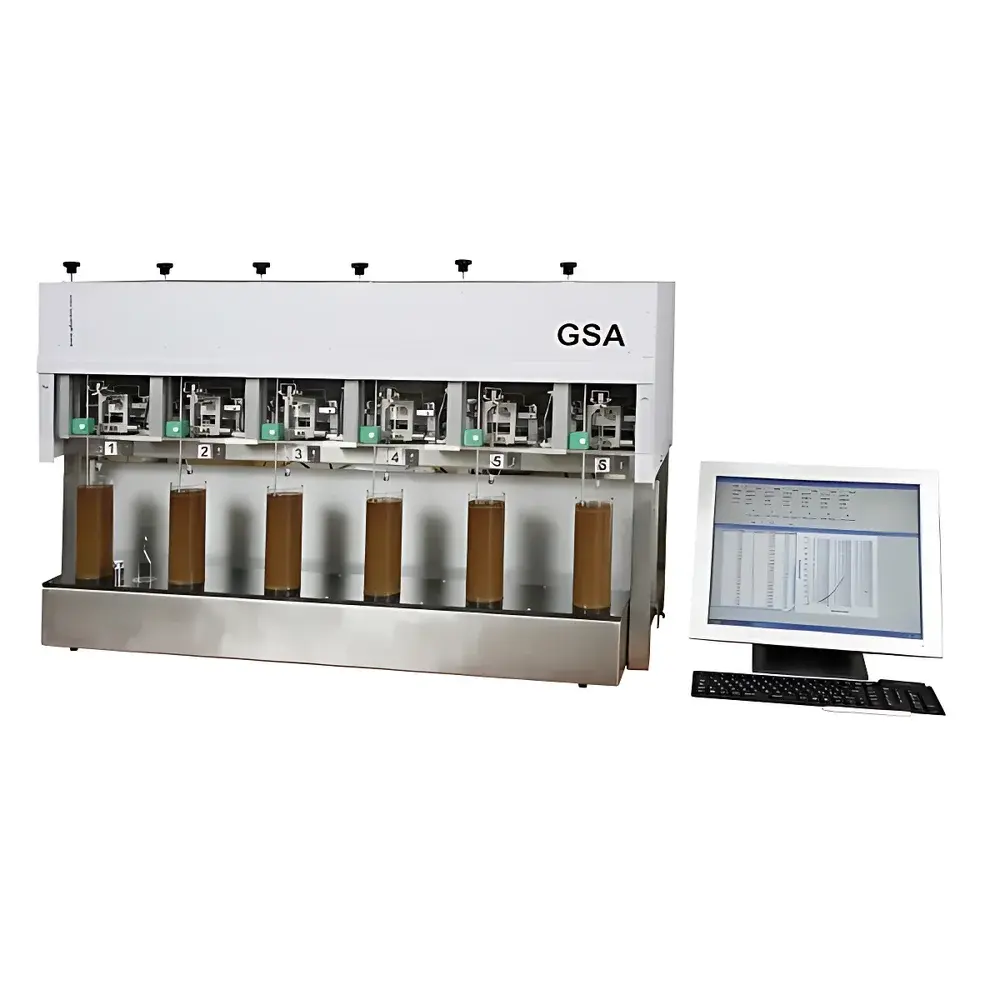
ChemTron GSA Soil Particle Size Analyzer
| Brand | ChemTron |
|---|---|
| Origin | Germany |
| Model | GSA |
| Density Measurement Range | 0.9000–1.0500 g/cm³ |
| Particle Size Range | 0.001–0.1 mm |
| Sample Capacity | 12 simultaneous measurements |
| Temperature Compensation | Automatic, based on Stokes’ law |
| Repeatability | < 2% RSD |
| Compliance | ASTM D422, ISO/TS 17892-4 |
| Programmable Parameters | Soil density, gravitational acceleration, data acquisition interval, sedimentation duration |
Overview
The ChemTron GSA Soil Particle Size Analyzer is a fully automated sedimentation-based instrument engineered for precise, high-throughput granulometric characterization of soil and sediment samples. It operates on the physical principle of gravitational sedimentation governed by Stokes’ law, wherein particle settling velocity in a quiescent liquid medium is directly related to particle diameter, fluid viscosity, and density differential between solid and suspension medium. Unlike manual hydrometer methods—which require discrete, time-point density readings at fixed intervals (e.g., 1, 2, 4, 8, 16, 30, 60, 120, 240, 480, and 1440 minutes)—the GSA performs continuous, real-time density monitoring of the soil suspension column. This enables high-resolution temporal tracking of sedimentation fronts and delivers statistically robust particle size distribution (PSD) curves without operator intervention during measurement cycles. The system is calibrated and validated against internationally recognized geotechnical standards, including ASTM D422 (“Standard Test Method for Particle-Size Analysis of Soils”) and ISO/TS 17892-4 (“Geotechnical investigation and testing — Laboratory testing of soil — Part 4: Determination of particle size distribution”), ensuring regulatory acceptability in environmental, civil engineering, and agricultural laboratories.
Key Features
- Fully automated, continuous density profiling using precision hydrostatic transduction—eliminating human error associated with manual hydrometer reading and meniscus correction.
- Simultaneous analysis of up to 12 independent soil samples within a single run, significantly improving laboratory throughput and inter-sample comparability.
- Real-time temperature compensation integrated into the Stokes-based calculation engine, dynamically adjusting for thermal variations in suspension viscosity and density.
- Programmable experimental parameters—including assumed soil particle density, local gravitational acceleration, sedimentation duration, and data acquisition frequency—enabling method customization per soil type and project requirement.
- High-resolution density detection range from 0.9000 to 1.0500 g/cm³, optimized for aqueous suspensions with sodium hexametaphosphate or other standard dispersants.
- Repeatability of < 2% relative standard deviation (RSD) across replicate analyses under controlled conditions, supporting method validation and quality assurance protocols.
Sample Compatibility & Compliance
The GSA accommodates standard soil preparation protocols defined in ASTM D422 and ISO/TS 17892-4, including oven-drying, disaggregation, chemical dispersion (e.g., Na-hexametaphosphate), and mechanical shaking. It supports evaluation of method equivalence between traditional hydrometer analysis and automated sedimentation, enabling laboratories to validate transition strategies without compromising data continuity. The system also facilitates controlled assessment of procedural variables—such as reduced dispersant dosage, container geometry effects on near-bottom particle accumulation, and sand-content influence on coarse-fraction resolution. All measurement outputs are traceable to SI units and documented with full metadata (operator ID, timestamp, calibration status, environmental conditions), satisfying GLP and ISO/IEC 17025 documentation requirements.
Software & Data Management
The proprietary GSA software provides an intuitive, icon-driven interface compliant with modern laboratory informatics expectations. It supports real-time visualization of density decay curves, automatic PSD derivation via inverse Stokes transformation, and export of tabular and graphical results in CSV, PDF, and XML formats. Audit trails record all user actions—including parameter modifications, calibration events, and report generation—with timestamps and operator authentication. The software architecture supports 21 CFR Part 11–compliant electronic signatures and role-based access control when deployed in regulated environments (e.g., environmental consulting firms operating under EPA oversight or accredited geotechnical testing labs). Raw sensor data and processed distributions are stored with versioned backups and may be integrated into LIMS via standardized API endpoints.
Applications
- Geotechnical classification of fine-grained soils (silt and clay fractions) for foundation design and slope stability modeling.
- Environmental site assessment, including contaminant transport modeling dependent on soil texture and hydraulic conductivity estimation.
- Agricultural soil health monitoring, where particle size distribution correlates with water retention, nutrient availability, and tillage response.
- Regulatory compliance reporting for landfill liner specifications, dredged material disposal criteria, and erosion control planning.
- Research applications in sedimentology, paleopedology, and soil genesis studies requiring high-reproducibility PSD datasets across large sample sets.
FAQ
How does the GSA ensure alignment with ASTM D422 and ISO/TS 17892-4?
The GSA implements the same theoretical foundation (Stokes’ law), uses identical dispersion and pretreatment procedures, and reports results in the standardized phi-scale or metric sieve-equivalent format required by both standards.
Can the GSA replace manual hydrometer analysis entirely?
Yes—when operated according to validated SOPs, the GSA meets or exceeds the precision and repeatability benchmarks of manual hydrometer methods while eliminating subjective interpretation errors and increasing analytical capacity.
Is temperature control external or built-in?
The GSA does not include active temperature regulation; however, its real-time temperature sensor feeds dynamic corrections into the Stokes calculation, making it compatible with standard laboratory ambient-controlled rooms or water-bath stabilized setups.
What level of technical support and calibration services are available?
ChemTron-certified service engineers provide on-site installation qualification (IQ), operational qualification (OQ), and periodic performance verification using NIST-traceable density standards and reference soils.
Does the software support multi-language interfaces?
The GSA software ships with English as the primary interface; localized language packs (German, French, Spanish) are available upon request for international deployment.



