
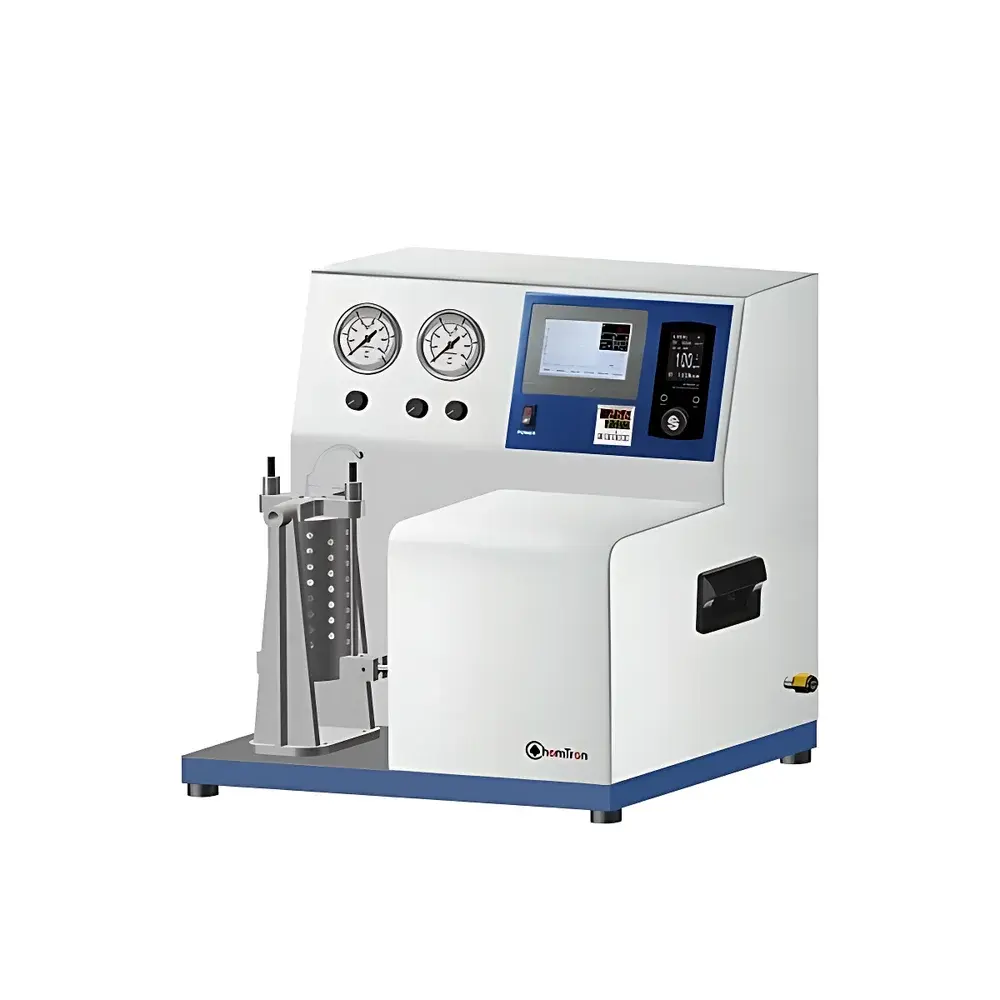
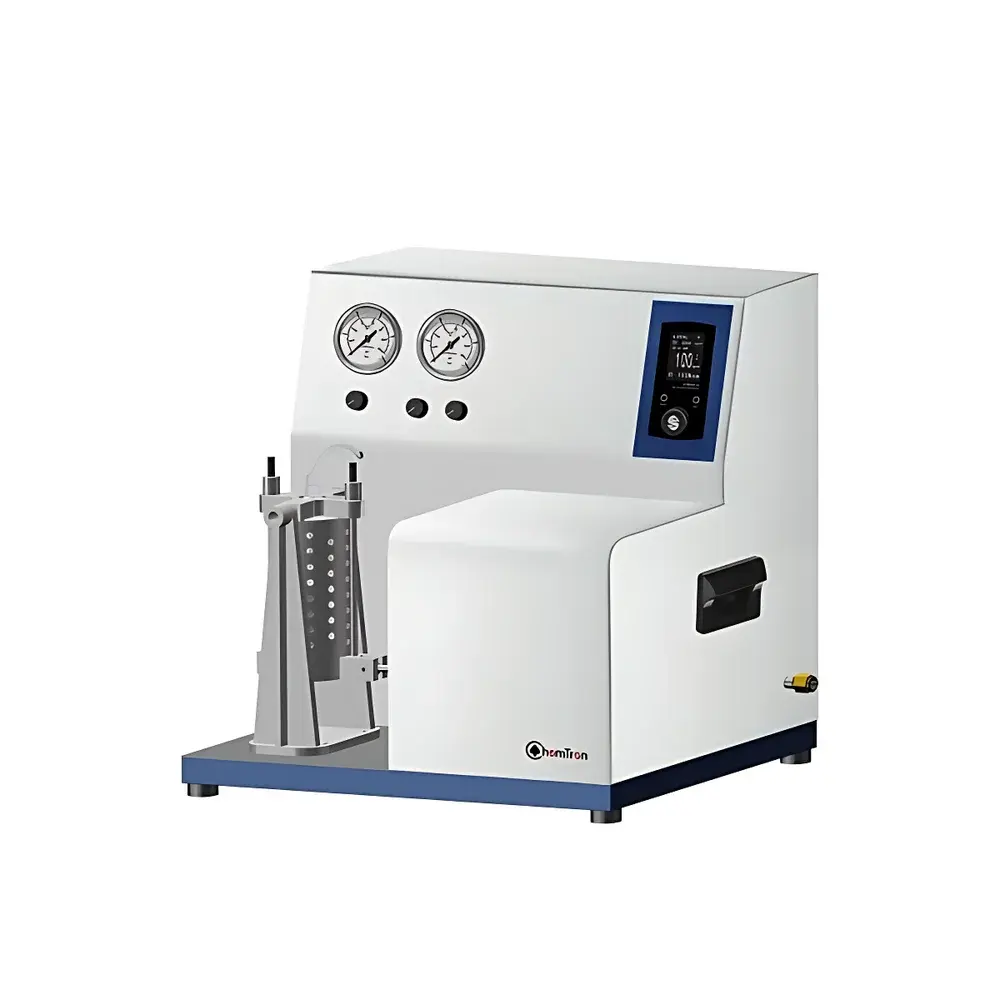
ChemTron HR / HRT Oscillating Hydrogenation Reactor System
| Brand | ChemTron |
|---|---|
| Origin | Germany |
| Model | HR / HRT |
| Vessel Capacity | 9 mL to 1850 mL |
| Construction Material | Borosilicate Glass (with optional epoxy-coated variant) & Stainless Steel Frame |
| Operating Pressure Range | Up to 4–10 bar (60 psig) |
| Temperature Control Range | Ambient to 80 °C |
| Oscillation Drive | Electric or Pneumatic Motor |
| Safety Certification | NEC Class I, Group D |
| Sealing Interface | ACE-THRED™ precision threaded connection |
| Vacuum Compatibility | Yes (via integrated vacuum line interface) |
| Control Interface | TFT touchscreen with real-time display of oscillation speed, pressure, and temperature |
Overview
The ChemTron HR / HRT Oscillating Hydrogenation Reactor System is an engineered solution for safe, efficient, and scalable gas–liquid heterogeneous reactions under mild pressure and temperature conditions. Unlike conventional stirred autoclaves relying on high-speed impellers and elevated hydrogen pressures (often >30 bar), the HR/HRT platform employs controlled orbital oscillation—typically at frequencies up to 60 Hz—to induce turbulent surface renewal and dynamic interfacial mixing within the reaction vessel. This motion generates continuous wave-like agitation across the liquid–gas interface, significantly enhancing mass transfer coefficients and reducing diffusion limitations inherent in static or poorly mixed systems. The system is specifically designed for catalytic hydrogenation, reductive amination, unsaturated hydrocarbon saturation, condensation chemistry, and catalyst screening workflows where reproducibility, visual process monitoring, and compatibility with corrosive reagents (e.g., halogenated solvents, acidic media) are critical. Its operational envelope—up to 10 bar and 80 °C—aligns with ICH Q5A and USP guidelines for small-scale process development in pharmaceutical R&D labs.
Key Features
- ACE-THRED™ precision-threaded borosilicate glass vessels (available in #7 and #25 thread standards) ensure leak-tight sealing under pressure while eliminating cross-contamination risks associated with elastomeric stoppers.
- Modular vessel set covering six discrete volumes (9, 16, 46, 77, 180, 335 mL) for HR series and two large-capacity options (950 mL and 1850 mL) for HRT series—enabling direct scale-up studies without re-optimization.
- Integrated hydrogen storage cylinder (rated to 60 psig) with dual analog pressure gauges for independent monitoring of reactor headspace and supply reservoir pressure.
- JULABO-engineered heating jacket with PID-controlled thermal regulation (±0.3 °C accuracy), compatible with external circulators for extended temperature stability during multi-hour reactions.
- Explosion-resistant containment architecture: reinforced polycarbonate safety shield, epoxy-coated glass vessel option (shatter-retentive layer), and stainless steel anti-rupture guard frame compliant with EN 14470-1 for flammable liquid storage.
- TFT touchscreen interface with programmable oscillation profiles (speed, amplitude, duration), real-time data logging, and password-protected user access levels.
Sample Compatibility & Compliance
The HR/HRT system accommodates solid catalysts (Pd/C, PtO₂, Raney Ni), gaseous reagents (H₂, CO, NH₃), volatile organic solvents (THF, EtOAc, MeOH, DMF), and acid- or halide-containing substrates—enabled by chemically inert borosilicate glass construction. All wetted parts meet USP Class VI biocompatibility requirements. The pneumatic motor variant (HR/HRT-B) satisfies ATEX/IECEx Zone 1 and NEC Class I/II hazardous location standards, supporting operation in environments where solvent vapors or hydrogen accumulation may occur. System design adheres to ISO 14001 environmental management principles and supports GLP-compliant documentation via audit-trail-enabled software export (CSV/TXT). Pressure components conform to PED 2014/68/EU Annex I essential safety requirements.
Software & Data Management
Data acquisition is handled through embedded firmware supporting timestamped recording of oscillation frequency (rpm), internal vessel pressure (bar), jacket temperature (°C), and runtime (hh:mm:ss). Exported logs include metadata such as operator ID, batch number, and vessel ID—facilitating traceability per FDA 21 CFR Part 11 Annex 11 requirements. Optional ChemTron ControlSuite™ (v3.2+) provides remote monitoring via Ethernet/Wi-Fi, automated report generation (PDF/Excel), and integration with LIMS platforms through RESTful API endpoints. All calibration events—including pressure transducer zeroing and thermal sensor verification—are digitally recorded with electronic signatures.
Applications
- Catalyst activity evaluation under industrially relevant H₂ partial pressures (1–10 bar) and temperatures (25–80 °C).
- Process intensification of hydrogenation steps in API synthesis, reducing cycle time by ≥5× compared to batch-stirred reactors.
- Screening of chiral catalysts in asymmetric hydrogenation, leveraging optical clarity for in situ FTIR or UV-Vis sampling ports (optional).
- Development of continuous-flow precursors using oscillatory mixing as a surrogate for microreactor residence time control.
- Evaluation of heterogeneous reaction kinetics via online GC sampling through septum-piercing needle ports (accessory kit available).
- Teaching laboratory implementation for undergraduate chemical engineering courses on mass transfer limitation analysis and reactor selection criteria.
FAQ
What pressure ranges are supported, and how is overpressure protection implemented?
The system operates safely up to 10 bar (145 psi) with mechanical burst discs (set at 12 bar) installed upstream of all glass vessels. Each ACE-THRED™ closure includes a calibrated torque-limiting mechanism to prevent thread damage during pressurization.
Can the system be used with corrosive reagents such as HCl or brominated solvents?
Yes—borosilicate glass (Duran® 3.3) exhibits excellent resistance to mineral acids, halogenated organics, and oxidizing agents below 80 °C. Epoxy-coated variants provide additional mechanical integrity in high-shear environments.
Is temperature uniformity validated across vessel volumes?
JULABO heating jackets undergo DIN 12878-compliant thermal mapping per vessel size; axial and radial gradients remain ≤±0.5 °C at steady state (verified with NIST-traceable thermocouples).
How does oscillation improve reaction efficiency versus magnetic stirring?
Oscillation induces chaotic fluid motion with Reynolds numbers exceeding 10⁴ in standard configurations, achieving volumetric mass transfer coefficients (kLa) up to 0.02 s⁻¹—approximately fivefold higher than equivalently sized magnetically stirred reactors under identical H₂ partial pressure.
Are spare parts and service support available globally?
ChemTron maintains authorized service centers in North America, EMEA, and APAC regions. Critical spares—including ACE-THRED™ seals, PTFE adapters, and pressure transducers—are stocked with <72-hour dispatch SLA.



