
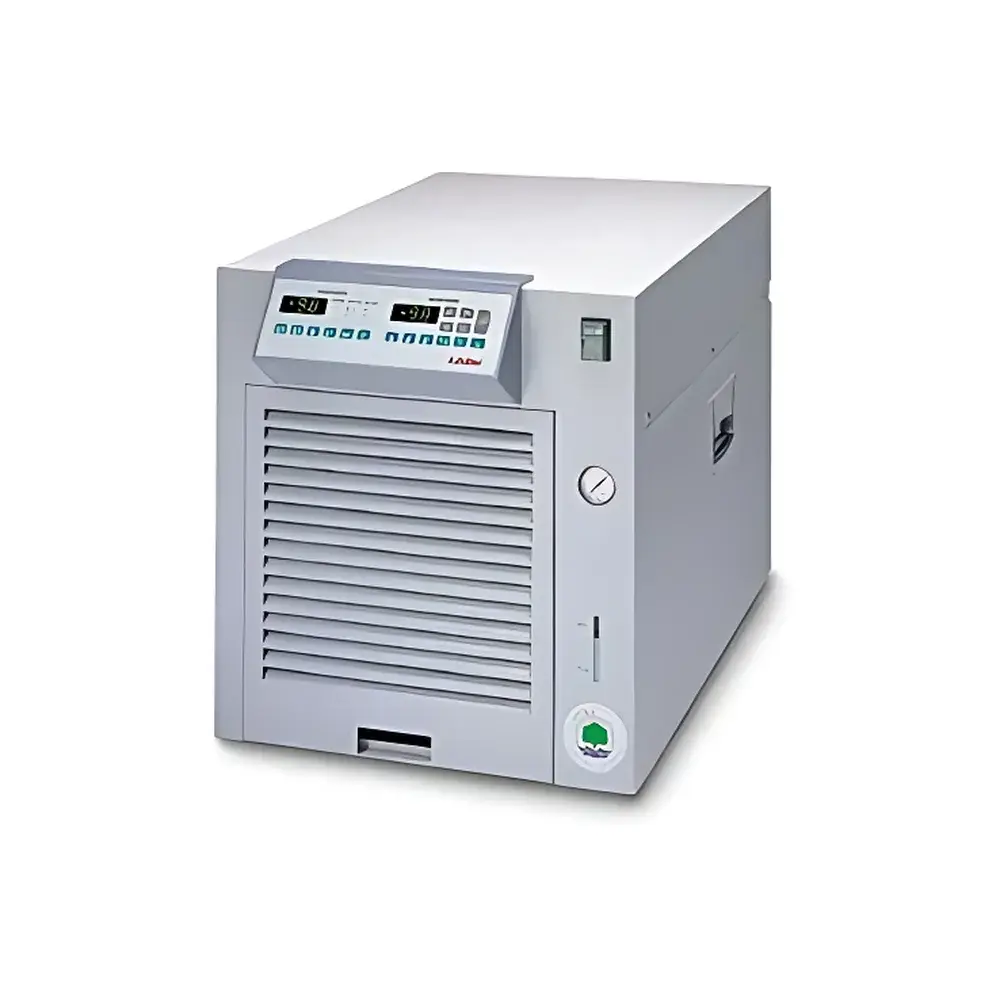
Julabo FCW2500T Circulating Chiller
| Brand | Julabo |
|---|---|
| Origin | Germany |
| Model | FCW2500T |
| Instrument Type | Integrated Circulating Chiller |
| Cooling Method | Water-Cooled |
| Temperature Range | −25 to +80 °C |
| Temperature Stability | ±0.2 °C |
| Refrigeration Capacity | 2500 W at 20 °C |
| Heating Power | 1.2 kW |
| Pump Flow Rate | 28 L/min |
| Pump Pressure | 3.5 bar |
| Reservoir Volume | 8–11 L |
| Operating Mode | Continuous |
| Refrigerant | R404A (GWP = 3922) |
| Compressor | Single-Stage Hermetic |
| External Pt100 Sensor Interface | Integrated |
| Communication Interface | RS232 (optional Profibus) |
| Ambient Operating Temperature | 5–40 °C |
| Dimensions (W × L × H) | 46 × 61 × 49 cm |
| Weight | 74 kg |
| Sound Pressure Level (1 m) | ≤53 dBA |
Overview
The Julabo FCW2500T is an integrated, water-cooled circulating chiller engineered for high-precision temperature control in demanding laboratory and pilot-scale industrial applications. It operates on a vapor-compression refrigeration cycle with a single-stage hermetic compressor and R404A refrigerant, delivering stable thermal management across a wide operating range of −25 °C to +80 °C. Unlike tap-water-based cooling systems, the FCW2500T eliminates dependency on municipal water supply, reduces infrastructure load, and supports sustainable lab operations through closed-loop recirculation. Its dual-function architecture—combining active refrigeration and electric heating—enables seamless transition between cooling and heating modes without external equipment, making it suitable for applications requiring dynamic setpoint modulation, such as jacketed reactor temperature control, spectrometer cooling, or calorimeter stabilization.
Key Features
- Integrated heating capability (1.2 kW) enables precise temperature ramping and hold profiles up to +80 °C, supporting both exothermic and endothermic process control.
- High-flow, high-pressure circulation system delivers 28 L/min at 3.5 bar, ensuring reliable thermal transfer even with long tubing runs or high-backpressure accessories (e.g., rotary evaporators, vacuum pumps).
- Dual LED display provides independent readouts of outlet and inlet temperatures, facilitating real-time monitoring of ΔT across the application loop.
- Adjustable outlet-to-inlet temperature ratio allows fine-tuning of heat exchange efficiency based on system hydraulics and thermal load characteristics.
- Top-fill reservoir with visual level indicator simplifies maintenance and minimizes spill risk during coolant replenishment.
- Integrated Pt100 sensor input enables external temperature feedback from the process vessel or reaction medium, improving control accuracy beyond bath-level measurement.
- Analog and digital communication options—including RS232 (standard) and optional Profibus—support integration into centralized Lab Information Management Systems (LIMS), SCADA platforms, or programmable logic controllers (PLCs) for automated workflow execution and audit-ready data logging.
Sample Compatibility & Compliance
The FCW2500T is compatible with standard aqueous and water-glycol coolant mixtures (e.g., 30% propylene glycol), and its stainless-steel pump head and corrosion-resistant internal wetted parts ensure long-term compatibility with common laboratory coolants. It complies with IEC 61000-6-3 (EMC emission standards) and IEC 61000-6-2 (immunity), and meets CE marking requirements under the EU Machinery Directive 2006/42/EC and Low Voltage Directive 2014/35/EU. While not intrinsically rated for hazardous areas, its design supports GxP-aligned environments when deployed with appropriate documentation: full traceability of calibration records, configurable audit trails via optional software, and support for 21 CFR Part 11–compliant electronic signatures when paired with Julabo’s certified LabSoft or third-party validated control platforms.
Software & Data Management
The FCW2500T supports bidirectional serial communication via RS232, enabling remote parameter configuration, real-time data streaming (temperature, pressure, status flags), and event-triggered logging. When connected to Julabo LabSoft or compatible third-party software (e.g., LabVIEW, MATLAB, or DeltaV), users can implement multi-step temperature programs, generate time-stamped CSV reports, and embed chiller status into broader process narratives. Optional Profibus-DP integration permits deterministic cyclic data exchange in industrial automation settings. All logged data—including setpoints, actual values, alarm timestamps, and compressor duty cycles—can be exported with ISO/IEC 17025–compatible metadata (operator ID, instrument ID, environmental conditions) to satisfy GLP, GMP, or ISO 9001 documentation requirements.
Applications
- Temperature control of analytical instruments: HPLC column ovens, ICP-MS torch chillers, FTIR interferometer housings, and CCD detector cooling stages.
- Process-critical thermal management: Jacketed glass reactors, distillation condensers, crystallization vessels, and polymerization test rigs.
- Material testing systems: Dynamic mechanical analyzers (DMA), differential scanning calorimeters (DSC), and rheometers requiring stable thermal boundary conditions.
- Electronics testing: Semiconductor probe station cooling, power amplifier thermal stabilization, and battery cycling chamber integration.
- Pharmaceutical development: Dissolution apparatus temperature regulation, stability chamber auxiliary cooling, and lyophilizer condenser support.
FAQ
What coolant types are recommended for use with the FCW2500T?
Deionized water or a mixture of deionized water and USP-grade propylene glycol (typically 20–30% v/v) is recommended to prevent scaling, freezing, and microbial growth. Ethylene glycol is not advised due to material compatibility concerns with internal seals.
Can the FCW2500T operate continuously at −25 °C?
Yes—the unit is rated for continuous operation across its full temperature range; however, sustained sub-zero operation requires proper coolant formulation (e.g., ≥30% glycol), adequate ambient ventilation (>5 °C), and regular inspection of refrigerant charge integrity.
Is external water supply required for the water-cooled condenser?
Yes—a dedicated, clean, low-conductivity water source (≤250 µS/cm) at 10–30 °C and 2–4 bar is mandatory for the condenser circuit. A closed-loop cooling tower or facility chilled water loop may serve as the primary water source.
How is temperature uniformity maintained across variable thermal loads?
Through proportional-integral-derivative (PID) control with adaptive tuning, coupled with real-time monitoring of both inlet and outlet temperatures, allowing dynamic adjustment of compressor speed and heater output to maintain ±0.2 °C stability under load fluctuations up to 2.5 kW.
Does the FCW2500T support validation documentation for regulated environments?
Yes—Julabo provides IQ/OQ protocols, calibration certificates traceable to NIST standards, and firmware version verification reports. Full 21 CFR Part 11 compliance requires configuration of user access controls and electronic signature workflows within the host supervisory software.



