
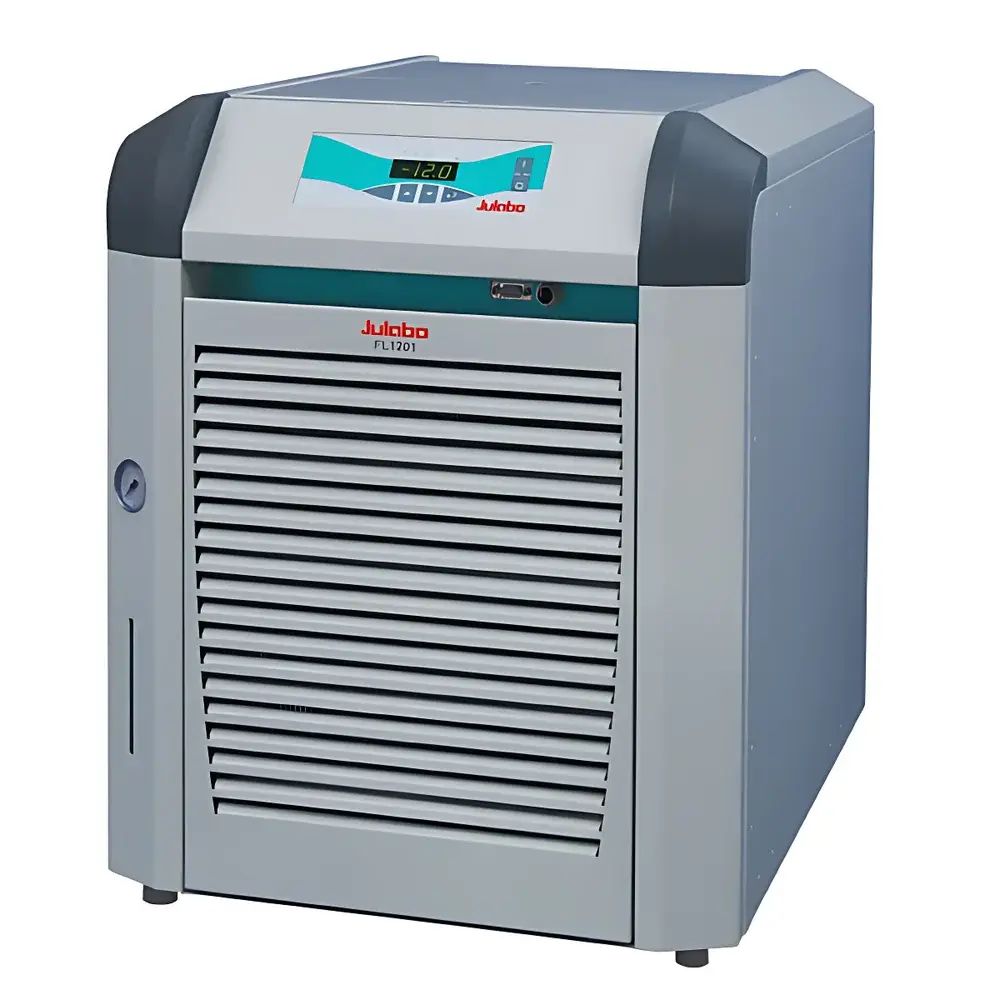
Julabo FL1203 Circulating Chiller
| Brand | Julabo |
|---|---|
| Origin | Germany |
| Model | FL1203 |
| Cooling Type | Air-Cooled |
| Temperature Range | -20 to +40 °C |
| Temperature Stability | ±0.5 °C |
| Refrigeration Capacity | 1200 W at 20 °C |
| Pump Flow Rate | 40 L/min |
| Pump Pressure | 0.5–3.0 bar |
| Reservoir Volume | 12–17 L |
| Refrigerant | R404A (GWP = 690) |
| Sound Pressure Level (1 m) | ≤61 dBA |
| Dimensions (W×L×H) | 50 × 76 × 64 cm |
| Weight | 73 kg |
| Compressor | Single-Stage Hermetic |
| Fluid Compatibility | Water, Water/Glycol Mixtures, JULABO Thermal Bath Fluids |
Overview
The Julabo FL1203 Circulating Chiller is a high-performance, air-cooled laboratory chiller engineered for precise temperature control and reliable heat removal in demanding continuous-operation environments. Based on vapor-compression refrigeration with a single-stage hermetic compressor and R404A refrigerant, the FL1203 delivers stable thermal management across a wide operating range of –20 °C to +40 °C. Its design eliminates dependence on municipal tap water for cooling—reducing resource consumption, preventing scaling or corrosion in connected equipment, and enabling operation in locations where chilled water infrastructure is unavailable. With a nominal refrigeration capacity of 1200 W at 20 °C ambient and an integrated circulation pump delivering up to 40 L/min at pressures adjustable from 0.5 to 3.0 bar, the FL1203 serves as a robust thermal interface for analytical instruments including HPLC column ovens, laser systems, spectrometers, vacuum pumps, and reactor jackets. The unit complies with IEC 61000-6-3 (EMC emission standards) and IEC 61000-6-2 (immunity), and its mechanical construction meets EN 61010-1 safety requirements for laboratory electrical equipment.
Key Features
- Air-cooled refrigeration system with low-maintenance single-stage hermetic compressor and R404A refrigerant (GWP = 690), optimized for laboratory environments without chilled water supply
- Precise temperature stability of ±0.5 °C over the full operating range (–20 to +40 °C), with 0.1 °C setting and display resolution via LED interface
- Integrated high-flow circulation pump (40 L/min max) with adjustable pressure output (0.5–3.0 bar) and G3/4″ male thread pump ports
- Large reservoir volume (12–17 L) with integrated level indicator and pressure gauge (standard on FL1201 and above)
- Top-fill access port for convenient fluid replenishment without disassembly or draining
- Thermally stable stainless-steel reservoir and corrosion-resistant internal wetted parts compatible with water, aqueous glycol mixtures (up to 50% v/v), and JULABO-certified Thermal Bath Fluids
- Robust steel enclosure with acoustic insulation; sound pressure level ≤61 dBA at 1 m distance
- Continuous-duty rating with ambient operating temperature range of 5–40 °C
Sample Compatibility & Compliance
The FL1203 supports a broad range of heat-transfer fluids, including deionized water, water–ethylene glycol (up to 50% by volume), and JULABO Thermal G series bath fluids—enabling operation down to –20 °C without freezing risk or viscosity-induced flow restriction. It accommodates return fluid temperatures up to 80 °C, making it suitable for applications involving exothermic processes or external heating elements. From a regulatory standpoint, the unit is CE-marked and conforms to essential requirements under the EU Machinery Directive 2006/42/EC and Low Voltage Directive 2014/35/EU. While not inherently 21 CFR Part 11 compliant (as it lacks user authentication or electronic audit trail functions), its stable thermal output supports GLP- and GMP-aligned workflows when integrated into validated instrument platforms requiring documented temperature consistency.
Software & Data Management
The FL1203 operates via a standalone front-panel interface with push-button navigation and real-time LED display of setpoint, actual temperature, pump status, and error codes. It does not include built-in data logging, remote connectivity (e.g., RS232, Ethernet, or USB), or PC software integration. However, analog voltage outputs (0–10 V) for temperature and pump status are available upon request via optional accessories, enabling integration into centralized building management or SCADA systems for supervisory monitoring. For laboratories requiring digital traceability, third-party data loggers may be connected to the analog outputs to record temperature trends and operational uptime—supporting routine IQ/OQ documentation per ISO/IEC 17025 or ASTM E2911-13 guidelines.
Applications
- HPLC and UHPLC column ovens and detector cooling blocks
- Laser diode and solid-state laser cavity temperature stabilization
- FTIR, Raman, and fluorescence spectrometer detector cooling
- Vacuum pump condenser cooling to prevent oil backstreaming
- Small-scale jacketed reactors and calorimeters (≤5 L volume)
- Electrophoresis and gel imaging systems requiring ambient-temperature suppression
- Environmental test chambers requiring auxiliary cold-side heat rejection
FAQ
What is the maximum allowable inlet fluid temperature?
The FL1203 accepts return fluid at temperatures up to 80 °C, provided the chiller’s setpoint remains within its specified operating range (–20 to +40 °C).
Can the FL1203 be used with 50% ethylene glycol solution?
Yes—glycol concentrations up to 50% (v/v) are fully supported; however, viscosity increases must be accounted for in system pressure drop calculations.
Is R404A refrigerant being phased out globally?
R404A is subject to phase-down under the EU F-Gas Regulation and EPA SNAP restrictions; Julabo offers retrofit guidance and next-generation models using lower-GWP alternatives such as R450A or R513A upon request.
Does the unit include dry-run protection for the pump?
Yes—the FL1203 features automatic pump shutdown if reservoir level falls below the minimum threshold, preventing cavitation and mechanical damage.
What maintenance intervals are recommended?
Annual visual inspection of condenser coils, biannual verification of refrigerant charge integrity, and quarterly cleaning of air intake filters are advised under typical laboratory usage conditions.



