
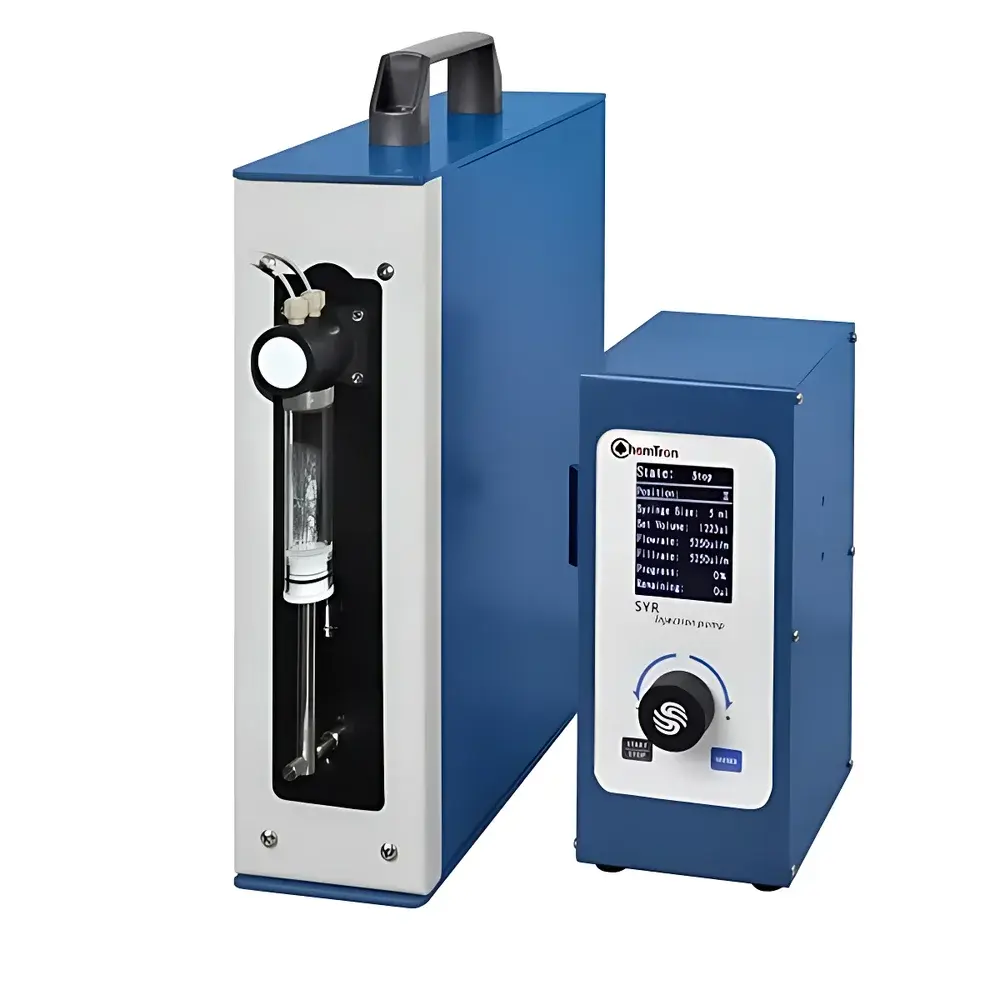
ChemTron Vdose4200 Single-Channel Precision Syringe Pump
| Brand | ChemTron |
|---|---|
| Origin | Germany |
| Model | Vdose4200 |
| Instrument Type | Microfluidic Syringe Pump |
| Flow Rate | 1.25 µL/min to 375 mL/min |
| Accuracy | ≤ 0.5% (±5 ‰) |
| Display | TFT LCD |
| Valve Configuration | 3-Port Auto-Switching Valve |
| Communication Interface | RS-232 / RS-485 |
| Power Supply | 110–240 V, 50/60 Hz |
| Weight | 5.5 kg |
| Dimensions (H × W × D) | 305 × 89 × 330 mm |
| Syringe Volume Range | 50 µL – 25 mL |
| Wetted Materials | Borosilicate Glass, PTFE, Viton |
| Plunger Resolution | 1/6000 steps |
| Syringe Mounting | Tool-free Quick-Change Mechanism |
Overview
The ChemTron Vdose4200 is a high-precision, single-channel syringe pump engineered for reproducible micro-to-macro fluid delivery in analytical, pharmaceutical, and process development laboratories. Operating on a stepper motor-driven linear actuation principle, it delivers volumetrically controlled liquid transfer via calibrated syringe displacement—ensuring traceable, pulseless flow across six orders of magnitude (1.25 µL/min to 375 mL/min). Unlike peristaltic or piston pumps with elastic tubing or sliding seals, the Vdose4200 employs rigid glass syringes and PTFE-coated plunger assemblies to eliminate compliance-related drift, adsorption, and chemical leaching—critical for handling solvents, APIs, viscous reagents, or low-volume biological samples. Its modular architecture separates control electronics from the dispensing module, enabling stable thermal management and long-term positional repeatability under continuous operation.
Key Features
- Tool-free syringe mounting system supporting 11 interchangeable syringe volumes—from 50 µL micro-syringes to 25 mL standard borosilicate glass barrels—enabling rapid method adaptation without recalibration.
- Three-port solenoid valve with automatic switching logic for integrated aspiration, hold, and dispense cycles; supports closed-loop fluid recovery without disassembling tubing or syringes.
- TFT color display with real-time graphical feedback: flow rate, elapsed time, remaining volume, plunger position, and valve state—configured via intuitive soft-key navigation.
- High-resolution stepper motor drive (1/6000 step resolution) coupled with optical end-stop detection ensures sub-microliter positioning accuracy and repeatable stroke termination.
- Wetted-path materials strictly limited to USP Class VI-certified PTFE, Viton elastomers, and ASTM E438 Type I, Class A borosilicate glass—validated for compatibility with aggressive organics, aqueous buffers, and halogenated solvents.
- Dual communication protocols (RS-232 and RS-485) compliant with Modbus RTU, allowing seamless integration into SCADA systems, PLC-controlled synthesis platforms, or centralized lab automation networks.
Sample Compatibility & Compliance
The Vdose4200 accommodates a broad range of sample types—including volatile organic compounds, high-viscosity polymer solutions (up to 5000 mPa·s), cell suspensions, and particulate-laden slurries—provided syringe selection and flow rate are optimized to avoid shear-induced degradation or clogging. All fluid-contact components conform to ISO 10993-5 (cytotoxicity) and USP Biological Reactivity Tests. The device meets IEC 61326-1 (EMC for laboratory equipment) and IEC 61010-1 (safety requirements for electrical equipment). For regulated environments, audit trail functionality can be enabled via external software logging (e.g., LabArchives or custom SCADA), satisfying ALCOA+ data integrity principles required under FDA 21 CFR Part 11 and EU Annex 11 when deployed with validated procedures.
Software & Data Management
The pump operates standalone or under host control using ASCII-based command sets over serial interface. ChemTron provides optional Windows-compatible configuration software (Vdose Control Suite v3.x) supporting protocol scripting, multi-step sequences (e.g., gradient dilution, timed infusions, valve-triggered wash cycles), and CSV export of timestamped operational logs. All commands and parameter changes are logged internally with date/time stamps—accessible via query command—and support third-party integration with LabVIEW, Python (pySerial), or MATLAB for automated assay development. No proprietary drivers or cloud dependencies are required; firmware updates are performed via UART bootloader using standard terminal emulation tools.
Applications
- Automated sample introduction for HPLC, IC, and CE systems requiring precise, low-pulse injection volumes (e.g., 1–100 µL).
- Controlled reagent addition in flow chemistry reactors, including exothermic nitration or Grignard reactions where stoichiometric accuracy and timing govern selectivity.
- Calibration standard delivery in environmental labs (e.g., EPA Method 524/525) for VOC spiking at sub-ppb levels using 100 µL glass syringes.
- Cell culture media supplementation in bioreactor feed strategies, leveraging programmable ramp profiles and valve-mediated recirculation to minimize shear stress.
- GMP-compliant formulation trials where batch records require full traceability of dispense parameters, operator ID, and equipment calibration status.
FAQ
What syringe sizes are supported, and how is volume calibration performed?
The Vdose4200 accepts syringes from 50 µL to 25 mL using standardized Luer-lock or small-bore fittings. Calibration is performed per syringe type via two-point volumetric verification (e.g., gravimetric measurement at min/max flow), stored in non-volatile memory.
Can the pump operate in continuous infusion mode with automatic syringe replacement?
No—syringe replacement requires manual intervention. However, the quick-change mount enables sub-60-second swap between pre-loaded syringes during method sequencing.
Is the 3-port valve compatible with corrosive gases or vacuum applications?
The valve is rated for liquid-phase use only; gas-phase or vacuum operation voids warranty and risks seal extrusion due to differential pressure limits (max 6 bar operating pressure).
Does the device support analog input/output for external triggering?
Not natively—only digital serial control is provided. Analog interfacing requires an external I/O module (e.g., National Instruments USB-6009) configured as a TTL-level event translator.
How often does the system require maintenance or recalibration?
Under normal use (≤8 hrs/day), mechanical recalibration is recommended annually; plunger seal inspection is advised every 6 months or after 50,000 actuation cycles.



