
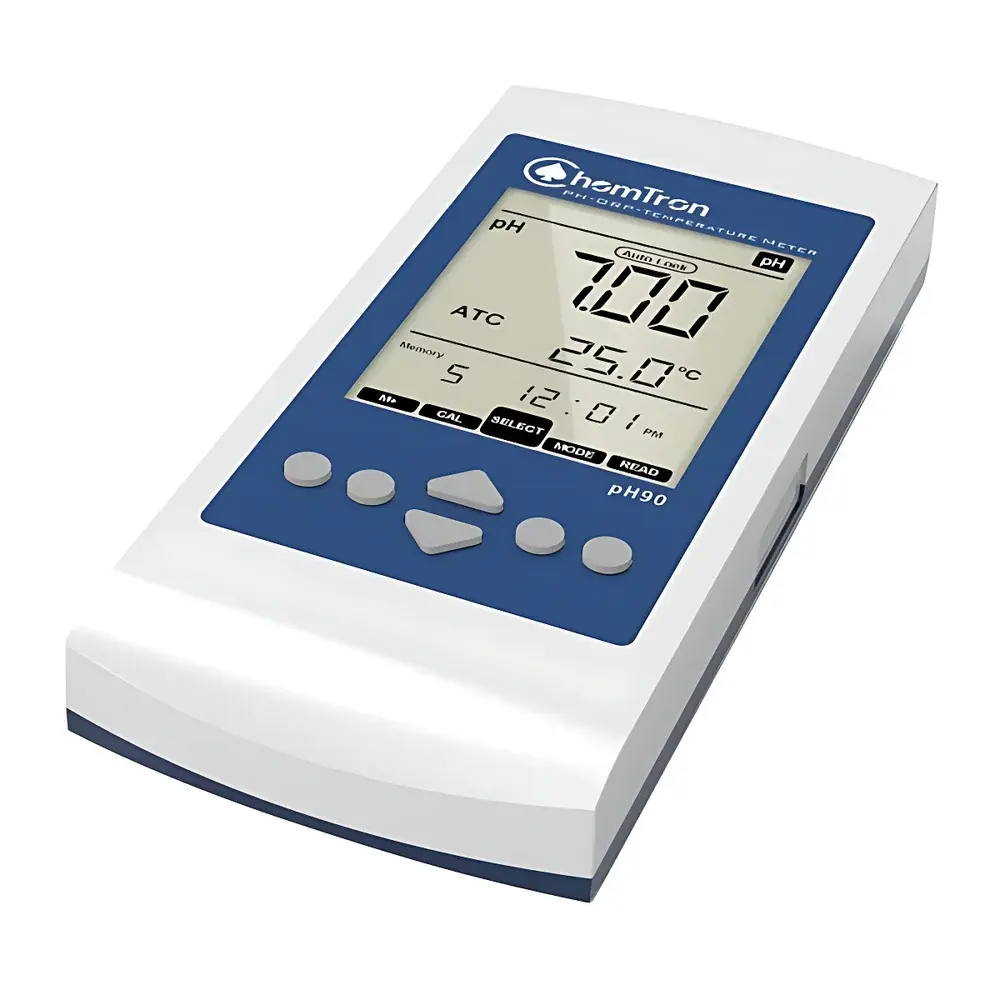
ChemTron CAS9010 Standard Portable pH Meter
| Brand | ChemTron |
|---|---|
| Origin | Germany |
| Model | CAS9010 |
| Instrument Type | Portable |
| Parameter Types | Multi-parameter |
| Measurement Accuracy | ±0.02 pH |
| pH Range | -2.00 to 16.00 |
| mV Range | ±700.0 mV / ±2000 mV |
| Temperature Range | 0 to 120 °C |
| Resolution | 0.01 pH / 0.1 mV / 0.1 °C |
| Calibration Points | 2–5 point |
| ATC Range | 0–120 °C |
| Data Storage | 99 sets with timestamp |
| Power | 4×AAA batteries (1.5 V) |
| Operating Humidity | ≤95% RH (non-condensing) |
| Operating Temperature | 5–40 °C |
| Storage Temperature | -20–60 °C |
Overview
The ChemTron CAS9010 Standard Portable pH Meter is a precision-engineered electrochemical instrument designed for field-deployable and laboratory-grade pH, mV, and temperature measurements. Built upon a robust potentiometric measurement principle—utilizing the Nernst equation to quantify hydrogen ion activity—the CAS9010 delivers high reproducibility and long-term stability across diverse aqueous and semi-aqueous matrices. Its modular architecture supports interchangeable BNC-compatible electrodes, enabling seamless adaptation to routine quality control, environmental monitoring, educational labs, and process verification workflows. The device complies with fundamental metrological requirements aligned with ISO 3696 (Grade 3 water), ASTM D1293 (pH of water), and EN ISO 10523 (water quality — determination of pH), ensuring data integrity in regulated and non-regulated environments alike.
Key Features
- High-resolution LCD display showing simultaneous real-time readings of pH, temperature, and system time—eliminating manual cross-referencing during field calibration or sampling.
- Multi-standard buffer recognition: automatic detection and selection of ISO (pH 4.01, 7.00, 10.01), NIST (pH 4.01, 6.86, 9.18), or user-defined calibration standards—reducing procedural errors and supporting method traceability.
- Advanced electrode diagnostics: post-calibration slope calculation (% deviation from theoretical 59.16 mV/pH at 25 °C) and offset evaluation provide objective metrics for electrode health assessment—critical for GLP-compliant documentation and preventive maintenance scheduling.
- Five-point calibration capability with adjustable calibration sequence order—enabling extended-range validation for non-aqueous or high-ionic-strength samples where conventional two-point calibration may introduce systematic bias.
- Integrated Automatic Temperature Compensation (ATC) across 0–120 °C using a dedicated Pt1000-class stainless steel temperature probe (PT9010), minimizing thermal drift without requiring external thermometers or manual input.
- Onboard timestamped data logging: 99 measurement records stored with date/time stamps, accessible via front-panel navigation—satisfying basic audit trail requirements per FDA 21 CFR Part 11 Annex A guidance for non-electronic record systems.
Sample Compatibility & Compliance
The CAS9010 is validated for use with aqueous solutions, buffer standards, wastewater effluents, soil extracts, food slurries, and pharmaceutical formulations within specified conductivity and viscosity limits. It accepts standard BNC-input glass-body or plastic-composite pH electrodes (e.g., PP5003), redox electrodes, and optional conductivity probes (PO5106). All factory-supplied buffers (SP0401N, SP0701N, SP1001N) are certified to ISO 3696 and traceable to NIST SRMs. The instrument’s design adheres to IEC 61010-1 safety standards for electrical equipment for measurement, control, and laboratory use, including protection against transient overvoltage (CAT II) and IP54-rated ingress resistance for dust and splash exposure.
Software & Data Management
When paired with the optional AX9010U USB interface kit, the CAS9010 enables direct serial communication with Windows-based PCs. The bundled software supports live data streaming, batch export of logged measurements (CSV format), and configurable report generation—including operator ID, sample ID, and calibration history metadata. Data files retain embedded timestamps and calibration parameters, facilitating retrospective review and alignment with internal SOPs. While the device itself does not implement full 21 CFR Part 11 electronic signature functionality, its deterministic memory architecture and immutable timestamping support ALCOA+ principles (Attributable, Legible, Contemporaneous, Original, Accurate) when used within documented workflows.
Applications
- Environmental field testing: surface water, groundwater, and leachate pH profiling per EPA Method 150.1 and ISO 10523.
- Pharmaceutical QC: dissolution media pH verification, cleaning validation rinse water checks, and excipient compatibility screening.
- Food & beverage production: fermentation monitoring, brine consistency control, and regulatory compliance testing under Codex Alimentarius guidelines.
- Educational laboratories: hands-on instruction in electrochemistry fundamentals, calibration theory, and uncertainty estimation practices.
- Industrial process support: cooling tower chemistry management, boiler feedwater conditioning, and electroplating bath control.
FAQ
What calibration standards are pre-programmed into the CAS9010?
The meter recognizes ISO (pH 4.01, 7.00, 10.01), NIST (pH 4.01, 6.86, 9.18), and custom user-defined buffers—each with corresponding temperature-dependent dissociation values.
Can the CAS9010 perform temperature-compensated mV measurements?
Yes—redox (ORP) measurements include automatic temperature compensation based on the measured solution temperature, improving comparability across seasonal or ambient variations.
Is the device suitable for measuring pH in non-aqueous solvents?
It is primarily validated for aqueous systems; measurements in low-dielectric solvents (e.g., ethanol, acetone) require specialized electrodes and empirical correction factors—not supported by default firmware.
How is electrode performance monitored between calibrations?
The slope % and offset (mV) values displayed after calibration serve as quantitative indicators; slopes below 90% or offsets exceeding ±35 mV suggest electrode aging or contamination and warrant reconditioning or replacement.
Does the CAS9010 meet GMP documentation requirements?
While not a fully Part 11-compliant system, its calibrated accuracy, traceable buffers, and timestamped storage enable compliant usage within GMP frameworks when integrated into validated procedures and reviewed by QA personnel.
Related Products





