
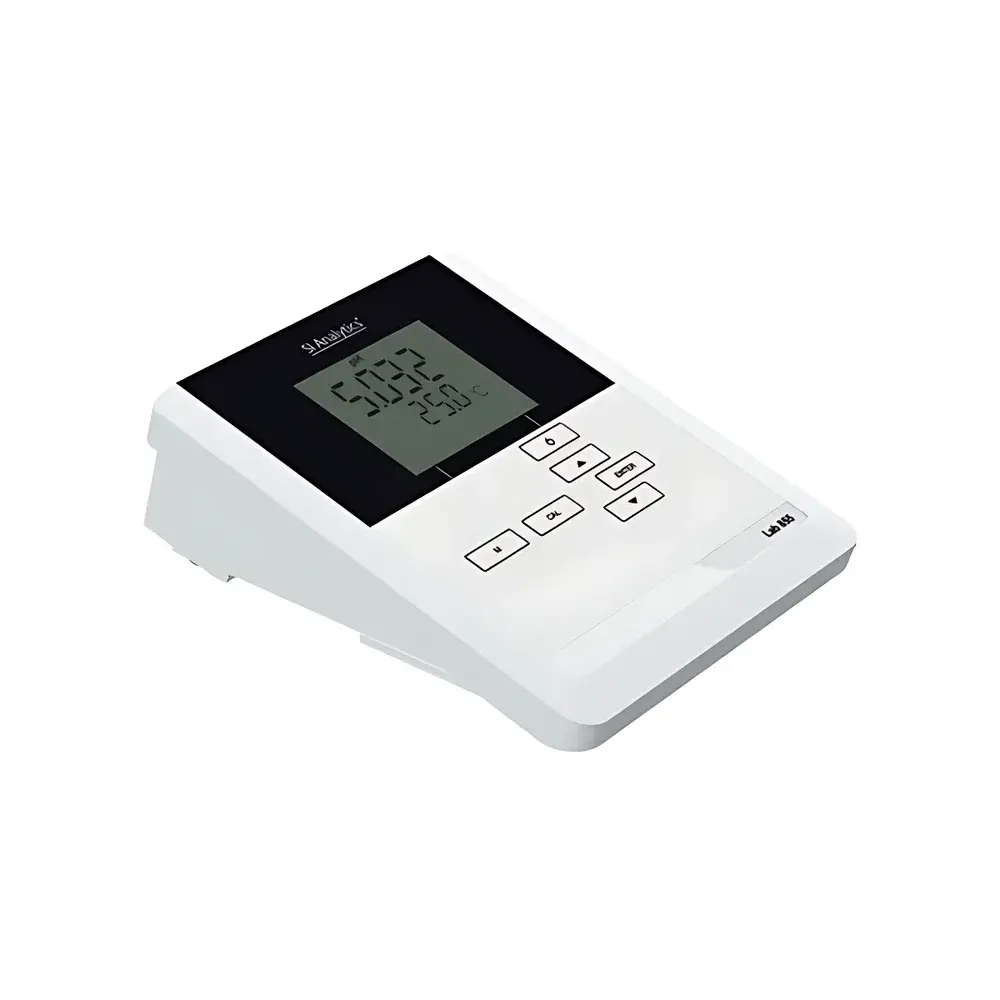
ChemTron Lab 855 Benchtop pH Meter
| Brand | ChemTron |
|---|---|
| Origin | Germany |
| Model | Lab 855 |
| Instrument Type | Benchtop |
| Parameter Types | Multi-parameter |
| Measurement Precision | 0.001 pH |
| Resolution | 0.01 pH |
| Accuracy | ±0.1 pH |
| pH Range | –2.000 to 19.999 |
| pH Accuracy | ±0.005 pH (at 25 °C, calibrated) |
| mV Range | ±1200.0 mV / ±2000 mV |
| mV Accuracy | ±0.3 mV / ±1 mV |
| Temperature Range | –5.0 to 105.0 °C |
| Temperature Accuracy | ±0.1 °C |
| Calibration Points | 1–3 point automatic or manual |
| Auto-Read Function | Yes |
| Temperature Compensation | Automatic & Manual |
| Calibration Memory | 1 set stored |
| Data Storage Capacity | 500 or 5000 readings (configurable) |
| Display | LCD |
| Electrode Interface | DIN |
| Connectivity | Mini USB-B |
| Compliance | GLP/AQS compliant |
| Power Supply | AC adapter or battery operation |
| CMC Detection | Supported |
Overview
The ChemTron Lab 855 Benchtop pH Meter is a precision electrochemical instrument engineered for rigorous laboratory environments in chemistry, pharmaceutical development, and biopharmaceutical quality control. Based on potentiometric measurement principles, the Lab 855 determines hydrogen ion activity via a glass pH electrode coupled with a reference system—typically Ag/AgCl—in accordance with Nernst equation fundamentals. Its triple-range pH capability (–2.000 to 19.999) supports highly alkaline and strongly acidic media, including non-aqueous or low-ionic-strength samples common in API synthesis and excipient characterization. Designed and assembled in Germany, the instrument adheres to stringent European manufacturing standards and integrates active auto-read functionality to eliminate subjective endpoint judgment, thereby enhancing inter-operator reproducibility and reducing measurement variance in regulated workflows.
Key Features
- Triple-resolution pH display: selectable between 0.1, 0.01, and 0.001 pH increments—enabling trace-level process monitoring and method validation studies.
- Integrated temperature compensation with both automatic (via integrated Pt1000 sensor or external probe) and manual input modes—ensuring thermodynamic accuracy across wide thermal gradients (–5.0 to 105.0 °C).
- DIN-standard electrode interface ensures mechanical and electrical compatibility with industry-leading combination electrodes, refillable single-junction probes, and specialized sensors (e.g., low-volume, high-temperature, or antifouling designs).
- GLP/AQS-compliant data architecture: timestamps, operator ID fields (user-definable), calibration history logging, and audit-trail-ready memory storage (500 standard / 5000 extended mode).
- Mini USB-B port enables direct connection to LIMS or ELN systems without proprietary drivers; supports CSV export for statistical process control (SPC) integration and trending analysis.
- Ergonomic keypad with tactile feedback and logical key grouping minimizes operational errors during high-throughput testing—particularly under gloved-hand conditions in cleanroom or cGMP environments.
Sample Compatibility & Compliance
The Lab 855 accommodates aqueous buffers, organic-aqueous mixtures, cell culture supernatants, dissolution media, and aggressive cleaning solutions (e.g., NaOH, HNO₃). Its extended pH range and configurable mV mode support redox potential (Eh) measurements per ASTM D1129 and ISO 10523 protocols. The device meets essential requirements of ISO/IEC 17025 for testing laboratories and aligns with FDA 21 CFR Part 11 expectations when paired with validated software and access-controlled user accounts. All calibration events—including date, time, buffer IDs, slope (%), offset (mV), and temperature—are immutably recorded and exportable for regulatory submission.
Software & Data Management
Data management is structured around traceability and integrity. Each stored reading includes sample ID, electrode serial number (manually entered), ambient temperature, and calibration status flag. The internal memory retains up to 5000 entries with full metadata, while Mini USB-B facilitates batch download into Excel or statistical platforms such as JMP or Minitab. No cloud dependency or vendor-hosted software is required—data remains under full laboratory control. Optional firmware updates preserve backward compatibility and extend support for emerging electrode technologies and metrological best practices.
Applications
- pH monitoring in USP and EP 2.2.3-compliant titration and buffer preparation.
- In-process control of fermentation broths and downstream purification steps (e.g., ion exchange elution profiling).
- Stability-indicating assays per ICH Q5C, including accelerated degradation studies where pH drift correlates with hydrolytic pathway activation.
- Water quality verification in purified water (PW) and water for injection (WFI) distribution loops per EU GMP Annex 1 and USP .
- Electrode performance qualification (EPQ) and routine verification using certified reference materials (CRMs) traceable to NIST SRM 186, 188, and 469.
FAQ
Does the Lab 855 support automatic calibration verification (ACV) or electrode diagnostics?
No—ACV is not implemented; however, real-time slope calculation (±0.1%) and asymmetry potential reporting enable proactive electrode health assessment prior to calibration.
Is the instrument compatible with non-DIN electrodes (e.g., BNC or screw-type connectors)?
Only DIN-compatible electrodes are natively supported; adapters are not supplied or validated by ChemTron.
Can calibration data be exported separately from measurement records?
Yes—calibration logs are stored independently and can be exported via USB as a dedicated CSV file.
What battery life can be expected during continuous operation?
With alkaline AA batteries, typical runtime exceeds 200 hours under normal usage; rechargeable NiMH batteries are not recommended due to voltage regulation constraints.
Is firmware upgrade capability available through the front panel?
Firmware updates require USB connection to a Windows PC and execution of ChemTron’s signed update utility—no over-the-air or embedded updater is provided.






