
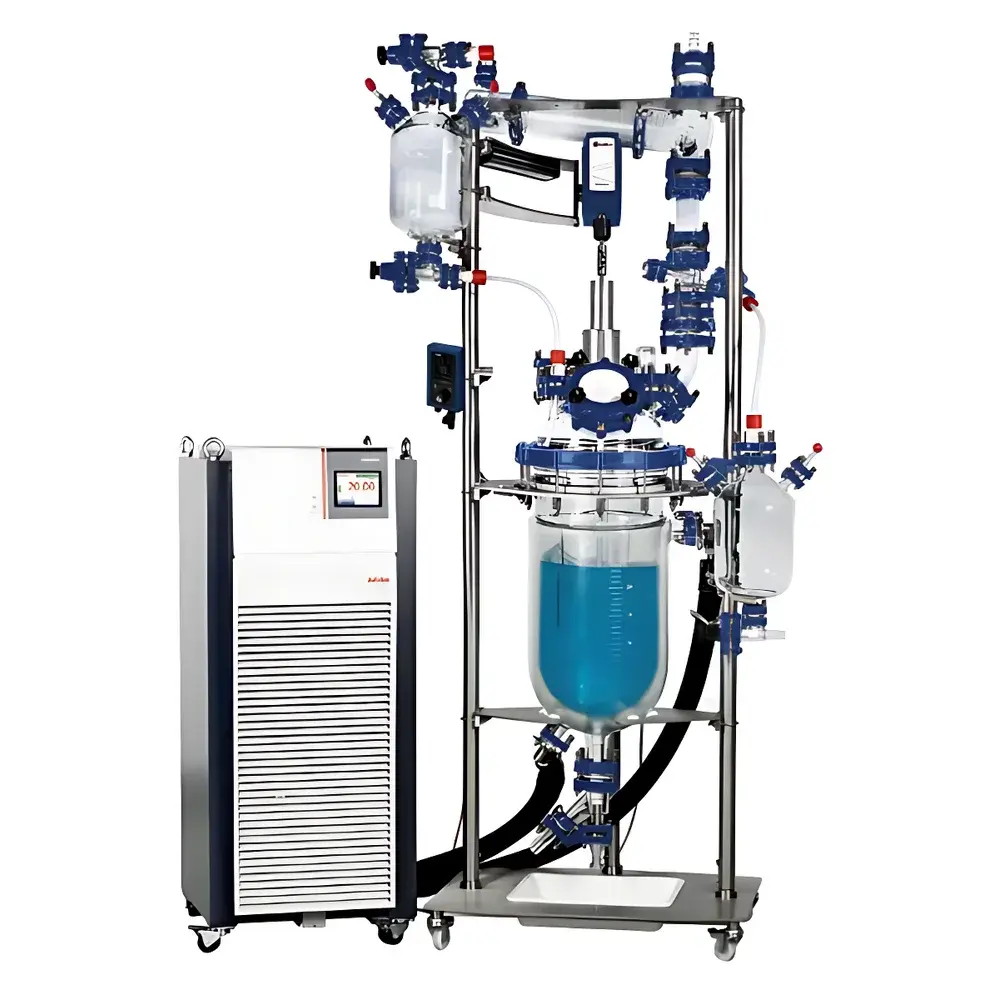
ChemTron PlusChem PPG30L Glass Reactor System
| Brand | ChemTron |
|---|---|
| Origin | Germany |
| Model | PPG30L |
| Temperature Range | −60 °C to +200 °C |
| Temperature Control Accuracy | ±0.01 °C |
| Reaction Vessel Capacity | 10–100 L |
| Number of Reaction Units | 1 |
| Maximum Continuous Stirring Speed | 500 rpm |
| Short-Term Stirring Speed | 800 rpm |
| Jacket Inlet/Outlet Port Size | DN25 |
| Condenser Surface Area | 0.6 m² (DN50P) |
| Material of Construction | High-Quality Borosilicate Glass (DIN ISO 3585), PTFE, PFA |
| Pressure Rating | −1 to +0.5 bar (gauge) |
| Vessel Opening Diameter (PPG30L) | DN300 |
| Bottom Valve Orifice | 0–25 mm |
| Stirrer Shaft Diameter | 16 mm (Stainless Steel/PTFE-coated) |
Overview
The ChemTron PlusChem PPG30L Glass Reactor System is a precision-engineered, modular laboratory-scale chemical synthesis platform designed for controlled, scalable, and reproducible reaction development under demanding thermal, pressure, and material compatibility conditions. Built upon a fundamentally industrial design philosophy, the system employs borosilicate glass (DIN ISO 3585 compliant) as the primary wetted material—ensuring exceptional chemical resistance to strong acids, bases, halogenated solvents, and oxidizing agents across its full operational temperature range of −60 °C to +200 °C. Its vacuum-rated construction (−1 bar) and low positive pressure capability (+0.5 bar) support applications including low-boiling solvent reflux, cryogenic reactions, controlled gas evolution, and gentle distillation. The reactor’s mechanical architecture integrates flexible buffer flanges at all major junctions—minimizing stress-induced fracture risk during thermal cycling or mechanical agitation—and features a height-optimized layout with a horizontal condenser, integrated reflux/distillation valve, low-position receiver flask, and elevated feed reservoir. This configuration reduces overall footprint while maintaining ergonomic access and stable center-of-gravity operation—critical for long-duration, unattended syntheses.
Key Features
- Modular, GMP-ready reactor system with standardized DN300 flange interface for PPG30L configuration—compatible with optional top-mounted accessories including temperature-sensing bottom valves and pneumatically actuated discharge valves.
- High-precision temperature control system delivering ±0.01 °C stability over the full −60 °C to +200 °C range, enabled by dual-zone jacketed circulation and PID-regulated heat transfer fluid delivery.
- Robust mechanical stirring assembly with 16 mm stainless steel/PTFE-coated shaft, rated for continuous operation at 500 rpm and short-term duty up to 800 rpm; bearing design accommodates viscous media and suspended solids without seal degradation.
- Integrated horizontal condenser (DN50P, 0.6 m² surface area) with seamless switching between reflux and distillation modes via a single multi-port valve—eliminating manual tubing reconfiguration and reducing vapor path dead volume.
- Standardized 7-port reactor head (DN300) includes dedicated ports for thermocouple insertion (600 mm probe), overhead stirrer, condenser, inert gas inlet, pressure/vacuum line, sampling, and auxiliary instrumentation—enabling simultaneous monitoring and process control.
- Optional AR1.8 Automated Reaction Control System provides programmable ramp/soak profiles, real-time data logging (temperature, pressure, stir speed, pH, conductivity), event-triggered dosing, and audit-trail-compliant operation aligned with FDA 21 CFR Part 11 and GLP/GMP documentation requirements.
Sample Compatibility & Compliance
The PPG30L system is chemically inert toward nearly all organic and inorganic reagents due to its all-glass (borosilicate 3.3), PTFE, and PFA wetted-path construction—validated per ASTM E438 Type I, Class A specifications. It meets ISO 17025 calibration traceability standards for temperature and pressure instrumentation when configured with certified sensors. The system supports compliance workflows for pharmaceutical process development (ICH Q5, Q7), fine chemical synthesis (REACH, CLP), and academic research requiring reproducible reaction documentation. GMP-compatible kits (KC2 variant) include fully traceable multi-channel jacket valves, pre-assembled sterile-grade tubing, and validation-ready documentation packages—including IQ/OQ protocols and material certificates. All electrical components conform to CE, UL 61010-1, and EMC Directive 2014/30/EU requirements.
Software & Data Management
When equipped with the AR1.8 control module, the system operates under a deterministic real-time OS with embedded web server functionality—accessible via secure HTTPS from any networked device. Process data (≥100 Hz sampling) is stored locally on encrypted SSD storage with automatic daily backup to network drives. The software enforces user role-based access control (RBAC), electronic signatures, and immutable audit trails—including operator ID, timestamp, parameter changes, alarm events, and manual overrides. Export formats include CSV, PDF reports (with configurable templates), and native .arx files compatible with LIMS integration via OPC UA or RESTful API. All data handling complies with GDPR and HIPAA-aligned security frameworks; raw sensor logs retain full resolution without interpolation or compression.
Applications
- Process optimization of exothermic hydrogenations, Grignard couplings, and lithiation reactions under tightly controlled sub-zero conditions.
- Multi-step telescoped synthesis with inline quenching, phase separation, and solvent swap—leveraging the integrated reflux/distillation valve and dual-level liquid handling (5 L feed + 5 L collection).
- Crystallization kinetics studies using high-resolution temperature ramping and in situ turbidity monitoring through the glass vessel wall.
- Photochemical reactions with optional UV-transparent quartz sight glasses and LED irradiation modules mounted on standard DN40 ports.
- Scale-down modeling for pilot-plant transfer—PPG30L’s geometric similarity, power-per-volume consistency, and heat-transfer coefficient matching enable predictive correlation to 100–1000 L production reactors.
- Regulatory filing batches for IND/IMPD submissions, where full digital traceability, equipment qualification records, and raw-data archiving are mandatory.
FAQ
What is the maximum allowable working pressure for the PPG30L reactor vessel?
The vessel is rated for −1 bar (vacuum) to +0.5 bar (gauge) at 200 °C. Pressure testing is performed per PED 2014/68/EU Annex I, Section 2.2.
Can the system be validated for GMP manufacturing use?
Yes—KC2 GMP kits include calibrated, traceable instrumentation, documented IQ/OQ protocols, and AR1.8 software with 21 CFR Part 11 compliance features (audit trail, e-signature, data integrity controls).
Is the glass reactor compatible with hydrofluoric acid or molten alkali metals?
No—borosilicate glass is not resistant to HF or anhydrous alkali metal melts. For such applications, custom quartz or Hastelloy-lined alternatives must be specified.
What level of temperature uniformity can be expected across the reaction mass?
With optimized jacket flow rate (>12 L/min) and baffled vessel geometry, radial and axial gradients remain ≤±0.3 °C during steady-state operation at 150 °C.
Does the system support remote monitoring and control outside the local network?
Yes—AR1.8 enables secure cloud-assisted remote access via TLS 1.3-encrypted tunneling, with configurable firewall rules and two-factor authentication enforced at the gateway level.



