
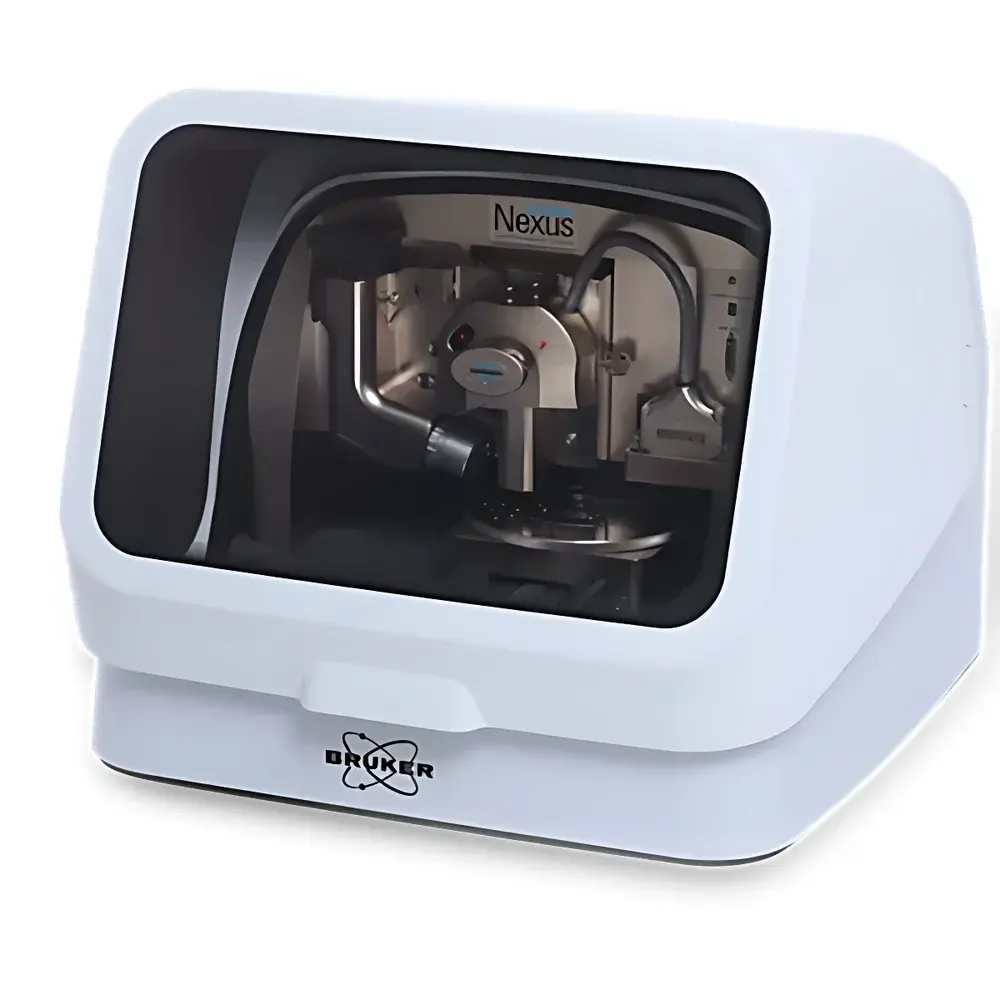
Bruker Dimension Nexus Atomic Force Microscope
| Brand | Bruker |
|---|---|
| Origin | USA |
| Manufacturer Type | Authorized Distributor |
| Origin Category | Imported |
| Model | Dimension Nexus |
| Instrument Type | Atomic Force Microscope |
| Application Class | Materials Science AFM |
| Architecture | Modular, Multi-Mode Scanning Probe Microscope |
| Controller Platform | NanoScope 6 |
| Core Imaging Modes | PeakForce Tapping®, PeakForce QNM®, PeakForce MFM®, ScanAsyst® Auto-Optimization |
| Environmental Operation | Air, Liquid, Controlled Atmosphere |
Overview
The Bruker Dimension Nexus is a high-performance, modular atomic force microscope engineered for quantitative nanoscale characterization across diverse material systems. Built upon Bruker’s industry-proven NanoScope 6 controller platform, it implements advanced scanning probe microscopy (SPM) principles—including direct force control via closed-loop piezoelectric actuation, real-time feedback-driven probe-sample interaction regulation, and sub-piconewton force sensitivity—to deliver reproducible topographic, mechanical, electrical, and magnetic property mapping. Unlike resonant oscillation-based AFM modes, the Dimension Nexus leverages PeakForce Tapping®, a non-resonant, force-controlled imaging paradigm that decouples lateral forces from vertical feedback, enabling stable, low-damage scanning of soft biological specimens, polymer thin films, and hard inorganic surfaces within a single experimental framework. Its open-architecture design supports seamless integration of environmental enclosures, electrochemical cells, and temperature-controlled stages—making it suitable for GLP-compliant materials R&D, semiconductor process development, and life science applications requiring nanoscale structural fidelity.
Key Features
- PeakForce Tapping® technology with real-time force setpoint adjustment (0.1–10 nN range), ensuring consistent tip-sample interaction across heterogeneous samples
- NanoScope 6 controller featuring 24-bit DAC resolution, <100 µV RMS electronic noise floor, and dual-channel simultaneous data acquisition for correlated property mapping
- ScanAsyst® auto-optimization suite: automatically calibrates gains, scan speed, and setpoint for novice and expert users alike—reducing setup time by >70% without compromising resolution
- PeakForce QNM® (Quantitative Nanomechanical Mapping): extracts modulus, adhesion, deformation, and dissipation maps at pixel-level resolution under ambient or liquid conditions
- PeakForce MFM® mode with phase-locked loop (PLL) demodulation for high-sensitivity magnetic domain imaging—validated on commercial 20 TB-per-platter HDD media with 2.5 × 2.5 µm field-of-view
- Modular SPM head compatible with fluid cells (ScanAsyst-Fluid+ probes), vacuum-compatible stages, and custom-built electrochemical accessories
Sample Compatibility & Compliance
The Dimension Nexus accommodates a broad spectrum of sample types—from conductive and insulating substrates to hydrated biomolecular assemblies—without requiring metal coating or conductive modification. It complies with ISO/IEC 17025 calibration traceability requirements when used with NIST-traceable reference standards (e.g., Si grating SRM 2053, polymer roughness standard SRM 2109). For regulated environments, its software architecture supports audit trail logging, electronic signatures, and user-access controls aligned with FDA 21 CFR Part 11 and EU Annex 11 expectations. All mechanical and thermal drift performance metrics meet ASTM E2531-22 specifications for SPM dimensional stability over 30-minute acquisitions.
Software & Data Management
NanoScope Analysis v2.0 software provides full post-processing capabilities—including cross-section profiling, grain analysis, power spectral density (PSD) computation, and statistical parameter extraction (Ra, Rq, Rz, skewness, kurtosis). Raw data is stored in Bruker’s proprietary .spm format, which embeds metadata such as scanner calibration coefficients, environmental conditions, and operator credentials. Export options include TIFF, ASCII, HDF5, and MATLAB-compatible .mat files. The system supports networked deployment via secure SSH tunneling and integrates with laboratory information management systems (LIMS) through standardized RESTful APIs compliant with HL7 FHIR and ISA-Tab conventions.
Applications
- Quantitative nanomechanics of battery electrode coatings (e.g., NMC cathodes, silicon anodes) under in situ electrochemical cycling
- High-resolution topography and conformational mapping of DNA origami nanostructures in physiological buffer—demonstrated at 500 × 500 nm FOV with single-strand resolution
- Magnetic domain wall dynamics in perpendicular magnetic recording media and spintronic heterostructures
- Surface energy heterogeneity analysis of pharmaceutical tablet coatings using adhesion mapping
- Interfacial delamination quantification in multilayer photovoltaic absorbers (e.g., CIGS, perovskite)
- Time-lapse nanoscale swelling behavior of hydrogels during pH or ionic strength variation
FAQ
What distinguishes PeakForce Tapping® from traditional tapping mode AFM?
PeakForce Tapping operates in a non-resonant regime with direct force feedback, eliminating amplitude instability and cantilever ringing artifacts common in oscillatory modes—resulting in superior resolution on both soft and stiff samples.
Can the Dimension Nexus perform measurements in liquid environments?
Yes—equipped with ScanAsyst-Fluid+ probes and optional fluid cell modules, it enables quantitative nanomechanical mapping of biomolecules, membranes, and colloidal interfaces under physiological or controlled electrolyte conditions.
Is the system compatible with third-party probes and accessories?
It supports industry-standard probe holders (e.g., Bruker RTESPA, PPP-NCHR, MPP-11100) and accepts custom-designed cantilevers with integrated electrodes or optical waveguides via its open mechanical interface.
How does the NanoScope 6 controller enhance data integrity?
Its dual 24-bit ADC channels digitize deflection and Z-piezo signals simultaneously at up to 2 MHz sampling rate, minimizing temporal misregistration and enabling true vector-based property correlation.
Does Bruker provide application-specific training and method validation support?
Yes—Bruker’s Applications Scientists offer on-site and remote SOP development, GxP documentation templates, and IQ/OQ/PQ protocol assistance for regulated laboratories.






