
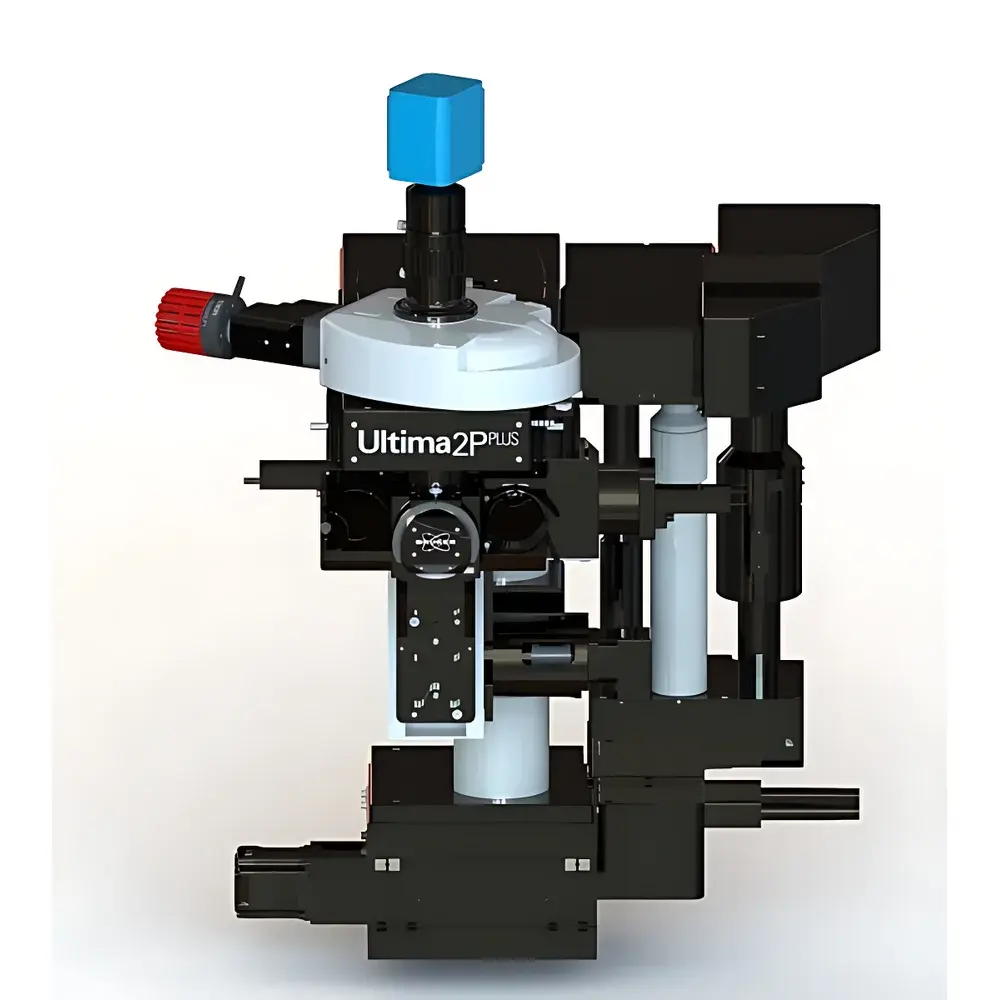
Bruker 2PPlus Multimodal Two-Photon Imaging Platform
| Brand | Bruker |
|---|---|
| Origin | USA |
| Manufacturer Type | Authorized Distributor |
| Origin Category | Imported |
| Model | 2PPlus |
| Price Range | USD $380,000–$640,000 (est.) |
| Instrument Type | Optical In Vivo Imaging System |
| Scanning Resolution | 2048 × 2048 pixels |
| Maximum Frame Rate | 1300 fps |
| Field of View | 1.9 mm × 1.9 mm (with 16× objective) |
| Sample Capacity | 1 specimen per acquisition session |
| Excitation Wavelength Range | 400–1700 nm |
| Multiphoton Capability | Two-photon and three-photon imaging supported |
| Scan Modes | Galvo-based raster, spiral, and resonant scanning |
| Objective Compatibility | Motorized and manual multi-axis rotating objectives (single- and multi-axis) |
| Optional Modules | Full-field LED illumination, 1P/2P uncaging, spatial light modulator (SLM)-based patterned excitation |
Overview
The Bruker 2PPlus is a high-performance, multimodal two-photon imaging platform engineered for deep-tissue, high-resolution functional and structural imaging in intact biological systems. Based on the principle of simultaneous absorption of two near-infrared (NIR) photons—typically within the 700–1300 nm “optical window” where scattering and absorption in biological tissue are minimized—the system enables intrinsic optical sectioning with minimal phototoxicity and photobleaching. Unlike confocal microscopy, which relies on pinhole-based rejection of out-of-focus light, two-photon excitation occurs only at the focal plane due to the nonlinear dependence on photon flux density, thereby providing inherent 3D resolution without mechanical sectioning. The 2PPlus extends this capability into the three-photon regime (via optional laser tuning and detection optimization), permitting imaging at depths exceeding 1.5 mm in highly scattering tissues such as cortical gray matter or intact organs. Designed for longitudinal in vivo studies in rodents and other small animal models, the platform supports physiological stability during extended acquisition sessions through its large working distance, modular sample stage integration, and non-invasive optical access strategies.
Key Features
- Three synchronized scanning modalities: high-fidelity galvanometric raster scanning, high-throughput spiral scanning, and ultrafast resonant scanning (up to 1300 fps at full 2048 × 2048 resolution)
- Expanded field of view (1.9 mm × 1.9 mm with 16× objective) enabled by proprietary 6-mm scan mirrors and oversized optical train—delivering 3–4× larger FOV than conventional two-photon systems without compromising resolution or signal-to-noise ratio
- Multi-axis rotating objective turret (manual and motorized options) supporting off-axis, oblique, and multi-angle imaging—enabling volumetric reconstruction and minimally perturbed observation of anatomically constrained regions (e.g., skull-embedded cortex, spinal cord, or abdominal organs)
- Integrated microscope translation stage compatible with rotating objectives—allowing dynamic repositioning of the imaging plane without physical displacement of the specimen, preserving native hemodynamics and neural activity
- Optimized scan optics spanning 400–1700 nm, facilitating flexible integration of UV-visible uncaging, NIR stimulation, and third-harmonic generation (THG) or stimulated Raman scattering (SRS) extensions
- Modular optogenetic stimulation architecture including full-field LED illumination, single-/two-photon uncaging modules, and high-speed SLM-based patterned excitation for spatiotemporally precise photostimulation concurrent with functional imaging
Sample Compatibility & Compliance
The 2PPlus is validated for use with live murine models (including transgenic, viral-injected, and surgically prepared preparations), acute brain slices (>500 µm thickness), ex vivo organ explants (e.g., heart, lung, kidney), and 3D organoid cultures. Its open optical architecture accommodates custom stereotaxic holders, thermal regulation stages, respiration monitoring interfaces, and electrophysiology rigs. All hardware and firmware comply with IEC 61000-6-3 (EMC emissions), IEC 60601-1 (medical electrical equipment safety), and ISO 13485–aligned quality management practices. Data acquisition workflows support ALARA (As Low As Reasonably Achievable) laser exposure protocols and are compatible with GLP-compliant documentation frameworks when paired with Bruker’s acquisition software audit trail features.
Software & Data Management
Control, acquisition, and analysis are unified under Bruker’s Prairie View™ software suite—designed for reproducible, metadata-rich experiment execution. The platform supports time-stamped, version-controlled acquisition scripts; real-time motion correction using fiducial tracking; and on-the-fly spectral unmixing for multicolor fluorophore separation. Raw data is saved in standardized HDF5 format with embedded TIFF-compatible metadata, ensuring interoperability with Python (e.g., CaImAn, Suite2p), MATLAB (e.g., SIMA), and ImageJ/Fiji pipelines. Audit trails—including user logins, parameter changes, laser power calibrations, and hardware state snapshots—are recorded per acquisition session in accordance with FDA 21 CFR Part 11 requirements for regulated preclinical research environments.
Applications
- Longitudinal calcium dynamics mapping in awake, head-fixed or freely moving mice using GCaMP or jRGECO indicators
- Structural plasticity tracking across dendritic spines and axonal boutons over days to weeks
- Functional connectivity mapping via targeted optogenetic perturbation and simultaneous volumetric readout
- Neurovascular coupling studies combining two-photon angiography (with dextran-conjugated dyes) and neuronal activity imaging
- Deep-tissue immunology imaging in lymph nodes, bone marrow, or tumor microenvironments using far-red/NIR probes
- Three-photon imaging of subcortical structures (e.g., hippocampus, thalamus) in intact, unsectioned brains
FAQ
Does the 2PPlus support three-photon imaging natively?
Yes—the optical path, detector quantum efficiency profile, and laser synchronization architecture are designed to accommodate three-photon excitation using tunable femtosecond lasers operating above 1300 nm.
Can the system be integrated with electrophysiology setups?
Yes—dedicated electrical shielding, low-noise analog/digital I/O ports, and TTL-synchronized trigger lines enable seamless integration with patch-clamp amplifiers, silicon probes, and behavioral control systems.
Is remote operation and multi-user access supported?
Prairie View supports role-based network authentication, secure remote desktop access via TLS-encrypted VNC, and concurrent multi-user acquisition scheduling with resource locking.
What maintenance and calibration services are available?
Bruker offers annual performance verification (APV) packages including laser power calibration, PMT gain linearity validation, scan mirror alignment verification, and spectral response profiling—all traceable to NIST standards.
Are there application-specific training programs?
Bruker provides on-site and virtual workshops covering experimental design, motion artifact mitigation, quantitative fluorescence lifetime analysis, and compliance documentation for grant-funded or regulatory submissions.
Related Products



