
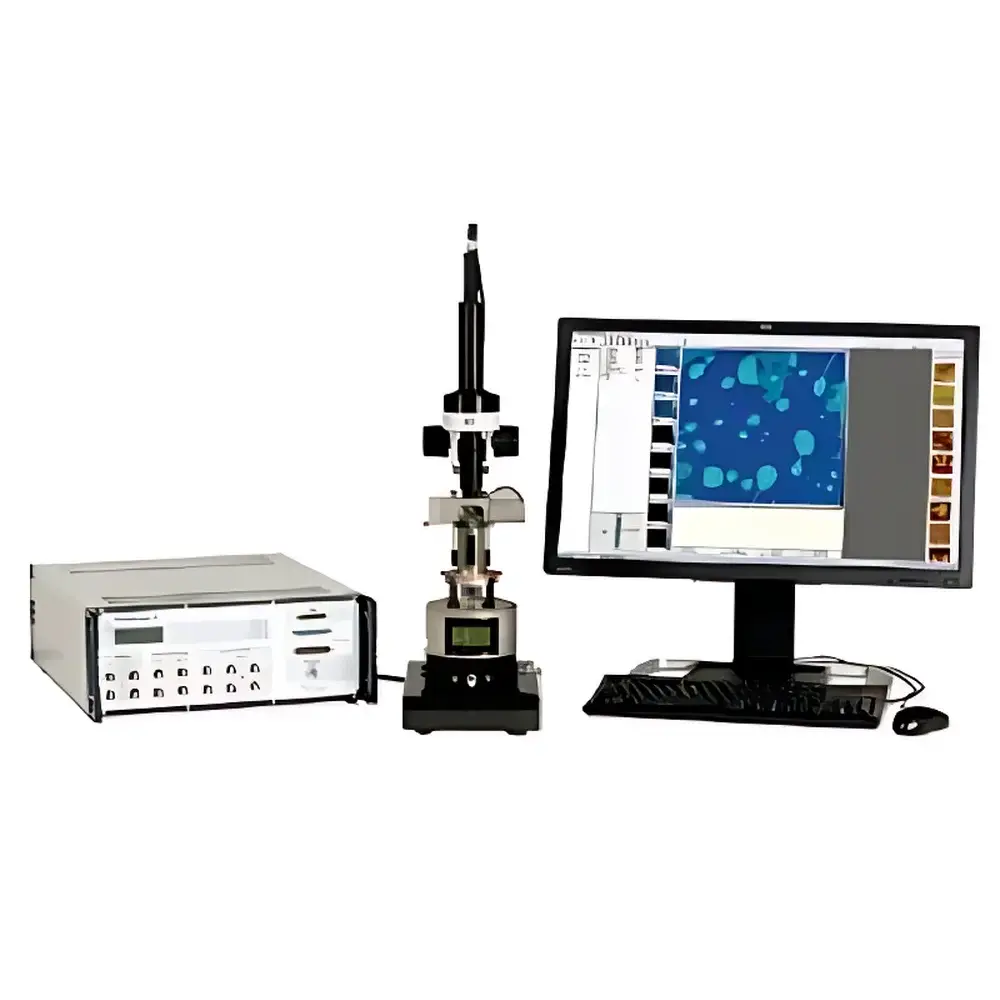
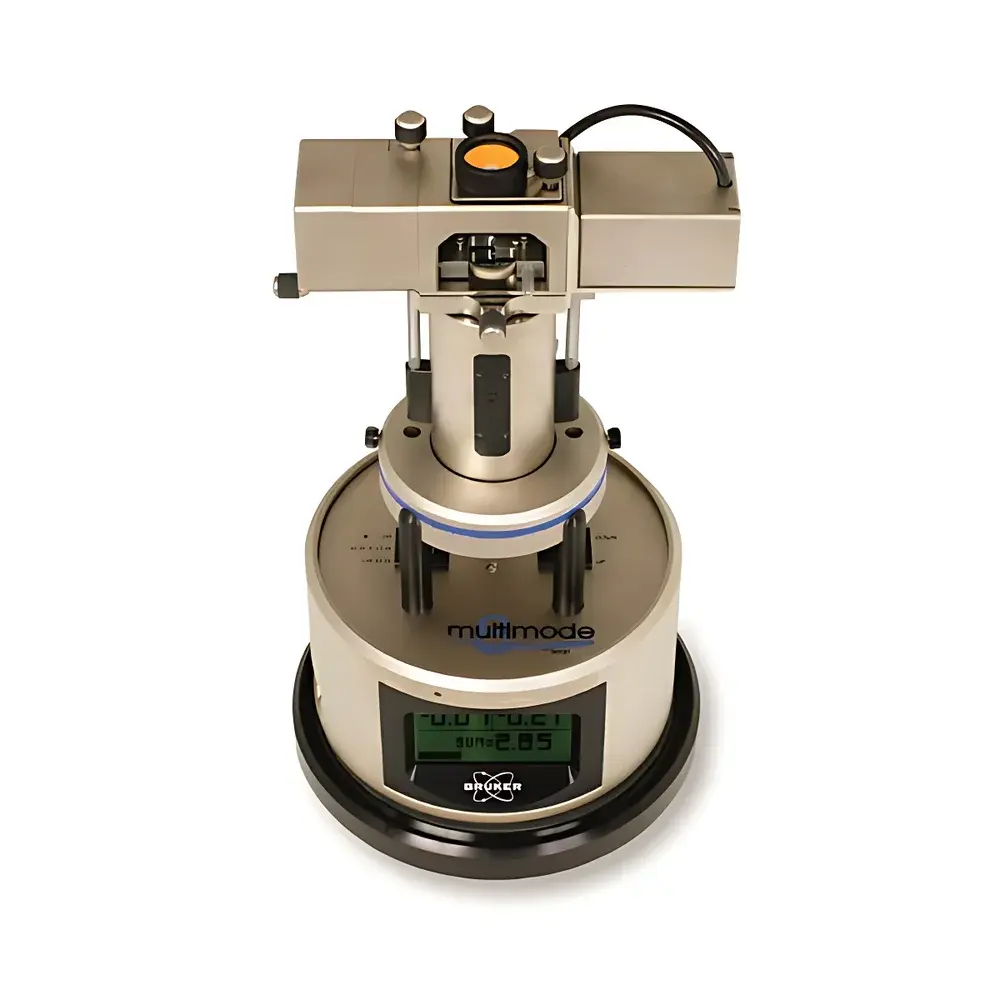
Bruker MultiMode 8 Atomic Force Microscope
| Brand | Bruker |
|---|---|
| Origin | USA |
| Model | MultiMode 8 |
| Instrument Type | Atomic Force Microscope (AFM) |
| Z-Direction Positioning Noise | <0.3 Å RMS (Tapping Mode, 0 nm scan size, with active vibration isolation) |
| Maximum Sample Size | 15 mm × 15 mm × 5 mm |
| XY Stage Travel Range | 15 mm × 15 mm |
| Optional Scan Heads | AS-0.5 (0.4 µm × 0.4 µm XY / 0.4 µm Z), AS-12 (10 µm × 10 µm XY / 2.5 µm Z), AS-130 (125 µm × 125 µm XY / 5.0 µm Z), PF50 (40 µm × 40 µm XY / 20 µm Z) |
Overview
The Bruker MultiMode 8 is the eighth-generation high-performance atomic force microscope (AFM) in Bruker’s globally deployed MultiMode platform — the world’s most widely adopted SPM system, with over 9,000 installations across academic, industrial, and government laboratories. Engineered for nanoscale surface characterization under ambient, liquid, and controlled environmental conditions, the MultiMode 8 leverages Bruker’s proprietary NanoScope V digital controller architecture to deliver exceptional signal fidelity, real-time data throughput, and sub-ångström vertical resolution. Its core measurement principle relies on piezoelectrically driven probe-sample interaction, where cantilever deflection or resonance frequency shifts are transduced via optical beam bounce detection to reconstruct topographic, mechanical, electrical, magnetic, and electrochemical properties at true atomic and molecular scales. Designed for rigorous materials science, life science, polymer physics, and semiconductor R&D workflows, the system supports quantitative nanomechanical mapping (e.g., PeakForce QNM), automated imaging (ScanAsyst), and multimodal correlative analysis — all within a single platform validated for GLP/GMP-compliant environments.
Key Features
- Sub-ångström Z-noise floor: <0.3 Å RMS in tapping mode with integrated active vibration isolation — enabling atomic-scale lattice resolution on crystalline surfaces and soft biomolecular assemblies
- NanoScope V controller: Fifth-generation digital architecture featuring 16-bit ADCs, >10 MHz data bandwidth, real-time FFT processing, and deterministic latency for high-speed force spectroscopy and dynamic mode imaging
- Modular scan head options: AS-0.5 (high-resolution), AS-12 (general-purpose), AS-130 (large-area mapping), and PF50 (high-force nanomechanics), each optimized for specific resolution–range trade-offs
- Environmental flexibility: Integrated temperature control module enables operation from –35 °C to +250 °C; liquid cells support physiological buffers, electrolytes, and organic solvents; environmental chamber permits precise gas composition control (N2, O2, H2, CO2) at atmospheric pressure
- Multi-modal capability: Native support for >20 SPM techniques including Tapping Mode, Contact Mode, Phase Imaging, LFM, MFM, EFM, SCM, SSRM, CAFM, TUNA, EC-AFM/EC-STM, PeakForce QNM, and PicoForce spectroscopy — all accessible via unified software interface
- Automated optimization: ScanAsyst technology eliminates manual parameter tuning by dynamically adjusting setpoint, gain, and drive amplitude during acquisition — reducing user dependency while maintaining reproducibility across skill levels
Sample Compatibility & Compliance
The MultiMode 8 accommodates samples up to 15 mm × 15 mm × 5 mm in dimension, compatible with standard silicon wafers, TEM grids, biological substrates (e.g., mica, glass coverslips), conductive polymers, battery electrode films, and catalytic nanoparticles. Its modular sample stage allows rapid exchange between air, liquid, and vacuum-compatible configurations. All hardware and firmware comply with ISO/IEC 17025 calibration traceability requirements. Data acquisition and instrument control meet FDA 21 CFR Part 11 criteria for electronic records and signatures when configured with audit-trail-enabled software licenses. The system supports full ALCOA+ principles (Attributable, Legible, Contemporaneous, Original, Accurate, Complete, Consistent, Enduring, Available) for regulatory submissions in pharmaceutical, medical device, and advanced materials development.
Software & Data Management
Acquisition and analysis are performed using Bruker’s NanoScope Analysis v2.0 software suite — a Windows-based platform supporting scripting (Python API), batch processing, and third-party plugin integration (e.g., MATLAB, ImageJ). Raw data files (.spm) store full metadata including timestamp, environmental conditions, feedback parameters, and calibration constants — ensuring full experimental provenance. Built-in tools enable quantitative roughness analysis (Ra, Rq, Rz), grain statistics, force-distance curve fitting (Hertz, Sneddon, DMT models), modulus mapping, adhesion quantification, and statistical correlation across modalities. Export formats include TIFF, PNG, CSV, HDF5, and OMEX (Open Microscopy Environment) for interoperability with institutional data repositories and FAIR-aligned infrastructure.
Applications
- Materials Science: Nanomechanical property mapping of thin-film coatings, phase separation in block copolymers, defect analysis in 2D materials (graphene, MoS2), and interfacial strain in heterostructures
- Life Sciences: High-resolution imaging of membrane proteins, DNA-protein complexes, and extracellular matrix fibrils in near-physiological buffer; single-molecule force spectroscopy of receptor-ligand binding kinetics
- Electrochemistry: In situ and operando EC-AFM studies of SEI formation on Li-ion battery anodes, corrosion initiation on metal alloys, and catalyst degradation under potential sweep
- Semiconductors: Nanoscale dopant profiling via SSRM, leakage current localization with CAFM, and gate oxide integrity assessment using TUNA
- Polymers & Soft Matter: Viscoelastic mapping of hydrogels, crystallinity gradients in polyolefins, and self-assembly dynamics of amphiphilic block copolymers in liquid
FAQ
What distinguishes the MultiMode 8 from earlier generations?
The MultiMode 8 integrates the NanoScope V controller, enhanced thermal stability architecture, expanded environmental control options (–35 °C to +250 °C), and native support for PeakForce QNM and ScanAsyst — significantly improving throughput, quantitation robustness, and ease-of-use without compromising resolution.
Is the system suitable for regulated GxP environments?
Yes — when equipped with appropriate software licensing and documentation packages, the MultiMode 8 meets 21 CFR Part 11 requirements for audit trails, electronic signatures, and data integrity — supporting validation per IQ/OQ/PQ protocols.
Can it perform measurements in liquid without compromising resolution?
Yes — the system supports dedicated liquid cells with low-noise fluidics and optimized cantilevers, enabling sub-nanometer resolution in aqueous and non-aqueous media while maintaining thermal and acoustic stability.
What sample preparation is required for biological specimens?
Standard protocols apply: adsorption onto freshly cleaved mica or functionalized glass, followed by gentle rinsing and buffer exchange; no metal coating is required due to the non-destructive nature of AFM imaging.
How is calibration traceability maintained?
Bruker provides NIST-traceable calibration standards (grating, step-height, and modulus reference samples) with documented uncertainty budgets; annual recalibration services are available through Bruker-certified service centers.




