
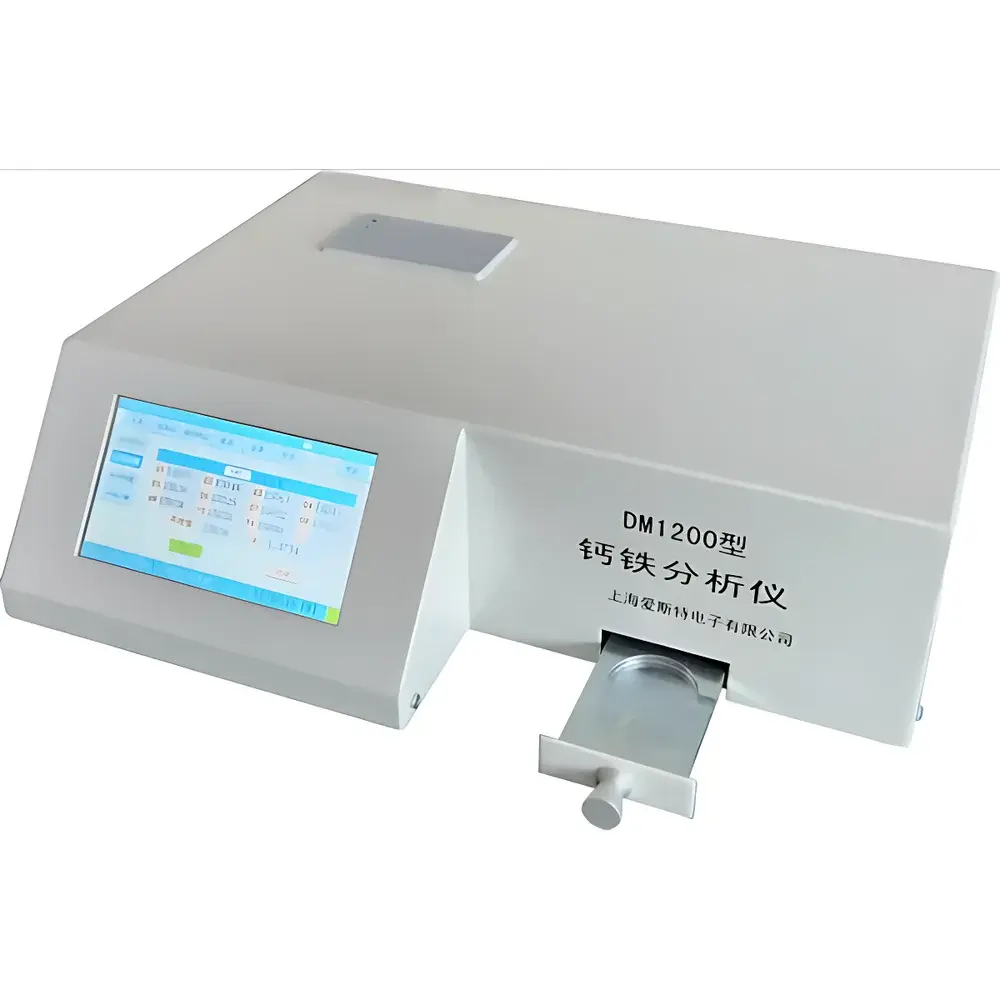
AST DM1200 Energy-Dispersive X-ray Fluorescence (EDXRF) Calcium and Iron Analyzer
| [Brand | AST / ST |
|---|---|
| Origin | Shanghai, China |
| Model | DM1200 |
| Excitation Source | Low-power micro-focus X-ray tube (≤10 kV, ≤0.5 mA, ≤5 W) |
| Detector | Thin beryllium-window gas-flow proportional counter |
| Measurement Time | 1–999 s (default 30 s) |
| Elements Quantified | CaO, Fe₂O₃ (simultaneously) |
| Accuracy | σ(CaO) ≤ 0.09 wt%, σ(Fe₂O₃) ≤ 0.05 wt% |
| Sample Form | Solid pellets (powder pressed into discs) |
| Compliance | GB/T 176–2017, JC/T 1085–2008, JB/T 11145–2011 |
| Display | 7-inch color capacitive touchscreen |
| Data Storage | Internal non-volatile memory with power-loss retention |
| Interface | RS-232/USB for PC connectivity |
| Dimensions | 470 × 365 × 130 mm (W×D×H) |
| Weight | 15 kg] |
Overview
The AST DM1200 is a benchtop energy-dispersive X-ray fluorescence (EDXRF) analyzer engineered for rapid, non-destructive quantification of calcium oxide (CaO) and iron oxide (Fe₂O₃) in cementitious materials—including raw meal, clinker, finished cement, and industrial minerals. Unlike radioisotope-based XRF systems, the DM1200 employs a low-power micro-focus X-ray tube (≤10 kV, ≤0.5 mA) as its excitation source, eliminating regulatory constraints associated with radioactive sources and achieving full compliance with national radiation exemption certification in China. Its optical architecture features a downward-beam geometry, minimizing contamination risk to the detector—critical for high-volume analysis of abrasive, fine particulate samples such as cement powders. The instrument implements hard-sample ratio calibration methodology, leveraging fundamental parameter corrections and secondary target filtering to enhance peak-to-background ratios and improve spectral resolution for overlapping Ca Kα (3.69 keV) and Fe Kα (6.40 keV) lines. Designed explicitly for process control environments, the DM1200 delivers quantitative results within 30 seconds per sample without chemical digestion, solvent use, or vacuum/gas purge requirements.
Key Features
- Source-free operation: No radioactive isotopes—fully compliant with IAEA safety guidelines and national radiation exemption regulations.
- Downward-beam optics: Prevents sample dust accumulation on detector window; extends maintenance intervals and ensures long-term counting stability.
- Digital multi-channel pulse height analyzer (MCA): FPGA- and DSP-based architecture with variable-gain amplification, enabling real-time gain stabilization, spectral drift correction, and improved linearity across extended measurement campaigns.
- Integrated touchscreen interface: 7-inch capacitive display with intuitive icon-driven workflow; eliminates external keyboard/mouse dependency and supports direct method selection, calibration recall, and result review.
- Robust hardware design: Surface-mount technology (SMT) PCBs, embedded ARM-based CPU with isolated data bus, and thermal-printer module replace legacy electromechanical components—reducing failure points and field return rates by >85% versus prior generations.
- Zero-consumables operation: Requires no helium, argon, vacuum pumps, or reagents; annual operational cost is limited to electricity (~50 W average) and routine pellet die maintenance.
Sample Compatibility & Compliance
The DM1200 accepts homogenized, dry powder samples compacted into 32-mm diameter pellets using standard hydraulic presses (e.g., 20-ton pressure for 60 s). It is validated for use with cement raw meals (CaO: 40–65 wt%, Fe₂O₃: 0.5–5.0 wt%), clinkers (CaO: 60–67 wt%), and blended cements. Liquid and slurry matrices are not supported. The analyzer conforms to three key Chinese standards governing analytical instrumentation for cement: GB/T 176–2017 (Chemical Analysis Methods for Cement), JC/T 1085–2008 (XRF Analyzers for Cement Applications), and JB/T 11145–2011 (General Technical Requirements for XRF Spectrometers). While not certified to ISO/IEC 17025 or ASTM C114, its repeatability performance—3σ(CaO) = 0.23%, 3σ(Fe₂O₃) = 0.014%—exceeds the repeatability limits specified in GB/T 176–2017 (0.25% and 0.15%, respectively), confirming suitability for QC/QA applications under GLP-aligned internal laboratory procedures.
Software & Data Management
Firmware-integrated analysis software provides full control over acquisition parameters (live time, voltage, current), background subtraction algorithms, and calibration curve management. Quantitative analysis uses a quadratic intensity-concentration model: C = D + E·IC + F·IC², where IC is corrected intensity derived from raw pulse counts via dead-time correction and matrix normalization. Up to 11 certified reference materials (CRMs) may be used for multi-point calibration; regression coefficients (D, E, F) and correlation coefficients (γ > 0.995 for both CaO and Fe₂O₃) are stored per method. All measurement metadata—including date/time stamp, operator ID, sample ID, and raw spectrum—are logged internally with non-volatile flash memory (≥100,000 records). Data export is supported via USB mass storage or RS-232 serial transfer to Windows-based PCs running optional AST DataLink software, which enables CSV export, trend charting, SPC chart generation (X̄/R), and audit-trail-enabled user access logs—facilitating alignment with FDA 21 CFR Part 11 principles where electronic records are subject to review.
Applications
Primary deployment occurs in cement plant quality control laboratories and automated raw mix proportioning systems. By delivering CaO and Fe₂O₃ concentrations in <30 s, the DM1200 enables closed-loop feedback to belt-scale controllers—forming an “Analyzer–PLC–Weighfeeder” architecture for real-time adjustment of limestone and iron ore feed rates. Secondary applications include coal ash composition screening (CaO/Fe₂O₃/SO₃), metallurgical slag characterization, fly ash classification (per ASTM C618), and geological exploration core logging (where portability and minimal sample prep are critical). Though optimized for Ca and Fe in silicate matrices, the system’s spectral range (1–12 keV) permits qualitative screening of other mid-Z elements (e.g., Si, Al, S, K, Ti), though quantitative accuracy outside the factory-calibrated CaO/Fe₂O₃ range is not guaranteed without additional CRM validation.
FAQ
Does the DM1200 require radioactive source licensing or shielding infrastructure?
No. It uses a sealed X-ray tube operating below 10 kV and is certified radiation-exempt under Chinese regulatory frameworks.
Can the instrument analyze loose powder without pelletization?
No. Uniform density and surface flatness are essential for reproducible geometry effects; only pressed pellets meet measurement validity criteria.
Is calibration transferable between instruments?
No. Each unit requires individual calibration using site-specific CRMs due to minor variations in tube output, detector efficiency, and optical path alignment.
What is the recommended maintenance interval for the proportional counter?
Under normal operation (≤8 hrs/day, clean environment), the gas-flow detector requires replenishment every 18–24 months; no recalibration is needed after gas refill.
Does the DM1200 support remote diagnostics or firmware updates?
Yes—via USB-connected service laptop using AST ServiceTool v4.2+, which enables log retrieval, parameter diagnostics, and secure firmware patching under password-controlled admin mode.
Related Products





