
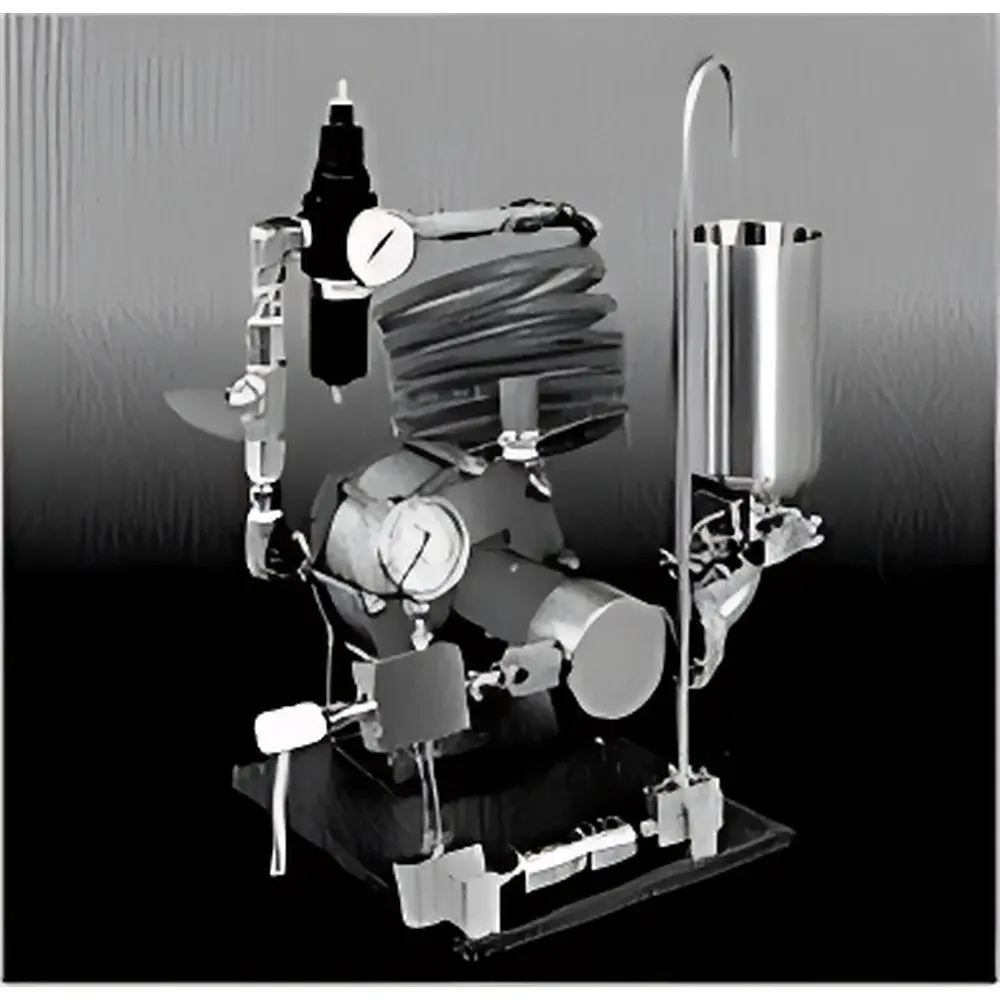
MFIC HC-2000 Series High-Pressure Microfluidic Nanoscale Homogenizer
| Origin | USA |
|---|---|
| Manufacturer Type | Authorized Distributor |
| Origin Category | Imported |
| Model | HC-2000 |
| Pricing | Available Upon Request |
| Max Operating Pressure | 2,000 psi |
| Max Flow Rate | 2,000 mL/min |
| Feed Temperature Limit | 75 °C (165 °F) |
| Compressed Air Requirement | 24 SCFM at 50 psi, Dew Point: −17.7 to 1.6 °C |
| Minimum Sample Volume | 100 mL |
| Dimensions | 44 × 44 × 51 cm |
| Weight | 16.8 kg |
| Construction Material | Electropolished 316 Stainless Steel |
| Drive Type | Pneumatic, Explosion-Proof Certified |
Overview
The MFIC HC-2000 Series is a high-pressure microfluidic homogenizer engineered for reproducible nanoscale dispersion and particle size reduction in laboratory-scale R&D and process development environments. Unlike conventional valve-based homogenizers, the HC-2000 employs a fixed-geometry interaction chamber—patented by Microfluidics International Corporation (MFIC), USA—that subjects fluid streams to controlled, turbulent microjet impingement under precisely regulated pressure. This hydrodynamic principle enables consistent shear stress distribution across the entire sample volume, minimizing thermal degradation while achieving sub-200 nm mean particle diameters in lipid vesicles, nanoemulsions, colloidal suspensions, and biopolymer dispersions. Designed for benchtop deployment, the system operates exclusively on standard lab-grade compressed air (no hydraulic oil or electric high-pressure pumps), eliminating contamination risks and simplifying maintenance in GMP-aligned cleanrooms or ISO Class 5/7 laboratories.
Key Features
- Patented fixed-geometry microchannel interaction chamber—zero moving parts, no wear-prone valves or seals in the fluid path
- Pneumatically driven architecture with intrinsic explosion-proof compliance (ATEX/IECEx-ready configuration available)
- Electropolished 316 stainless steel wetted surfaces meeting FDA 21 CFR Part 11 and USP material compatibility requirements
- In-line clean-in-place (CIP) capability via integrated high-pressure rinse ports; compatible with validated sterilization protocols (SIP up to 121 °C, 15 psi steam)
- Dual-stage pressure regulation with digital readout (0–2,000 psi) and real-time flow monitoring (0–2,000 mL/min)
- Compact footprint (44 × 44 × 51 cm) and lightweight design (16.8 kg) enabling mobility between fume hoods, biosafety cabinets, and QC labs
- High-reliability piston seal assembly with fluoropolymer-elastomer composite formulation, rated for >5,000 operating cycles under full-load conditions
Sample Compatibility & Compliance
The HC-2000 accommodates aqueous, organic, and biphasic formulations—including liposomes, polymeric nanoparticles, protein-stabilized emulsions, and thermolabile biologics—with feed temperature tolerance up to 75 °C. Its all-metal fluid path eliminates leachables and supports solvent compatibility with ethanol, acetone, chloroform, and common pharmaceutical excipients. The device conforms to ASTM F2399 (Standard Guide for Nanomaterial Characterization), ISO 13320:2020 (Laser Diffraction Particle Size Analysis), and EU GMP Annex 1 requirements for equipment qualification. Full documentation packages—including DQ/IQ/OQ protocols, material traceability certificates (EN 10204 3.1), and risk assessments per ISO 14971—are provided for regulated users in pharmaceutical, cosmetic, and food-grade applications.
Software & Data Management
While the base HC-2000 operates via analog pressure/flow controls, optional digital interface modules support RS-485 and Ethernet connectivity for integration into LIMS or MES platforms. All operational parameters—including pressure setpoint, cycle count, total processed volume, and ambient temperature—are logged with timestamped audit trails compliant with FDA 21 CFR Part 11 (electronic records and signatures). Optional software packages include MFIC Homogenization Analytics Suite, which correlates processing parameters with post-homogenization DLS, TEM, or dynamic light scattering data to establish process parameter maps for scale-up validation.
Applications
- Liposome and exosome extrusion替代 (nanoscale vesicle formation without membrane shear damage)
- Submicron emulsion stabilization for topical and oral drug delivery systems
- Nanoparticle dispersion in conductive inks, quantum dot suspensions, and ceramic precursors
- Cell disruption for intracellular organelle isolation (mitochondria, nuclei) with minimal protein denaturation
- Homogenization of high-viscosity cosmetic bases (e.g., silicone emulsions, wax-in-water systems) at controlled thermal input
- Preparation of reference standards for particle size calibration and method transfer studies
FAQ
Is the HC-2000 suitable for sterile processing?
Yes—the entire fluid path is autoclavable (121 °C, 15 psi, 30 min) and compatible with vaporized hydrogen peroxide (VHP) decontamination cycles.
Can it process samples containing abrasive particles?
The interaction chamber’s hardened stainless-steel geometry resists erosion from silica, titania, or calcium carbonate suspensions up to 30 wt% loading.
What validation support is provided for regulated environments?
MFIC supplies complete qualification documentation templates, including URS, FMEA, and PQ test scripts aligned with ICH Q5C and Q5D guidelines.
How does it compare to rotor-stator or ultrasonic homogenizers for nanosizing?
Unlike high-shear mechanical devices, the HC-2000 delivers uniform energy input per unit mass, resulting in narrower PDI (<0.1) and reduced batch-to-batch variability in critical quality attributes.
Is remote monitoring supported?
With the optional Digital Control Module (DCM-2000), real-time pressure, flow, and cycle data can be streamed to SCADA or cloud-based dashboards via Modbus TCP or OPC UA.
Related Products



