
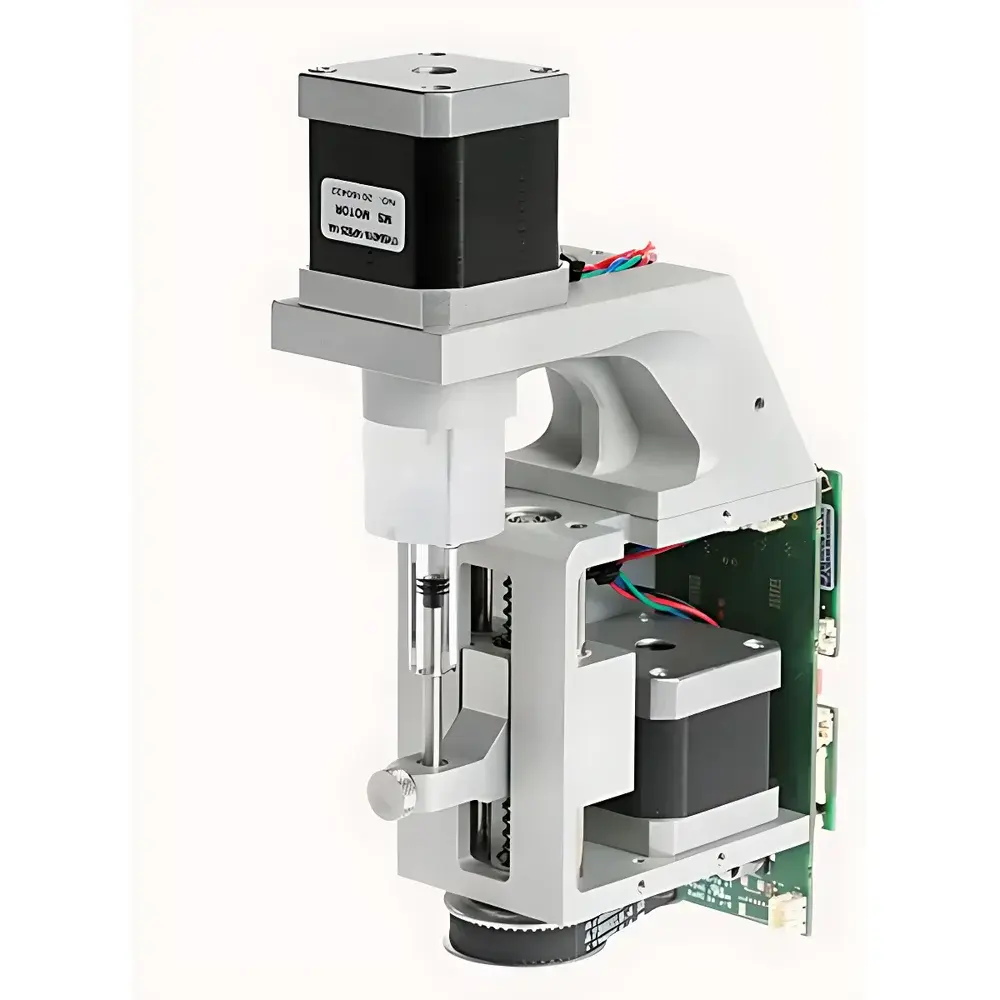
AMF SPM OEM Syringe Pump
| Brand | Advanced MicroFluidics (AMF) |
|---|---|
| Origin | Switzerland |
| Model | SPM OEM Syringe Pump |
| Instrument Type | Precision Microfluidic Syringe Pump |
| Flow Rate Range | 0.25 nL/min to 30 mL/min (model-dependent) |
| Accuracy | <1% deviation over full stroke |
| Repeatability | High-precision volumetric delivery |
| Dead Volume | <1.5 µL (valve-integrated configurations) |
| Operating Temperature | 5–40 °C |
| Operating Humidity | 20–80% RH, non-condensing |
| Max Back Pressure | 5 bar (pump head) |
| Drive Mechanism | Linear encoder-equipped lead screw actuator |
| Resolution | 3000 steps (standard) / 24,000 steps (high-res option) |
| Communication Interfaces | USB Mini-B, RS232, RS485, I²C (customizable) |
| Power Supply | 18–24 VDC, max 2.2 A |
| Dimensions | 199.7 × 126.3 × 50.5 mm |
| Weight | 1.5 kg |
Overview
The AMF SPM OEM Syringe Pump is a compact, high-precision microfluidic actuation module engineered for seamless integration into automated analytical, diagnostic, and research platforms. Based on the principle of controlled linear displacement of syringe plunger via a calibrated lead-screw mechanism with integrated linear position feedback, the SPM delivers exceptional volumetric accuracy and pulse-free flow across nanoliter-to-milliliter per minute ranges. Its design prioritizes minimal system-level dead volume, thermal stability, and deterministic fluidic behavior—critical for applications demanding strict reproducibility in low-volume liquid handling, such as single-cell analysis, organ-on-chip perfusion, capillary electrophoresis sample injection, and reagent dispensing in micro-total-analysis systems (µTAS). As an OEM-grade component, the SPM is not intended as a standalone benchtop instrument but rather as a validated subsystem compliant with industrial design-for-manufacturing (DFM) and regulatory traceability requirements.
Key Features
- Sub-microliter dosing resolution: Achieves minimum dispense volumes down to 0.05 µL (with S25-P syringe), enabled by 24,000-step high-resolution motor control and real-time encoder-based stall detection.
- Ultra-low dead volume architecture: Integrated zero-dead-volume switching valves (e.g., VD2-6 series) feature internal volumes as low as 3.5 µL and latency ≤1.5 µL—significantly below industry-standard 50 µL benchmarks—reducing carryover and improving assay fidelity.
- Inverted syringe mounting orientation: Eliminates air entrapment during priming and initial flow initiation, ensuring bubble-free startup without manual venting or pre-wetting protocols.
- Robust mechanical design: All-wetted materials include PTFE, PCTFE, and borosilicate glass; no elastomeric seals in primary fluid path, ensuring chemical compatibility with aggressive solvents and long-term dimensional stability.
- OEM-optimized interface: Standardized 1/4-28 UNF flat-bottom mounting threads, modular power and signal connectors, and configurable firmware allow plug-and-play integration into third-party chassis or multi-axis fluidic workstations.
- Low-power operation: Draws ≤2.2 A at 18 VDC (max 40 W), enabling deployment in portable, battery-assisted, or thermally constrained environments without active cooling.
Sample Compatibility & Compliance
The SPM OEM platform supports interchangeable syringes from 25 µL to 1000 µL capacity, constructed from PTFE or UHMW-PE barrels for broad chemical resistance—including acetonitrile, DMSO, and aqueous buffers. When paired with AMF’s VD/VFD-series rotary and distribution valves, the entire fluidic path maintains inert surface properties and pressure integrity up to 7 bar. The pump complies with CE marking directives (2014/30/EU EMC, 2014/35/EU LVD) and meets IEC 61326-1 requirements for laboratory equipment electromagnetic immunity. While not certified under FDA 21 CFR Part 11 out-of-the-box, its serial communication stack (ASCII-based command protocol over RS232/RS485) supports audit-trail-capable host software implementations aligned with GLP and GMP documentation workflows.
Software & Data Management
The SPM communicates via ASCII command protocol over USB Mini-B, RS232, RS485, or I²C interfaces, enabling direct integration with custom control environments. Native driver support is provided for LabVIEW™ (NI-VISA), MATLAB® (Instrument Control Toolbox), Python (PySerial), and C/C++ development toolchains. Firmware includes non-volatile parameter storage for syringe calibration coefficients, flow profile presets, and error logging (e.g., step loss, overpressure, temperature exceedance). Host-side software can implement closed-loop dosage verification using encoder position feedback timestamps, satisfying traceability requirements for regulated applications. Optional firmware upgrades enable synchronized multi-pump coordination and time-stamped event logging compatible with ISO/IEC 17025-compliant data archiving systems.
Applications
- Microfluidic chip priming and continuous perfusion in organ-on-chip and tissue engineering platforms.
- Automated calibration and standard addition in hyphenated techniques (e.g., LC-MS, CE-UV).
- Reagent metering in point-of-care diagnostics cartridges requiring sub-µL precision and low carryover.
- Controlled solvent gradient generation in miniaturized HPLC and nano-LC modules.
- High-throughput compound dilution and serial dispensing in drug discovery screening workflows.
- Integration into robotic liquid handling systems where space, power, and dead volume are critical constraints.
FAQ
Is the SPM OEM Syringe Pump suitable for sterile or ISO Class 5 cleanroom environments?
Yes—the pump body and all fluid-contact components are autoclavable (121 °C, 20 min) or compatible with vaporized hydrogen peroxide (VHP) decontamination, provided external cabling and connectors are appropriately sealed.
Can multiple SPM units be synchronized for parallel fluid delivery?
Yes—via RS485 daisy-chaining or host-controlled trigger signals, enabling phase-aligned multi-channel pumping with <100 µs timing jitter between units.
Does AMF provide syringe calibration certificates traceable to NIST standards?
Calibration data sheets (including linearity, hysteresis, and repeatability measurements per ISO 8536-4) are supplied with each OEM order; NIST-traceable certification is available upon request with additional lead time.
What is the expected service life under continuous operation?
Rated for ≥20,000 hours MTBF (mean time between failures) under nominal load conditions (≤3 bar back pressure, ambient temperature ≤35 °C), based on accelerated lifetime testing per ISO 13849-1.
Are firmware updates and technical support included post-purchase?
Yes—AMF provides free firmware revisions and application engineering support for OEM integrators throughout the product lifecycle, including assistance with regulatory documentation packages (e.g., risk analysis, verification protocols).



