
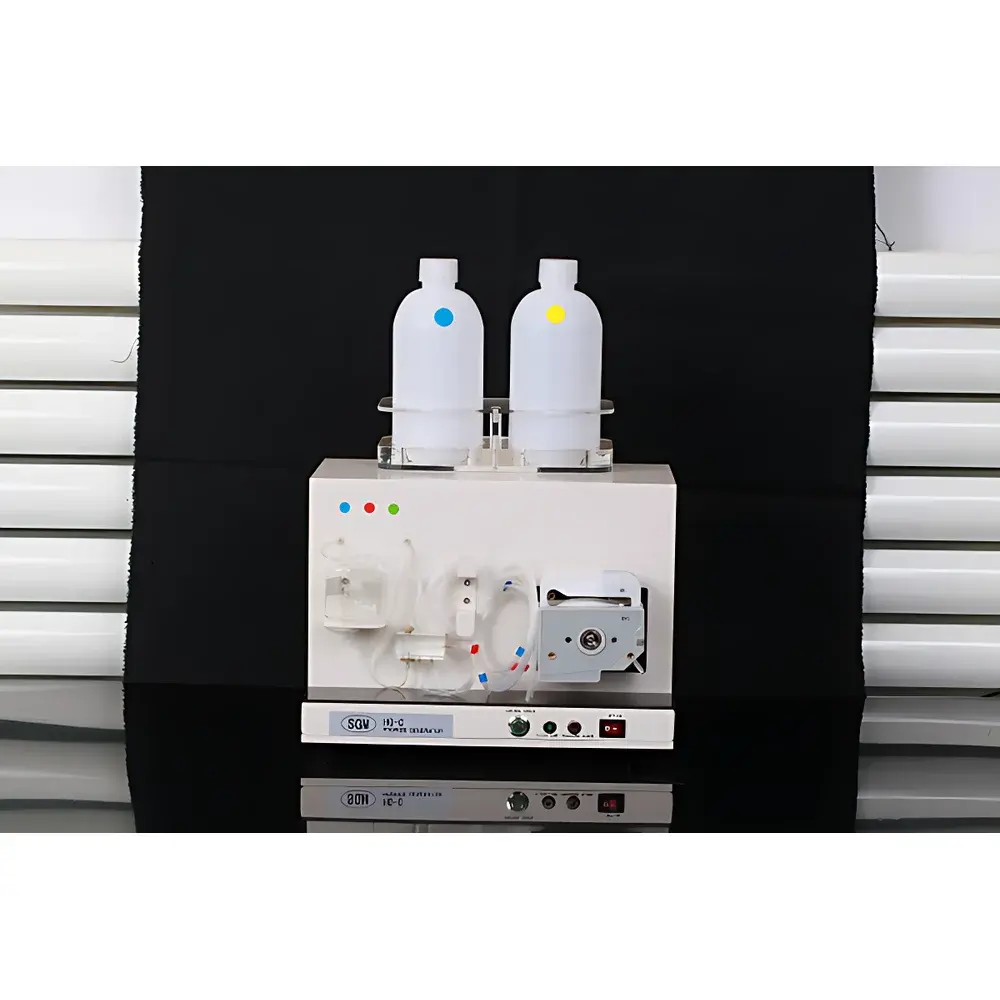
HG-C Single-Pump Hydride Generation System by SGM
| Brand | SGM |
|---|---|
| Origin | Beijing, China |
| Model | HG-C, HG-B |
| Pump Type | Single-channel peristaltic pump |
| Sample Introduction Mode | Continuous-flow hydride generation (flame-compatible) |
| Compatible Instruments | Universal interface for domestic and international atomic absorption spectrometers (AAS) |
| Memory Function | Onboard parameter retention across power cycles |
| Startup | One-button automated initialization |
| Detection Sensitivity (Hg) | ≥0.055 A at 5 ng/mL standard |
| Detection Sensitivity (As) | ≥0.055 A at 2 ng/mL standard |
| Precision (RSD) | ≤2% at 6 ng/mL As standard |
| Linearity (r²) | >0.998 for As calibration curve |
| Compliance | Designed to meet ASTM D3559, ISO 11929 (uncertainty evaluation), and USP <233> hydride-generation method requirements |
Overview
The HG-C Single-Pump Hydride Generation System is an engineered solution for trace-level determination of hydride-forming elements—including arsenic (As), selenium (Se), antimony (Sb), bismuth (Bi), tellurium (Te), lead (Pb), tin (Sn), and mercury (Hg)—by flame or graphite furnace atomic absorption spectroscopy (FAAS/GFAAS). It operates on the principle of continuous-flow hydride generation: acidic sample solutions react with sodium borohydride (NaBH₄) in a gas-liquid separator, producing volatile metal hydrides that are swept into the atomizer (flame or quartz tube) for quantification. The system features a dedicated single-channel peristaltic pump architecture optimized for stable reagent delivery, minimal memory effect, and reproducible hydride formation kinetics—critical for regulatory-grade analysis in environmental, food safety, and clinical laboratories.
Key Features
- Single-pump continuous-flow design minimizes mechanical complexity while ensuring consistent carrier gas flow and reaction residence time.
- Integrated memory function retains user-defined method parameters—including reagent concentrations, pump speeds, and delay times—across instrument power cycles, supporting GLP-compliant workflow continuity.
- One-button startup sequence automates priming, baseline stabilization, and readiness confirmation, reducing operator-dependent variability.
- Optimized gas-liquid separation chamber geometry suppresses foam carryover and ensures efficient hydride transfer with <2% RSD precision (verified using 6 ng/mL As standard under controlled lab conditions).
- Universal AAS interface supports analog voltage output (0–1 V) and TTL trigger compatibility with major spectrometer platforms including PerkinElmer AA, Thermo iCE, Shimadzu AA-6800, and GBC Avanta series.
- Chemically resistant fluid path (PTFE, PFA, and quartz components) ensures long-term stability with aggressive acid matrices (e.g., 5% HCl, 1% HNO₃).
Sample Compatibility & Compliance
The HG-C accommodates aqueous samples pre-reduced with potassium iodide (KI)/ascorbic acid or thiourea for As, Sb, and Se; cold vapor generation for Hg without prereduction; and direct reduction for Bi and Sn. It meets essential performance criteria outlined in ASTM D3559-22 (lead in water), ISO 17294-2:2016 (elements in water by ICP-MS/AAS), and USP Method 1 for elemental impurities. While not a standalone regulated device, its output data—when used within validated AAS methods—supports audit readiness for FDA 21 CFR Part 11 (electronic records), EU Annex 11, and ISO/IEC 17025:2017 documentation requirements.
Software & Data Management
The HG-C operates as a hardware-peripheral module with no embedded operating system. All method configuration, timing control, and status monitoring occur via the host AAS software platform. Instrument logs—including pump runtime, error flags, and initialization timestamps—are recorded in the spectrometer’s native audit trail when paired with compliant AAS systems (e.g., Thermo’s SOLAAR v9.2+ or PerkinElmer’s WinLab32 with GLP extension). No proprietary drivers or cloud connectivity are required, ensuring full data sovereignty and compatibility with air-gapped laboratory networks.
Applications
- Environmental monitoring: As and Sb quantification in drinking water per WHO Guidelines and EPA Method 200.9.
- Food safety testing: Inorganic As in rice flour and seaweed extracts (AOAC 2013.05).
- Clinical toxicology: Urinary Hg and Se profiling in occupational exposure assessment.
- Pharmaceutical quality control: Elemental impurity screening in APIs per ICH Q3D, particularly for Category 1 (As, Cd, Hg, Pb) and Category 2A (Co, Ni, V) elements requiring hydride access.
- Geochemical analysis: Low-level Sb and Bi in soil leachates following EPA 3050B digestion.
FAQ
Is the HG-C compatible with graphite furnace AAS?
Yes—the system delivers hydride vapor directly to standard quartz atomizers and supports integrated temperature programming via TTL synchronization with furnace controllers.
What is the typical detection limit achievable with this generator?
When coupled with a high-sensitivity FAAS system (e.g., Deuterium background correction, 0.7 nm slit), typical 3σ MDLs are 0.08 ng/mL for As and 0.03 ng/mL for Hg—dependent on spectrometer optics and burner alignment.
Does it support dual-element sequential analysis?
No—the HG-C is a single-channel system optimized for one element per run. Dual-element capability requires separate generators or a multi-channel platform (e.g., HG-B variant with independent reagent lines).
How often does the peristaltic pump tubing require replacement?
Under standard operation (8 h/day, 5% HCl matrix), PTFE/PFA tubing maintains accuracy for ≥3 months; replacement is recommended after 500 hours of cumulative pump operation or upon visible deformation.
Can it be integrated into an automated sample introduction system?
Yes—TTL-ready trigger input enables synchronization with autosamplers (e.g., ASX-710, SPS-3) for unattended batch analysis of up to 120 samples per sequence.





