
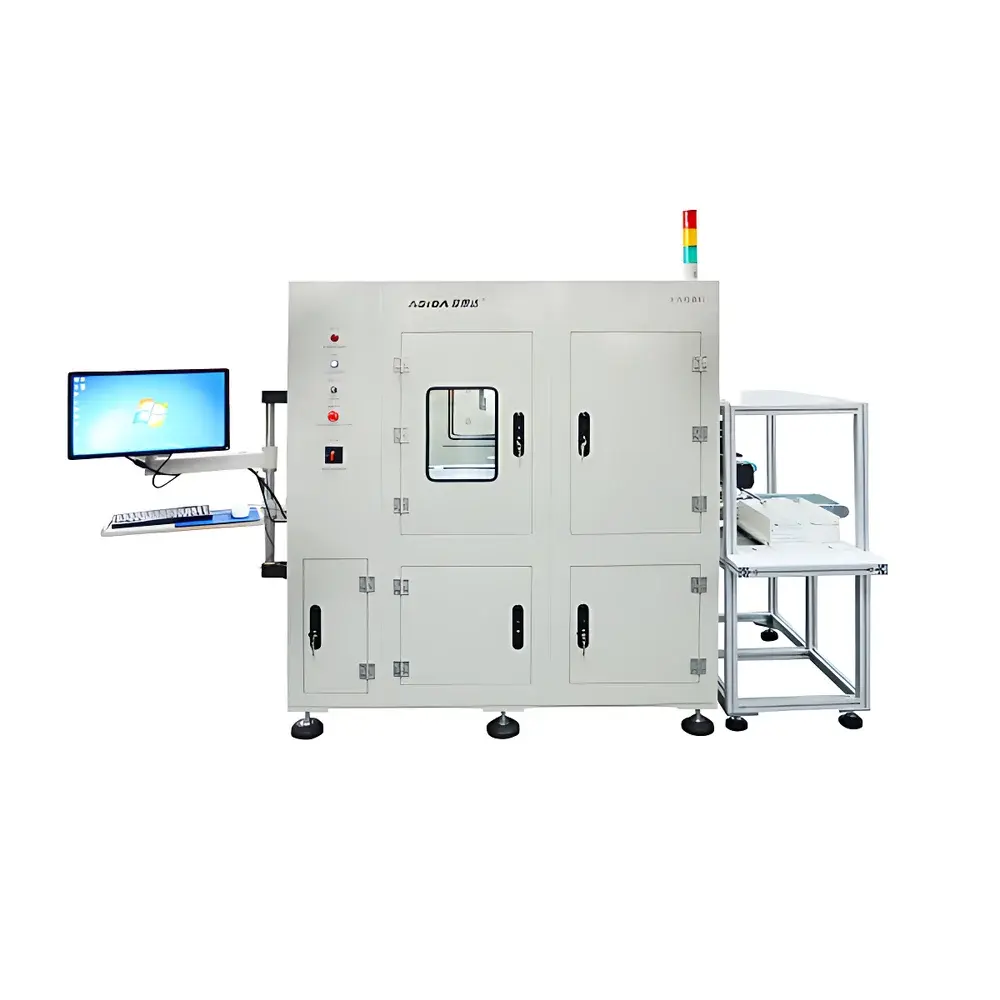
ASIDA XG5130A Automated Inline X-ray Inspection System for Prismatic and Pouch Lithium-ion Battery Cells
| Brand | ASIDA |
|---|---|
| Origin | Guangdong, China |
| Manufacturer Type | Authorized Distributor |
| Country of Origin | China |
| Model | ASIDA XG5130A |
| Price | Upon Request |
| X-ray Tube Voltage | ≤90 kV |
| X-ray Tube Current | ≤89 µA |
| Focal Spot Size | 5 µm |
| Cooling Method | Forced Air Cooling |
| Image Intensifier Field of View | 2″ / 4″ |
| Spatial Resolution | 75 / 110 lp/cm |
| X-CCD Resolution | 752 × 480 pixels |
| Repeatability Accuracy | ±60 µm |
| Throughput | ≥30 ppm (≥1,800 units/hour, ≥30,000 units/shift) |
| False Positive Rate | ≤2% |
| Miss Detection Rate | 0% |
| Pass Rate Consistency | ≥99.5% |
| Radiation Leakage | ≤1 µSv/hr (compliant with IEC 61000-6-4, IEC 62471, and GBZ 138–2019) |
Overview
The ASIDA XG5130A is an industrial-grade, fully automated inline X-ray inspection system engineered specifically for high-throughput quality assurance of prismatic and pouch-format lithium-ion battery cells at final assembly stage. It operates on the principle of transmission radiography: a microfocus X-ray source (≤90 kV, ≤89 µA, 5 µm focal spot) emits collimated X-rays that penetrate the battery cell; differential absorption by internal components—such as electrode layers, current collectors, tabs, welds, and separator integrity—is captured by a dual-field-of-view image intensifier (2″/4″) coupled to a 752 × 480-pixel X-CCD sensor. Real-time digital radiographic imaging enables pixel-level analysis of structural anomalies—including misalignment, foreign particles, foil wrinkles, tab deformation, voids in jelly-roll or stacking zones, and electrolyte distribution irregularities—without physical contact or sample destruction.
Key Features
- Fully integrated inline architecture with conveyor-based feed and dual-robotic loading/unloading stations, enabling seamless integration into existing battery module assembly lines.
- Dual-arm alternating motion control via industrial motion controller board, eliminating idle time between inspections and sustaining ≥30 parts per minute throughput.
- Maintenance-free integrated microfocus X-ray tube with forced-air cooling and stable thermal management—designed for 24/7 operation in Class 10,000 cleanroom environments.
- Real-time image acquisition with automatic frame buffering and timestamped storage; supports DICOM-compliant export for traceability and archival.
- Rapid changeover capability: mechanical and software reconfiguration for new cell formats (e.g., varying thickness, width, or tab position) completed within 30–120 minutes.
- Triple-layer radiation safety architecture: interlocked access doors, real-time photogate monitoring, and perimeter-mounted radiation sensors continuously logging dose rate (≤1 µSv/hr at all external surfaces), certified to GBZ 138–2019 and aligned with IEC 61000-6-4 EMC requirements.
Sample Compatibility & Compliance
The XG5130A accommodates standard prismatic and laminated pouch cells ranging from 30 mm to 200 mm in width, up to 15 mm in thickness, and weighing ≤1.2 kg. It supports both bare cells and fully sealed, electrolyte-filled modules. All detection logic and measurement algorithms are calibrated against NIST-traceable reference phantoms and validated per ISO/IEC 17025-accredited procedures. The system meets functional safety requirements per IEC 62061 (SIL2) and incorporates hardware-enforced emergency stop circuits. Radiation shielding and operational protocols comply with national occupational exposure limits (GBZ 138–2019) and international guidance (ICRP Publication 103, IAEA Safety Standards Series No. GSR Part 3). Data handling conforms to GLP-aligned audit trail requirements, including immutable operator logins, session timestamps, and revision-controlled parameter sets.
Software & Data Management
ASIDA VisionInsight™ v4.2 software provides deterministic image processing and rule-based defect classification. Core modules include: (1) Auto-alignment measurement of anode/cathode edge offset (±0.01 mm resolution), reporting min/max/mean deviation per batch; (2) Multi-threshold segmentation engine for detecting metallic contaminants (>50 µm equivalent steel sphere), delamination shadows, and weld discontinuities; (3) Barcode/2D code scanning interface compatible with common industrial readers (e.g., Cognex DataMan, Keyence SR-2000), enabling full unit-level traceability across MES platforms; (4) Statistical process control dashboard with Cp/Cpk calculation, Pareto analysis of defect modes, and SPC charting (X-bar/R, P-chart); (5) Export modules for CSV, XML, and PDF reports compliant with internal QA documentation standards and customer-facing PPAP submissions.
Applications
Primary deployment includes final QA screening of automotive-grade prismatic LFP/NMC cells prior to module assembly; secondary use cases cover incoming inspection of pouch cells from tier-2 suppliers, R&D validation of novel electrode architectures (e.g., dry electrode stacks), and failure analysis support for 8D root-cause investigations. The system is routinely deployed in production facilities certified to IATF 16949, ISO 14001, and UL 2580. Its non-destructive nature permits 100% inspection without compromising cell hermeticity or electrochemical performance—critical for AEC-Q200-qualified battery manufacturing.
FAQ
What is the maximum allowable cell thickness for reliable penetration and contrast resolution?
Cells up to 15 mm thick (with aluminum or stainless steel casing) are fully supported; thicker configurations require application-specific beam hardening compensation, available under ASIDA’s Engineering Support Program.
Does the system support integration with Siemens SIMATIC or Rockwell FactoryTalk?
Yes—OPC UA server implementation is standard; Modbus TCP and EtherNet/IP drivers are available as optional firmware modules.
How is measurement repeatability verified during routine maintenance?
Built-in calibration phantom scans are executed daily; annual verification uses NIST-traceable step wedges and line-pair gauges, documented per ISO/IEC 17025 internal procedure ASIDA-QC-INS-007.
Can the software classify defects by root cause (e.g., welding vs. stacking error)?
Yes—customizable defect taxonomy trees can be trained using supervised learning on historical image datasets; classifier models are exported as ONNX files and deployed locally without cloud dependency.
Is remote diagnostics and software update capability included?
Standard configuration includes TLS-secured remote desktop access (ISO 27001-aligned credentials), firmware delta updates, and predictive maintenance alerts based on tube runtime and thermal drift logs.



